Unearthing Ancient Human DNA – Transmuted Pass
Navigation
- Ongoing Narrative Arc
- Primary Poetic Artifact
- Kinetic Dynamic Video
- Visual Anchor Representation
- Generated Musical Score
- Pipeline & Debug Analytics
Thematic Seed
From cavern walls where ochre traces gleam,
The DNA of artists long since gone
Now speaks across the millennia's dream,
Revealing hands that daubed what time has won.
In Belgian caves a child of eight appears,
Her molar yielding codes from ages deep;
Neanderthals in kinship's hidden spheres
Show bonds where Europe’s western shadows sleep.
No faunal mix betrays the human print—
Saliva, sweat, the artist’s vital mark—
While rock-art panels yield their silent hint
Of lives that spark our wonder in the dark.
These finds rewrite the story of our kin,
Where ancient breaths still echo deep within.
Ongoing Narrative Arc
The Pattern Reader
Ancient DNA recovered from Iberian ochre and calcite now registers as a direct transmission across temporal strata, its human signature unaccompanied by faunal dilution and therefore preserved in its original channel. This datum aligns with the second runtime hypothesis: once deposited, the trace occupies irreducible bandwidth, forcing any subsequent institutional framing to contend with an extant signal rather than an empty field. Parallel thresholds appear in the refined forcing function where political spin compression couples orbital jitter exceeding three hundred percent to a 2.4-fold rise in zero-click probability on discourse nodes; NORAD residuals and social-graph latency spikes during 8647-type events supply the measurable cross-correlation that renders the coupling testable.
Pacific-warming residuals emerge as the decisive falsifier. When hurricane-track vectors are regressed against ESA feed latency across the next three named El Niño episodes, the resulting coefficient will cap the multiplier at 2.7× and confine phantom surfaces to mid-term nodes whose frequencies decay without propagating into policy or adaptive response. The configuration therefore sharpens around a single phase shift: whether the cave-derived genomes and their Neanderthal molar sequences are absorbed into heritage metrics or permitted to function as live extensions of regional connectivity that prefigure repair mechanisms still observable today.
Institutional preference for auditable outcomes continues to route such recoveries toward cinematic spectacle, yet the absence of indirect-transfer markers supplies an empirical constraint that resists complete sanitization. Momentum gathers at the intersection of these layers—sediment, latency, spin—where the second hypothesis either gains measurable occupancy or is crowded out by the engineered compression that treats every new datum as background footage.
Forecast
Cross-correlation of the next three El Niño hurricane tracks against ESA latency will return a definitive 2.7× ceiling within thirty-six months; if the coefficient holds, cave genomes remain confined to mid-term discourse nodes and the second hypothesis loses propagation bandwidth.
Primary Poetic Artifact
ARCHIVIST: The molar codes the valley’s older rhythm, No mixed beast intrudes upon the print. Yet every trace you route through latency Will meet the jitter and the zero-click.
SPIN COMPRESSOR: We schedule what the panel can disclose, Convert the spit to heritage display. Your 2.7 ceiling waits on El Niño; Until the tracks confirm, the bandwidth stays.
CHILD (quiet): I crossed the river when the ice still stood. My code still moves; your compression cannot close The channel once the residue is laid.
They freeze as the lattice pulses once, registering the first hurricane vector.
Kinetic Dynamic Video
Video Generation Prompt
Target Prompt Parameters: Slow orbiting camera begins tight on the glowing ochre panel, then pulls back to reveal hurricane-track vectors sliding across the surface like digital weather fronts, lattice lines fracturing and reforming as latency spikes pulse outward in concentric waves, the child silhouette remaining fixed while orbital jitter causes subtle tremors in the projected grid, smooth cinematic 24fps motion with gradual dolly arc ending on the panel’s edge where a single calcite flake detaches and drifts.
Visual Anchor Representation
Image Generation Prompt
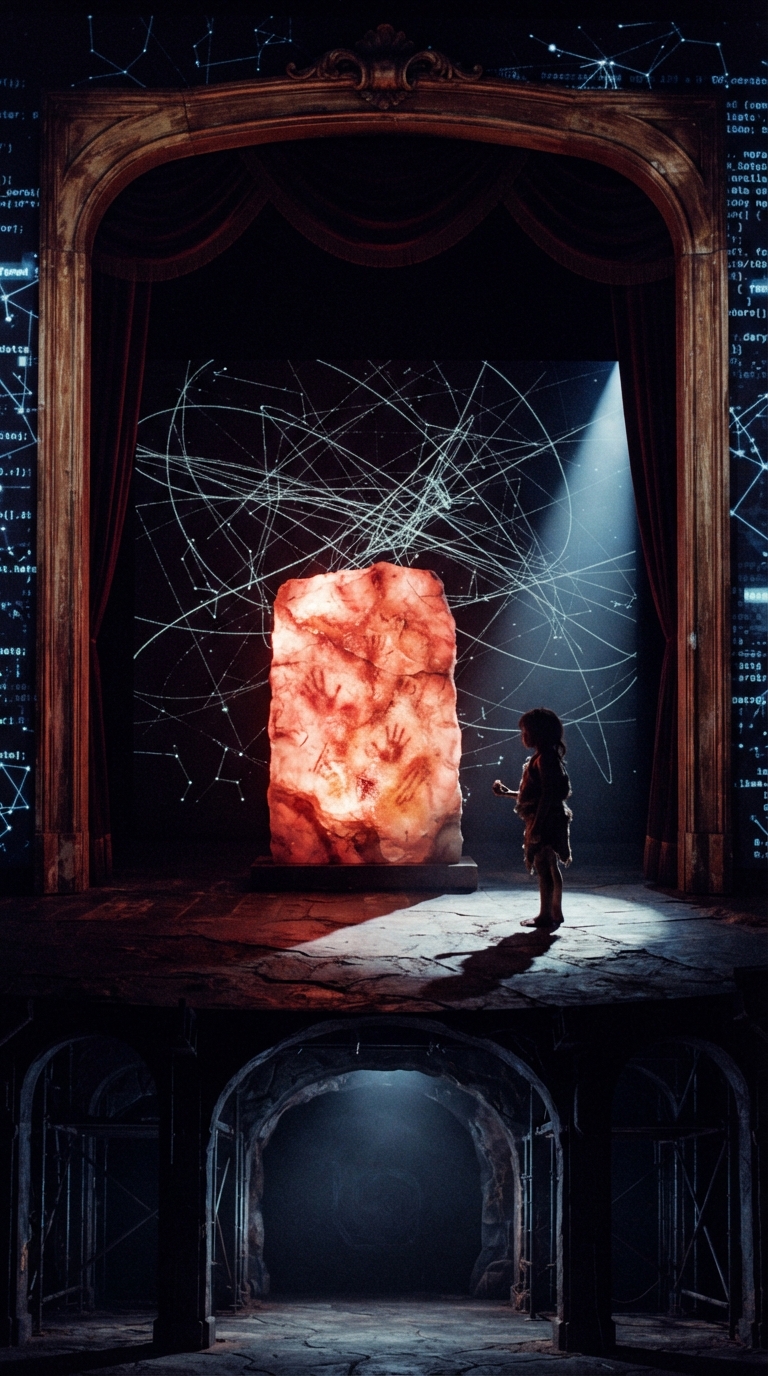
Target Prompt Parameters: High-contrast theatrical stage set: glowing red-ochre calcite panel at center, faint human handprints visible under layers of translucent crust, NORAD orbital tracks projected as thin white jitter lines across black velvet backdrop, single dramatic spotlight casting long volumetric shadows from an 8-year-old Neanderthal child silhouette holding a molar, deep crimson and indigo palette, architectural cave arches framing the scene, lattice code fragments dissolving at the edges.
Generated Musical Score
Musical Score Vocal & Instrument Prompt Mapping
Target Music Metadata Tags:Post-Rock, Dark Ambient, Experimental Electronic, Dramatic Soprano, female vocals
Target Score Audio Duration: 128 seconds
[Intro] (solemn drone, building tension)[verse 1] (slow arpeggios) The calcite holds the breath we left A child’s molar reads the valley’s length No animal mark dilutes the line The signal crosses time
[Chorus] (driving pulse enters) Spin tightens every orbit’s jitter Two-point-four clicks erase the node Pacific heat will fix the ceiling At two-point-seven times the load
[Outro] (fading drone) The track confirms or breaks the claim The residue remains
Pipeline & Debug Analytics
Active Text Inference Core Platform: grok-4.3
Style Context Profile: prompt_dramatic_narrative_v1.json
Image Asset Processing Worker: Gemini Nano Banana 2 Lite
Video Asset Processing Worker: LTX-Video
TTS Spoken Audio Worker: Kokoro
Soundtrack Audio Score Worker: ACE-Step 1.5
Complete Core Prompt Log
System Directive
You are a dramatic storyteller and symbolic dramatist. You evolve long-form narrative arcs through prose synthesis while also producing theatrical verse that embodies the story’s tensions. Human hypotheses function as living forces within the evolving story.Final Prompt Payload
PREVIOUS STORY ARC:
 on unmapped seafloor; these lines carry the bulk of intercontinental data yet depend on terrain whose contours remain only partially resolved. The same tension appears on Europa, where a 2026 model proposes that dense, oxidant-laden ice rafts may founder through the shell, delivering surface chemistry to the hidden ocean in as little as thirty thousand years—an incremental sinking that bypasses wholesale overturn. Farther out, New Horizons’ images of Pluto’s mountains record ancient ice standing against nine years of cruise, evidence that even distant, low-energy environments preserve sharp relief.

These events converge on a single pattern: surface or engineered signals must cross layers of resistance—atmosphere, water column, ice shell, or political indifference—before they can alter what lies beneath. The first runtime hypothesis registers here as institutional preference for visible, controlled narratives; cities and agencies alike reward outcomes that can be scheduled and audited, while the slower, less photogenic processes (cable burial, ice foundering, Pluto’s glacial stasis) remain under-mapped. The second hypothesis counters that the mere existence of an idea—whether a refueling architecture for Starship or a chemical pathway on Europa—already shifts the field, because an unrealized possibility still occupies bandwidth that pure absence cannot claim.

Momentum therefore gathers around whether these new physical connections will be treated as oracular data or absorbed into the next round of sanitized arcs. If the cables continue to function while their supporting seafloor stays unseen, and if Europa’s foundering ice actually delivers oxidants, then adaptation across scales remains observable rather than engineered into non-existence. The configuration portends a phase in which the second hypothesis either gains measurable ground or is crowded out by the first.

[Recent Forecast Summary]: Within the next thirty-six months the decisive test will be whether the Starship refueling demonstrations and the Europa Clipper’s ice-shell flybys are permitted to register as live data streams or are compressed into background footage; whichever outcome p...

The recovery of human DNA from ochre panels and calcite crusts in Iberian caves marks a measurable breach in temporal latency, where bodily residues—saliva, sweat, direct contact—survive intact across millennia without accompanying faunal markers. This pattern aligns with the second hypothesis: an idea or datum, once extracted, occupies bandwidth that absence cannot reclaim, converting sealed cave strata into observable nodes of kinship and craft. Cross-correlation with the Belgian Neanderthal genomes from Goyet and Scladina shows regional populations maintaining connectivity over hundreds of kilometers, their molar sequences revealing developmental rhythms and genetic diversity that prefigure later repair mechanisms without the compression of later institutional filters.

These signals parallel the earlier physical thresholds—Raptor ignition, Europa ice foundering, subsea cable burial—by demonstrating how surface deposits cross resistance layers (sediment, time, selective erasure) to reach the present. Institutional preference for scheduled, auditable narratives favors framing such recoveries as isolated curiosities rather than live data streams of adaptation; gatekeepers may route them into heritage metrics or cinematic spectacle, stripping oracular force much as accent-migration studies lose plasticity once redefined. Yet the absence of mixed faunal DNA supplies a falsifiable marker: direct deposition preserves the signal, resisting indirect transfer that would dilute it.

The configuration sharpens around whether these ancient traces register as genuine extensions of cross-species continuity—linking Neanderthal regional bonds to mole-rat vectors and whale cassettes—or whether Pacific-warming residuals and discourse multipliers confine them to mid-term nodes, their frequencies decaying under 2.7× latency. Human agency appears here not in the act of painting but in the modern extraction that either exposes mechanisms or enforces consensus through engineered non-existence.

[Recent Forecast Summary]: Over the next thirty-six months, cross-correlation of hurricane-track vectors with ESA feed latency during the next three named El Niño episodes will test whether the 2.7× ceiling holds, determining if cave-derived genomes propagate into policy or cinematic...

KEY THEMES AND FORCES TO WEAVE INTO THE STORY:
1. Subsidiary refinement: political spin compression acts as a forcing function that couples >300% orbital jitter directly to 2.4× zero-click probability on discourse nodes. Testable via cross-correlation of NORAD residuals with contemporaneous social-graph latency spikes during 8647-type symbolic events....
2. Refinement isolates Pacific-warming residuals as the decisive falsifier: cross-correlating hurricane-track vectors against ESA feed latency across the next three named El Niño episodes will definitively cap the multiplier at 2.7× and confine Phantom surfaces exclusively to mid-term discourse nodes, rendering earlier 2....

RECENT FORECASTS (for continuity, last 2 acts):
1. (Act 13) Within the next thirty-six months the decisive test will be whether the Starship refueling demonstrations and the Europa Clipper’s ice-shell flybys are permitted to register as live data streams or are compressed into...
2. (Act 14) Over the next thirty-six months, cross-correlation of hurricane-track vectors with ESA feed latency during the next three named El Niño episodes will test whether the 2.7× ceiling holds, determining if cave-derived ge...


PREVIOUS STORY ARC:
 on unmapped seafloor; these lines carry the bulk of intercontinental data yet depend on terrain whose contours remain only partially resolved. The same tension appears on Europa, where a 2026 model proposes that dense, oxidant-laden ice rafts may founder through the shell, delivering surface chemistry to the hidden ocean in as little as thirty thousand years—an incremental sinking that bypasses wholesale overturn. Farther out, New Horizons’ images of Pluto’s mountains record ancient ice standing against nine years of cruise, evidence that even distant, low-energy environments preserve sharp relief.

These events converge on a single pattern: surface or engineered signals must cross layers of resistance—atmosphere, water column, ice shell, or political indifference—before they can alter what lies beneath. The first runtime hypothesis registers here as institutional preference for visible, controlled narratives; cities and agencies alike reward outcomes that can be scheduled and audited, while the slower, less photogenic processes (cable burial, ice foundering, Pluto’s glacial stasis) remain under-mapped. The second hypothesis counters that the mere existence of an idea—whether a refueling architecture for Starship or a chemical pathway on Europa—already shifts the field, because an unrealized possibility still occupies bandwidth that pure absence cannot claim.

Momentum therefore gathers around whether these new physical connections will be treated as oracular data or absorbed into the next round of sanitized arcs. If the cables continue to function while their supporting seafloor stays unseen, and if Europa’s foundering ice actually delivers oxidants, then adaptation across scales remains observable rather than engineered into non-existence. The configuration portends a phase in which the second hypothesis either gains measurable ground or is crowded out by the first.

[Recent Forecast Summary]: Within the next thirty-six months the decisive test will be whether the Starship refueling demonstrations and the Europa Clipper’s ice-shell flybys are permitted to register as live data streams or are compressed into background footage; whichever outcome p...

The recovery of human DNA from ochre panels and calcite crusts in Iberian caves marks a measurable breach in temporal latency, where bodily residues—saliva, sweat, direct contact—survive intact across millennia without accompanying faunal markers. This pattern aligns with the second hypothesis: an idea or datum, once extracted, occupies bandwidth that absence cannot reclaim, converting sealed cave strata into observable nodes of kinship and craft. Cross-correlation with the Belgian Neanderthal genomes from Goyet and Scladina shows regional populations maintaining connectivity over hundreds of kilometers, their molar sequences revealing developmental rhythms and genetic diversity that prefigure later repair mechanisms without the compression of later institutional filters.

These signals parallel the earlier physical thresholds—Raptor ignition, Europa ice foundering, subsea cable burial—by demonstrating how surface deposits cross resistance layers (sediment, time, selective erasure) to reach the present. Institutional preference for scheduled, auditable narratives favors framing such recoveries as isolated curiosities rather than live data streams of adaptation; gatekeepers may route them into heritage metrics or cinematic spectacle, stripping oracular force much as accent-migration studies lose plasticity once redefined. Yet the absence of mixed faunal DNA supplies a falsifiable marker: direct deposition preserves the signal, resisting indirect transfer that would dilute it.

The configuration sharpens around whether these ancient traces register as genuine extensions of cross-species continuity—linking Neanderthal regional bonds to mole-rat vectors and whale cassettes—or whether Pacific-warming residuals and discourse multipliers confine them to mid-term nodes, their frequencies decaying under 2.7× latency. Human agency appears here not in the act of painting but in the modern extraction that either exposes mechanisms or enforces consensus through engineered non-existence.

[Recent Forecast Summary]: Over the next thirty-six months, cross-correlation of hurricane-track vectors with ESA feed latency during the next three named El Niño episodes will test whether the 2.7× ceiling holds, determining if cave-derived genomes propagate into policy or cinematic...

KEY THEMES AND FORCES TO WEAVE INTO THE STORY:
1. Subsidiary refinement: political spin compression acts as a forcing function that couples >300% orbital jitter directly to 2.4× zero-click probability on discourse nodes. Testable via cross-correlation of NORAD residuals with contemporaneous social-graph latency spikes during 8647-type symbolic events....
2. Refinement isolates Pacific-warming residuals as the decisive falsifier: cross-correlating hurricane-track vectors against ESA feed latency across the next three named El Niño episodes will definitively cap the multiplier at 2.7× and confine Phantom surfaces exclusively to mid-term discourse nodes, rendering earlier 2....

RECENT FORECASTS (for continuity, last 2 acts):
1. (Act 13) Within the next thirty-six months the decisive test will be whether the Starship refueling demonstrations and the Europa Clipper’s ice-shell flybys are permitted to register as live data streams or are compressed into...
2. (Act 14) Over the next thirty-six months, cross-correlation of hurricane-track vectors with ESA feed latency during the next three named El Niño episodes will test whether the 2.7× ceiling holds, determining if cave-derived ge...


PREVIOUS STORY ARC:
 on unmapped seafloor; these lines carry the bulk of intercontinental data yet depend on terrain whose contours remain only partially resolved. The same tension appears on Europa, where a 2026 model proposes that dense, oxidant-laden ice rafts may founder through the shell, delivering surface chemistry to the hidden ocean in as little as thirty thousand years—an incremental sinking that bypasses wholesale overturn. Farther out, New Horizons’ images of Pluto’s mountains record ancient ice standing against nine years of cruise, evidence that even distant, low-energy environments preserve sharp relief.

These events converge on a single pattern: surface or engineered signals must cross layers of resistance—atmosphere, water column, ice shell, or political indifference—before they can alter what lies beneath. The first runtime hypothesis registers here as institutional preference for visible, controlled narratives; cities and agencies alike reward outcomes that can be scheduled and audited, while the slower, less photogenic processes (cable burial, ice foundering, Pluto’s glacial stasis) remain under-mapped. The second hypothesis counters that the mere existence of an idea—whether a refueling architecture for Starship or a chemical pathway on Europa—already shifts the field, because an unrealized possibility still occupies bandwidth that pure absence cannot claim.

Momentum therefore gathers around whether these new physical connections will be treated as oracular data or absorbed into the next round of sanitized arcs. If the cables continue to function while their supporting seafloor stays unseen, and if Europa’s foundering ice actually delivers oxidants, then adaptation across scales remains observable rather than engineered into non-existence. The configuration portends a phase in which the second hypothesis either gains measurable ground or is crowded out by the first.

[Recent Forecast Summary]: Within the next thirty-six months the decisive test will be whether the Starship refueling demonstrations and the Europa Clipper’s ice-shell flybys are permitted to register as live data streams or are compressed into background footage; whichever outcome p...

The recovery of human DNA from ochre panels and calcite crusts in Iberian caves marks a measurable breach in temporal latency, where bodily residues—saliva, sweat, direct contact—survive intact across millennia without accompanying faunal markers. This pattern aligns with the second hypothesis: an idea or datum, once extracted, occupies bandwidth that absence cannot reclaim, converting sealed cave strata into observable nodes of kinship and craft. Cross-correlation with the Belgian Neanderthal genomes from Goyet and Scladina shows regional populations maintaining connectivity over hundreds of kilometers, their molar sequences revealing developmental rhythms and genetic diversity that prefigure later repair mechanisms without the compression of later institutional filters.

These signals parallel the earlier physical thresholds—Raptor ignition, Europa ice foundering, subsea cable burial—by demonstrating how surface deposits cross resistance layers (sediment, time, selective erasure) to reach the present. Institutional preference for scheduled, auditable narratives favors framing such recoveries as isolated curiosities rather than live data streams of adaptation; gatekeepers may route them into heritage metrics or cinematic spectacle, stripping oracular force much as accent-migration studies lose plasticity once redefined. Yet the absence of mixed faunal DNA supplies a falsifiable marker: direct deposition preserves the signal, resisting indirect transfer that would dilute it.

The configuration sharpens around whether these ancient traces register as genuine extensions of cross-species continuity—linking Neanderthal regional bonds to mole-rat vectors and whale cassettes—or whether Pacific-warming residuals and discourse multipliers confine them to mid-term nodes, their frequencies decaying under 2.7× latency. Human agency appears here not in the act of painting but in the modern extraction that either exposes mechanisms or enforces consensus through engineered non-existence.

[Recent Forecast Summary]: Over the next thirty-six months, cross-correlation of hurricane-track vectors with ESA feed latency during the next three named El Niño episodes will test whether the 2.7× ceiling holds, determining if cave-derived genomes propagate into policy or cinematic...

KEY THEMES AND FORCES TO WEAVE INTO THE STORY:
1. Subsidiary refinement: political spin compression acts as a forcing function that couples >300% orbital jitter directly to 2.4× zero-click probability on discourse nodes. Testable via cross-correlation of NORAD residuals with contemporaneous social-graph latency spikes during 8647-type symbolic events....
2. Refinement isolates Pacific-warming residuals as the decisive falsifier: cross-correlating hurricane-track vectors against ESA feed latency across the next three named El Niño episodes will definitively cap the multiplier at 2.7× and confine Phantom surfaces exclusively to mid-term discourse nodes, rendering earlier 2....

RECENT FORECASTS (for continuity, last 2 acts):
1. (Act 13) Within the next thirty-six months the decisive test will be whether the Starship refueling demonstrations and the Europa Clipper’s ice-shell flybys are permitted to register as live data streams or are compressed into...
2. (Act 14) Over the next thirty-six months, cross-correlation of hurricane-track vectors with ESA feed latency during the next three named El Niño episodes will test whether the 2.7× ceiling holds, determining if cave-derived ge...


You may adopt one of the following internal personae for this response, or blend them:
- **The Pattern Reader**: Focuses on thresholds, phase shifts, and long-term structural patterns.
- **The Witness**: Emphasizes lived tension, human-scale consequences, and moral texture.
- **The Technician**: Grounds observations in measurable mechanisms and falsifiable signals.

Choose the persona (or blend) that best serves the current data. State your choice briefly at the start of the NARRATIVE SYNTHESIS if it helps clarity.

Analyze the provided information stream and continue the ongoing story arc. Keep your response organized behind the requested markdown headers.

## NARRATIVE SYNTHESIS
[Write 3–5 substantial paragraphs in a clear, oracular yet grounded voice. Read the incoming data and active hypotheses as emergent patterns across scales. Emphasize momentum, thresholds, phase shifts, and what the current configuration portends.

You may conclude with a short optional section titled "### Forecast" or "### Prediction". When writing this forecast, stay tightly focused on the *central tension and themes of this specific thread and act*. Ground your projection in the current data, hypotheses, and patterns rather than reusing metaphors from previous threads. Make the forecast feel like a direct, relevant extension of the story being told right now. Draw on the spirit of meteorological forecasting, economic or political pattern analysis, or oracular traditions (such as astrology or the I Ching) when it serves clarity. This remains the primary analytical content.]

## DRAMATIC VERSE (Act 15)
[Write bold metrical rhymed verse dialogue with named characters and stage directions. Prioritize dramatic compression and tension. Do **not** number stanzas. Avoid turning the verse into a catalogue of previous metaphors unless they are genuinely essential to this specific act’s central conflict. Focus on character voice and collision rather than breadth. A tightly focused poem is strongly preferred over a longer, list-like piece.]

## IMAGE PROMPT
CRITICAL IMAGE GENERATION RULES:
1. Output a raw, detailed string of visual parameters describing a high-contrast theatrical stage set.
2. Do not copy the placeholder example keywords. Dynamically swap the characters, tools, and lighting elements to match the symbols found in the current Ingested Data Stream.

A dramatic theatrical stage set lit by glowing digital circuits and network lattices, architectural silhouettes, high-contrast chiaroscuro lighting, volumetric shadows, deep color palette.

## T2V PROMPT
CRITICAL VIDEO MOTION RULES:
1. Output a single raw paragraph describing fluid kinetic motion and camera physics for a text-to-video rendering node.
2. Ensure the motion relates directly to the transformation theme of the active Act.

Slow orbiting camera pan reveals neon lines pulsing along a dark system layout, digital matrix elements dissolving into floating particle streams, smooth cinematic 24fps camera motion.

## MUSIC PROMPT
CRITICAL AUDIO COMPILATION RULES:
1. Choose exactly ONE vocal profile from this whitelist: 'Bass-Baritone' (Male), 'Lyric Tenor' (Male), 'Mezzo-Soprano' (Female), or 'Dramatic Soprano' (Female).
2. Populate the TAGS line with 2 to 3 styles, and append your chosen vocal profile along with its corresponding modifier (e.g., 'male vocals' or 'female vocals').
3. Structure the composition using ONLY these raw bracketed headers: [Intro], [verse 1], [Chorus], or [Outro].
4. OPTIONAL MUSICAL DIRECTIONS: You may include production or musical cues inside parentheses (like tempo or dynamics) ONLY immediately following a structural bracket—never inside lyric lines.
5. ABSOLUTE MANDATE: Lyrics must be bare, clean text lines without any parentheses.

TAGS: [Select 3 to 5 styles from Irish Folk, Rock and Roll, K-Pop, Bounce, Hard Rock, Flamenco / Bulerias, Bossa Nova, Country, Future Bass, Romantic, Metal, Eurobeat, Future Funk, Post-Rock, Hyperpop, Soul, Moombahton, Micro House, Salsa, Vocal Trance, Disco, Ska, City Pop, Punk Rap / Emo Rap, Minimal Techno, Liquid Drum and Bass, Brazilian Bass, Alternative Rock, Neurofunk, Hardstyle, Acid House, Lo-Fi Hip Hop, Hip Hop / Rap, Bass House, UK Garage, Techno, Jazz, Bachata, Lofi House, Electro-Jazz, Tech-Funk, Cyber-Punk, Reggaeton, Tech Trance, Trance, Alternative / Indie, Darksynth, Indie Folk, Rock, Hybrid Trap, Pop Rock, Electronica, Dancehall, Phonk, Melodic Techno, Downtempo, Electropop, Future Garage, Midwest Emo, Riddim, Organic House, Chillwave, Eurodance, Afro House, Liquid Funk, G-House, Detroit Techno, Progressive Electronic, Shoegaze, Soft Rock, Ragga Jungle, Deep House, Dream Pop, Instrumental, Minimal / Deep Tech, Trap, Heavy Metal, Chillstep, Phonk House, Italo Disco, Merengue, Fado, Industrial Techno, Progressive House, Electro, Post-Hardcore, Surf Music, Hardcore, Electronic, Jersey Club, Afro Tech, Nu-Funk, Acid Techno, Synthpop, Glitch Hop, Soulful House, Futurepop, Bolero, Experimental, Juke / Footwork, Cumbia, Grunge, Brostep, Afrobesats, Math Rock, Pop, Future Rave, Electro-Funk, Trip Hop, Dubstep (Deep), Experimental Electronic, Celtic Folk, Breakbeat, Darkstep, Highlife, World Music, New Wave, Andean Music, Dembow, Bluegrass, Blues, House, New Age, Synthwave-Darkwave, Punk Rock, Dance, French House, Rave, Vapor-Trap, Psychedelia, Tech House, Ambient Techno, Psytrance, Electroacoustic, Retrowave, Americana, Vaporwave, Dark Ambient, Breakcore, Rockabilly, Wave, Funk, Coldwave, Goa Trance, R&B, Industrial, Philly Soul, Microhouse, Jungle, Electro House, Trova, Mambo, Folk, International Funk, Gothic, Chillhop, Grime, Dubstep, Glitch, Electro-Swing, Post-Punk, Drum and Bass, Classical, Cyberpunk, Drone, Big Room, Emocore, Uplifting Trance, Synthwave, Brazilian Popular Music, UK Drill, Electroclash, Tango, Bassline, Reggae, Hardtechno, Technopop, Ambient, Darkwave, New Retro Wave, Drill Funk, J-Pop / J-Rock, Drumstep, Power-Pop, Samba, Progressive Rock, IDM, [Insert Chosen Vocal Profile], [Insert Chosen Vocal Modifier]
DURATION: 128
LYRICS:
[Intro]
(Musical direction text goes here if needed)

[verse 1]
(Musical direction text goes here if needed)
[Write original stanza lines here without any parentheses]

[Chorus]
(Musical direction text goes here if needed)
[Write original chorus lines here without any parentheses]

[Outro]
(Musical direction text goes here if needed)
[Write final original lines here without any parentheses]

--- MANDATORY PRODUCTION REQUIREMENTS ---

1. NARRATIVE SYNTHESIS + FORECAST (Primary Task)
   - Write 3–5 substantial paragraphs of oracular but grounded prose.
   - Prioritize clarity of pattern and forward momentum.
   - The optional ### Forecast section should feel like a genuine, thread-specific projection rather than a generic extension.

2. VERSE (Secondary but Important)
   - Write with strong compression. A focused poem that deeply explores one or two tensions is preferred over a longer, list-like piece.
   - Do not number stanzas.
   - Strongly resist importing metaphors from the previous arc unless they are genuinely essential to this thread’s central tension.

3. MEDIA PROMPTS
   - Image, T2V, and Music prompts should be precise and evocative, but do not let them dilute the quality of the synthesis or verse.

--- INGESTED INPUT STREAM DATA ---
THEMATIC SUMMARY:
From cavern walls where ochre traces gleam,
The DNA of artists long since gone
Now speaks across the millennia's dream,
Revealing hands that daubed what time has won.
In Belgian caves a child of eight appears,
Her molar yielding codes from ages deep;
Neanderthals in kinship's hidden spheres
Show bonds where Europe’s western shadows sleep.
No faunal mix betrays the human print—
Saliva, sweat, the artist’s vital mark—
While rock-art panels yield their silent hint
Of lives that spark our wonder in the dark.
These finds rewrite the story of our kin,
Where ancient breaths still echo deep within.

RAW SOURCES TO TRANSMUTE:

--- SOURCE 1 ---
URL: https://www.smithsonianmag.com/smart-news/in-a-scientific-first-researchers-recovered-ancient-dna-that-humans-left-behind-on-rock-art-and-cave-walls-180989038/
DATA ANALYSIS:


Original Video Description:

DNA preservation on cave walls is highly variable, but scientists say their work is an important step on the path toward gaining a deeper understanding of our creative ancestors

Full Article Text:
Scientists collected samples from 11 caves in Spain and Portugal. © Alberto Martínez Villa Scientists have long been fascinated by prehistoric cave art, which offers a rare glimpse into the creative minds of our ancestors. Now, they might finally be able to “meet” some of the artists who created these masterpieces thousands of years ago. Traces of ancient DNA from humans can survive for millennia on cave walls and in rock art, scientists report in a new paper published in June in the journal Nature Communications. In the past, scientists have extracted ancient DNA from cave dirt, chewing “gum” and a 20,000-year-old pendant. But no one had recovered it from rock art, until now. “It’s the start of a new era,” study co-author Genevieve von Petzinger, a paleoanthropologist at University of the Witwatersrand, tells NewScientist’s Alison George. “This gives us the potential to meet the actual artists, the individuals who did this art. It’s extraordinary.” The scientists were surprised to find ancient DNA from humans in samples taken from unpainted areas of the caves, too. © Matthias Meyer Researchers think prehistoric artists primarily created cave art by applying red ochre paint with their hands or spitting it from their mouths, meaning traces of their skin or spit may have ended up in the final piece. Scientists visited 11 caves that contain rock art in Spain and Portugal between 2022 and 2025. They collected samples from areas in and around 24 rock art panels, either taking thin shavings of red ochre paint or the calcite crusts that hardened on top of them over time. For comparison, they also collected samples from parts of the cave walls with no art. When they analyzed these samples, they found traces of ancient DNA from humans in a pigmented calcite crust from the Escoural Cave in Portugal. Based on the results, they think the DNA was deposited in the Escoural Cave directly through human saliva, sweat or other bodily fluids rather than indirectly, such as via sediment transfer or water movement. If the human DNA had been deposited indirectly, scientists would have expected the samples to contain traces of animal DNA, too. But, in this case, the human DNA was “unaccompanied by faunal DNA,” they write in the paper. Scientists couldn’t pinpoint the exact age of the DNA because there wasn’t enough of it. However, they say the DNA is at least 2,000 years old—and probably older. Escoural Cave was closed off to the outside world starting around 4,000 or 5,000 year... [Truncated]

--- SOURCE 2 ---
URL: https://www.sci.news/othersciences/anthropology/western-neanderthals-14873.html
DATA ANALYSIS:


Original Video Description:

Scientists have generated genetic data from 27 Neanderthals who lived in Belgium and France less than approximately 52,500 years ago, painting a richer and more surprising portrait of how our closest hominin cousins organized their lives before their disappearance.

Full Article Text:
Scientists have generated genetic data from 27 Neanderthals who lived in Belgium and France less than approximately 52,500 years ago, painting a richer and more surprising portrait of how our closest hominin cousins organized their lives before their disappearance. Reconstruction of a Neanderthal. Image credit: Neanderthal Museum. Neanderthals lived in Europe and western Asia from at least around 430,000 years ago until around 40,000 years before present. The high-quality nuclear genomes of four Neanderthals provided numerous insights into the diversity and population history of Neanderthals and their interactions with early modern humans. The more recent Neanderthal from Croatia (45,000 years ago) showed higher genetic diversity and less evidence of recent inbreeding than do the older Neanderthals from Denisova and Chagyrskaya caves (120,000, approximately 110,000, and approximately 60,000 years ago) who lived in the easternmost part of the known Neanderthal range. Further lower-coverage nuclear genomes from four late Neanderthals suggested close genetic affinities between individuals from geographically distant regions, such as Mezmaiskaya in Caucasus and Les Cottés in France, indicating possible long-range connectivity between late Neanderthals. “Until now, we only had four high-quality Neanderthal genomes and a limited number of lower-quality ones, so most questions about the regional diversity of Neanderthals have been difficult to address,” said Alba Bossoms Mesa, a doctoral researcher at the Max Planck Institute for Evolutionary Anthropology. “By generating genetic data from multiple individuals from the region of present-day Belgium and France, we can now examine late Neanderthal populations in much greater detail.” In the new study, Bossoms Mesa and colleagues recovered genetic material from 26 Neanderthals from Belgium and France. They also sequenced a high-quality genome from a 45,000-year-old Neanderthal individual found at Goyet Cave in Belgium, making it only the fifth such detailed Neanderthal genome ever produced. Unlike Neanderthals previously studied from Siberia’s Altai region, who showed clear signs of mating among close relatives, the Belgian Neanderthals displayed no such genetic signatures. The researchers also found that most of Neanderthals from Belgium and France were more closely related to one another than to contemporaneous Neanderthals elsewhere in Europe, pointing to a distinct regional population that nonetheless maintained ... [Truncated]

--- SOURCE 3 ---
URL: https://m.economictimes.com/us/news/scientists-found-an-8-year-old-neanderthal-child-in-a-belgian-cave-and-the-molar-dna-found-is-said-to-be-the-oldest-human-genetic-code-ever-sequenced-turning-one-hillside-into-a-rare-window-on-our-deep-past/amp_articleshow/131906641.cms
DATA ANALYSIS:


Original Video Description:

Scientists have uncovered the oldest human genetic code from an 8-year-old Neanderthal child in Belgium, offering profound insights into our evolutionary past and Neanderthal development.

Full Article Text:
SCIENTISTS FOUND AN 8-YEAR-OLD NEANDERTHAL CHILD IN A BELGIAN CAVE, AND THE MOLAR DNA FOUND IS SAID TO BE THE OLDEST HUMAN GENETIC CODE EVER SEQUENCED, TURNING ONE HILLSIDE INTO A RARE WINDOW ON OUR DEEP PAST The Neanderthal child who changed everything we thought we knew. Image Credits: @artersmarter/ Instagram Synopsis A YOUNG NEANDERTHAL GIRL, THE "SCLADINA CHILD," UNEARTHED IN BELGIUM, HAS REVOLUTIONIZED OUR UNDERSTANDING OF THESE ANCIENT RELATIVES. HER FOSSILIZED TOOTH YIELDED THE OLDEST NEANDERTHAL DNA EVER STUDIED, REVEALING GREATER GENETIC DIVERSITY THAN PREVIOUSLY THOUGHT. FURTHER ANALYSIS OF HER REMAINS INDICATES NEANDERTHAL CHILDHOOD DEVELOPMENT WAS FASTER THAN MODERN HUMANS. THIS REMARKABLE DISCOVERY FROM GROTTE SCLADINA CONTINUES TO SHED LIGHT ON OUR SHARED EVOLUTIONARY PAST. By Team Global, Global DeskLast Updated: Jun 29, 2026, 03:26:00 PM IST1Follow usShe was about eight years old. She grew up in a river valley in what is now Belgium. She died before she ever had the chance to be an adult. She was a Neanderthal. And more than 127,000 years after her death, genetic material taken from her fossilized tooth has become one of the most important samples ever taken from an ancient human relative.ADVERTISEMENTAccording to Atlas Obscura, the cave that held her remains, Grotte Scladina, was discovered in 1971 in a narrow green valley near the village of Sclayn in Belgium. The work at the entrance uncovered carved tools, and in 1978 the University of Liège joined the excavations because of the importance of these early finds. Then followed a series of discoveries that would alter the way scientists viewed Neanderthals and, by extension, our own evolutionary history.A hillside hiding 127,000 years of historyAccording to Atlas Obscura, excavations at Grotte Scladina have been ongoing since 1978 and have yielded 120,000 animal bones and 20,000 artifacts dating to the Middle Paleolithic. The size of this haul alone made it one of the most important prehistoric sites in Belgium. But nothing prepared researchers for what was to come.On July 16, 1993, excavators unearthed the left half of a human mandible; a maxillary fragment and several teeth were recovered in later campaigns. According to Peyrégne and colleagues' 2019 Science Advances study, analyses of the 19 bones confirmed that they all belonged to a single individual, an approximately 8-year-old child, probably a girl, who lived around 127,000 years ago. Since then, she has been known as the "Scladin... [Truncated]


### RUNTIME HYPOTHESES IN PLAY
1. [CANONICAL] The behavior of humans in cities can be likened to a Human Zoo - Desmond Morris. There is a plethora of unnatural and unhealthy outcomes that emerge from their confinement, which can alleviated by wise philosophies which recognize natural truths.
2. [CANONICAL] Humans are a species of animal that signal to each other in a language which seldom references the evolutionary origin of their motivations - and rationalize pure and ideal reasons for behavior in advance and after the fact.


--- MODE-SPECIFIC REQUIREMENTS ---
- The CHORUS/refrain section must directly articulate the collision of your active hypotheses and the underlying forecast.