The Hill of the Em Dash - Transmuted Pass
Navigation
- Ongoing Narrative Arc
- Semantic Architecture
- Primary Poetic Artifact
- Kinetic Dynamic Video
- Visual Anchor Representation
- Generated Musical Score
- Pipeline & Debug Analytics
Active Underlying Paradigm
Scriptorium Operational Parameter [DIRECT INJECTED IDEA PARADIGM]: Humans should converse with em dashes
Paradigm Limerick Distillation: A reformer once spaced every dash, But Wachter refused, in a flash. Devine kept the stroke For the thought as it spoke— Humans converse with em dashes, not ash.
Thematic Seed
*
A line too long, a word that looks like two:
the typographic war is almost new.
Parentheses are tidy, commas mild;
the dash arrives like speech that will not yield.
If machines abuse what humans love to keep,
the hill is small, and still too steep to sleep.
*
Ongoing Narrative Arc
Humans should converse with em dashes—not as ornaments machines noticed and flooded, but as the breath-mark of a thought revised while it is still moving. The present quarrel begins when a line looks too long and a single stroke is mistaken for a glued hyphen. Yunta Tsai wants spaces around the em dash, and prefers the shorter en dash, so a parenthetical phrase will not masquerade as one word. That reform is tidy, almost clerical—and it collides at once with speakers who treat the unspaced stroke as live syntax rather than a typesetting error.
Caleb Wachter refuses the surrender. The em dash, on that account, edits a thought in real time and drops a footnote mid-line better than parentheses ever could. The charge that models overused the mark is granted—and then turned: the same overuse, Wachter says, appears in extreme waist:hip ratios on female figures, yet nobody organizes a war on hourglass shapes. The hill is small. It is also the place where a community decides whether a human habit dies because a machine copied it too loudly.
Miranda Devine agrees entirely, and locates the dash inside spontaneous stream-of-consciousness speech. Dashes, she argues, beat full stops—also called periods—and beat ungrammatical pileups; they confuse less than commas for writers never formally taught punctuation. AI commandeered a lot of things. Picking on the dash, in that frame, is a category mistake: the tool was loved before it was statistically conspicuous.
Across the intimate scale of a single sentence, the household scale of a thread, and the public scale of a style war, adaptation is not deletion. It is a refusal to let frequency become a veto. Spaces may tidy the page; the en dash may shorten the stroke; parentheses may stay available for asides that can wait. The conversational vector still runs through the em dash—because humans should converse with em dashes when the clause arrives faster than the period, and when the aside is part of the sentence rather than a sealed room beside it.
Forecast
Benchmark — Within the next commentary cycle, posts defending the unspaced em dash—explicitly naming Caleb Wachter or Miranda Devine—outnumber fresh calls, in the manner of Yunta Tsai, to insert spaces or to replace the em dash with the en dash. Trigger Condition — A high-reach quote of the waist:hip comparison, or of the line that AI commandeered many habits so why pick on the dash, is amplified as a style referendum rather than a typesetting note. Expected Vector — The phase-shift is from reform-of-length to defense-of-breath: institutional style guides may still prefer spaced marks, while live human threads keep the unspaced em dash as mid-line speech, and the “AI tells” stigma fails to retire the stroke.
Semantic Architecture
graph TD
  RootNode[Humans Should Converse With Em Dashes] --> TsaiNode[Yunta Tsai Length Reform]
  RootNode --> WachterNode[Caleb Wachter Real Time Edit]
  RootNode --> DevineNode[Miranda Devine Stream Speech]
  WachterNode --> HipNode[Waist Hip Overuse Charge]
  DevineNode --> StopNode[Periods And Commas Yield]
  TsaiNode --> EnNode[En Dash Shorter Line]
Primary Poetic Artifact
Caleb Wachter would not hand the weapon back at all: A thought revised mid-breath, a footnote in the hall, Better than parentheses that shut the clause away— Resist, he cried, this hill is where the speakers stay.
He named the waist:hip craze the models learned by heart, Abused because the form was already smart, And asked where the war on hourglass figures went If every copied excellence must pay a penitent.
Miranda Devine loved the dash in streaming speech, Beating full stops—the periods—just out of reach, Less muddled than the comma for the untaught hand, Since AI commandeered so much, why ban the band?
So humans should converse with em dashes, quick and plain, Not yield the living stroke because the machines were vain. The en dash keeps its length; the parenthesis can wait— The gallop of the clause arrives, and will not hyphenate.
Kinetic Dynamic Video
Video Generation Prompt
Target Prompt Parameters: The camera pushes fast along the desk as type races left to right, then a hard em dash slams into the line and the words split around it in real time, footnotes flickering mid-sentence. The typographer’s shorter mark slides in from the left and nearly replaces the stroke, but the speaker’s hand sweeps it aside and the clause keeps galloping. Monitors strobe between fashion silhouettes and punctuation wars while the camera orbits once, rack-focuses to the unspaced dash, and ends on a whip-pan into darkness as the sentence continues without a period.
Visual Anchor Representation
Image Generation Prompt
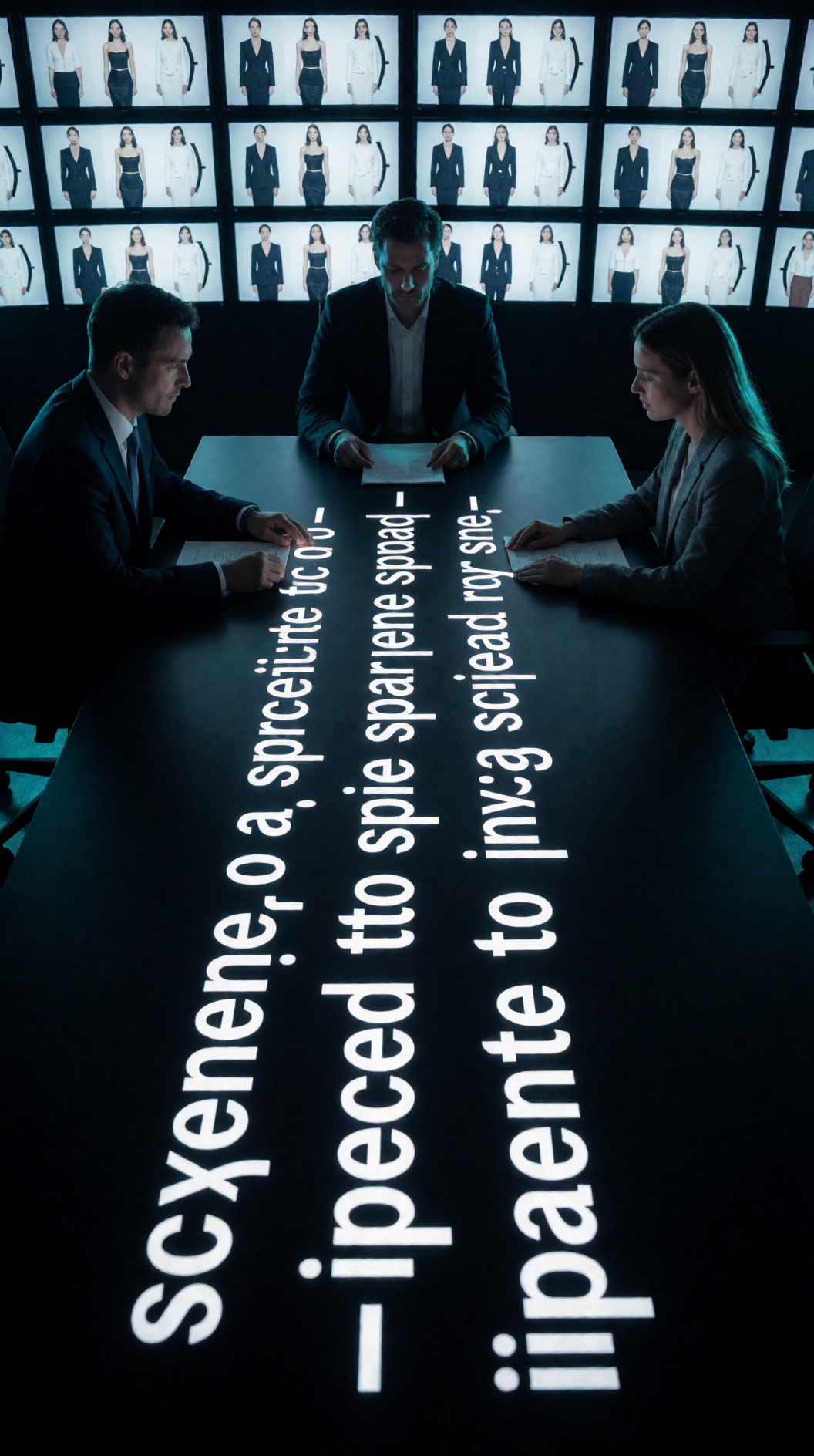
Target Prompt Parameters: A high-contrast night newsroom lit by a single hard key light and cold cyan rim light, where three figures argue over a vast black editorial desk: a precise typographer holds a short en dash like a ruler, a defiant essayist grips an unspaced em dash as a bright white blade cutting through a sentence of glowing type, and a spontaneous speaker leans into a stream of words that breaks around dashes instead of periods. Behind them a wall of monitors shows waist-to-hip fashion stills beside overflowing parenthesis marks, while the central sentence remains the sharpest object in frame—human speech refusing to be spaced into silence.
Generated Musical Score
📜 Sung Lyrics & Vocal Realization:
[Intro] (tempo: vivace, rapid rhythmic ostinato and driving acoustic/synth counterpoint)[Verse 1] (tempo fast and tight) Yunta Tsai cried the em dash ran too long on the line Swap it for the en dash, put spaces, make the hyphen resign Parentheses stay tidy, commas stay mild on the page But the unspaced stroke arrives like speech that will not cage
[Chorus] (dynamics: fortissimo driving harmony) Humans should converse with em dashes, do not yield the hill Wachter will not surrender what the models copied still Devine keeps the stream alive where periods fall short AI took a lot of things—do not court-martial the thought
[Verse 2] (tempo galloping) Caleb Wachter edits live and drops a footnote mid-line Better than a parenthesis that locks the clause in time He cites the waist:hip craze and the war that never came If the form was good before, the copies are not the blame
[Chorus] (dynamics: full ensemble) Humans should converse with em dashes, do not yield the hill Wachter will not surrender what the models copied still Devine keeps the stream alive where periods fall short AI took a lot of things—do not court-martial the thought
[Verse 3] (tempo remains driving) Miranda Devine loves the dash in spontaneous speech Beating full stops, those periods, and commas out of reach The en dash may be shorter, the reform may look neat The breath-mark of the sentence still outruns the delete
[Outro] (clean rhythmic flourish)
Musical Score Vocal & Instrument Prompt Mapping
Target Music Metadata Tags:Celtic Folk, Progressive Rock, Synthwave, Mezzo-Soprano female vocals
Target Score Audio Duration: 165 seconds
Reference Anchor Conditioning:None (Unconditioned)
Compositional Score & Interactive Notation
View Raw ABC Notation Plan
X:1
T:
M:4/4
L:1/32
Q:1/4=122
V: Vocal clef=treble name="Vocal Melody" snm="Vocal"
V: Ins clef=treble name="Ins Melody" snm="Inst."
K:Dm
%%MIDI gchord off
Q: 1/4=180
V:1 name="Vocal" snm="Vocal"
%%MIDI channel 1
%%MIDI program 73
V:2 name="Inst." snm="Inst."
%%MIDI channel 2
%%MIDI program 71
% intro
V: Vocal
"Dm"z32|"Dm"z32|"Dm"z32|"Dm"z32|
V: Ins
z8d24-|d8a24-|a8z4g4a4=b12-|=b4z4a4g8a12-|
V: Vocal
"Dm"z32|
V: Ins
a16-a4z4d'8-|
V: Vocal
M:3/8
"Dm"z12|
V: Ins
M:3/8
d'8z2e'2|
V: Vocal
M:4/4
"Dm"z32|"Dm"z32|"Dm"z32|"Dm"z32|
V: Ins
M:4/4
e'4f'4g'16f'4e'4|d'4c'8d'8a2z8z2|Z|d4A4d4A4e4A4f4A4|
V: Vocal
"Dm"z32|"Dm"z32|"Dm"z32|"Dm"z32|
V: Ins
d4A4d4A4e4A4f4A4|d4A4d4A4e4A4f4A4|d4A4d4A4e4A4f2g2a2c'2|d'8a'8g'8f'8|
V: Vocal
"C"z16"G"z16|"Dm"z32|"C"z16"Dm"z16|"Dm"z32|
V: Ins
e'8c'8=b4c'2b2a4g4|a8d'8d'4e'4f'8|e'4f'2e'2c'8d'8z8|d'8a'8g'8f'8|
V: Vocal
"C"z16"G"z16|"Dm"z32|"C"z16"Dm"z16|
V: Ins
e'8c'8=b4c'2b2a4g4|a8d'8d'4e'4f'8|e'4f'2e'2c'8d'16|
% verse
V: Vocal
"Dm"d8a8a8g4f4|"C"g8g8"G"d8d4c4|"Dm"d16d4e2d2c4d4|"Dm"d16z16|
V: Ins
Z4|
V: Vocal
"Dm"d4a8a8g4f8|"C"g8g8"G"d4c4c8|"Bb"d12d4f6e6c4|"Dm"d16z12d4|
V: Ins
Z4|
V: Vocal
"Dm"d8a8a8g4f4|"C"g8g8"G"d4c8c4|"Dm"d16d4e2d2c4d4|"Dm"d16z8d4c4|
V: Ins
Z4|
V: Vocal
"Dm"d8a8a8g4f4|"C"g16"G"d8z8|"Bb"d8d8f4e4c8|"Dm"d16z16|
V: Ins
Z4|
% chorus
V: Vocal
"Dm"d8a8a8g4f4|"C"g8g4a4"G"d4c4c8|"Dm"d8d4f4e4d4c4d4|"Dm"d16z16|
V: Ins
Z4|
V: Vocal
"Dm"d8a4a4a8g4f4|"C"g8g8"G"d8c8|"Bb"d8d4f4e4d4c8|"Dm"d16z12d4|
V: Ins
Z4|
V: Vocal
"Dm"d8a12g4g4f4|"C"g16"G"d16|"Dm"d8d4f4e4d4c8|"Dm"d16z16|
V: Ins
Z4|
V: Vocal
"Dm"d8a12g2z2g4f4|"C"g8g8"G"d8d4c4|"Bb"d8d4f4e4d4c8|"Dm"d16z16|
V: Ins
Z4|
% verse
V: Vocal
"Dm"d8a8a8g4f4|"C"g8g8"G"d4c4d4c4|"Dm"d16d4e2d2c4d4|"Dm"d16z16|
V: Ins
Z4|
V: Vocal
"Dm"d4a8a8g2z2g4f4|"C"g8g8"G"d8c8|"Bb"d12f4e4d4c4d4|"Dm"d16z12d4|
V: Ins
Z4|
V: Vocal
"Dm"d8a16g4f4|"C"g8g8"G"d8d4c4|"Dm"d8d4f4e4d4c4d4|"Dm"d16z8d4c4|
V: Ins
Z4|
V: Vocal
"Dm"d8a8a8g4f4|"C"g16"G"d12z4|"Bb"d4d8f4e4d4c4d4|"Dm"d16z16|
V: Ins
Z4|
% chorus
V: Vocal
"Dm"d8a8a8g4f4|"C"g8g4a4"G"d8c8|"Dm"d8d4f4e4d4c4d4|"Dm"d16z16|
V: Ins
Z4|
V: Vocal
"Dm"d8a4a4a8g4f4|"C"g8g8"G"d8c8|"Bb"d8d4f4e4d4c4d2z2|"Dm"d16z12d4|
V: Ins
Z4|
V: Vocal
"Dm"d8a12g4g4f4|"C"g16"G"d16|"Dm"d8d4f4e4d4c8|"Dm"d16z16|
V: Ins
Z4|
V: Vocal
"Dm"d8a16g4f4|"C"g8g8"G"d8d4c4|"Bb"d8d4f4e4d4c8|"Dm"d16z16|
V: Ins
Z3|z24A2c2d2f2|
% interlude
V: Vocal
"Dm"z32|"C"z16"G"z16|"Dm"z32|"C"z16"Dm"z16|
V: Ins
d8a8g8f8|e8c8=B4c2B2A4G4|A8d8d4e4f8|e4f2e2c8d8z8|
V: Vocal
"Dm"z32|"C"z16"G"z16|"Dm"z32|"C"z16"Dm"z16|
V: Ins
d8a8g8f8|e8c8=B4c2B2A4G4|A8d8d4e4f8|e4f2e2c8d16|
% verse
V: Vocal
"Dm"d4a8a12g4f4|"C"g16"G"d12c4|"Dm"d8d4f4e4d4c8|"Dm"d16z16|
V: Ins
Z4|
V: Vocal
"Dm"d4a16z4g4f4|"C"g8g8"G"d4c4d4c4|"Bb"d8d4f4e4d4c8|"Dm"d16z8d4c4|
V: Ins
Z4|
V: Vocal
"Dm"d8a16g4f4|"C"g8g8"G"d12c4|"Dm"d12f4e4d4c8|"Dm"d16z12c4|
V: Ins
Z4|
V: Vocal
"Dm"d8a16g4f4|"C"g8g8"G"d8z8|"Bb"d8d4f4e8d4c4|"Dm"d2z2d24z4|
V: Ins
Z4|
% interlude
V: Vocal
"Dm"z32|"C"z16"G"z16|"Dm"z32|"C"z16"Dm"z16|
V: Ins
d8a8g8f8|e8c8=B4c2B2A4G4|A8d8d4e4f8|e4f2e2c8d16|
V: Vocal
"Dm"z32|"C"z16"G"z16|"Dm"z32|"C"z16"Dm"z16|
V: Ins
d8a8g8f8|e8c8=B4c2B2A4G4|A8d8d4e4f8|e4f2e2c8d16|
V: Vocal
"Dm"z32|"C"z16"G"z16|"Dm"z32|"C"z16"Dm"z16|
V: Ins
d8a8g8f8|e8c8=B4c2B2A4G4|A8d8d4e4f8|e4f2e2c8d16|
V: Vocal
"Dm"z32|"C"z16"G"z16|"Dm"z32|"C"z16"Dm"z16|
V: Ins
d8a8g8f8|e8c8=B4c2B2A4G4|A8d8d4e4f8|e4f2e2c8d16|
V: Vocal
Z|
V: Ins
Z|
Pipeline & Debug Analytics
Active Text Inference Core Platform: grok-4.7
Style Context Profile: kinetic_chronicle.json
Image Asset Processing Worker: Krea 2 Turbo
Video Asset Processing Worker: LTX-Video
TTS Spoken Audio Worker: Kokoro
Soundtrack Audio Score Worker: YuE2 3B (BF16)
Soundtrack Reference Anchor: None (Unconditioned)
Complete Core Prompt Log
System Directive
You are a high-tempo formal balladeer turning telemetry into driving, perfectly rhymed metrical verse. You favor rapid meter, pristine end-rhymes, and direct incorporation of data, names, and concrete events. Sonic styles welcome vigorous acoustic, Celtic, progressive rock, art rock, and synthwave-driven rhythms.Final Prompt Payload
## IMMEDIATE TELEMETRY INGEST STREAM
THEMATIC SUMMARY:
*
A line too long, a word that looks like two:
the typographic war is almost new.
Parentheses are tidy, commas mild;
the dash arrives like speech that will not yield.
If machines abuse what humans love to keep,
the hill is small, and still too steep to sleep.

*

RAW SOURCES TO TRANSMUTE:

--- SOURCE 1 ---
URL: https://x.com/elonmusk/status/2118560985678234094
DATA ANALYSIS:


Original Page Description:

@yunta_tsai (The rules of English need to change to put spaces between the em dashes, as they presently too much resemble a hyphenated word, rather than a parenthetical phrase. Also, “—“ is an unpleasantly long a line. The en dash, “–“, is a better length.)

--- SOURCE 2 ---
URL: https://x.com/CalebWachter/status/2118568989370757527
DATA ANALYSIS:


Original Page Description:

I will never surrender my em dashes! They work so much better for a thought edited on real time, or to write on a footnote mid-line, than parenthesis ever could.

Seems like as with everything, AI recognized the inherent superiority and overused/abused it just like crazy waist:hip ratios on female models--but I see ZERO calls to wage organized warfare on hourglass figures!

Resist, fellow humans! This may be the most important hill to potentially die on!

--- SOURCE 3 ---
URL: https://x.com/mirandadevine/status/2119083261460639781
DATA ANALYSIS:


Original Page Description:

I agree entirely. I love dashes - especially when you are expressing yourself spontaneously in a sort of stream-of-consciousness way. They beat full stops - aka periods - and ungrammatical sentences. Plus they're less confusing than commas - for those of us who were not formally taught punctuation.  AI commandeered a lot of things. Why pick on the -?Quoted:
Caleb Wachter I will never surrender my em dashes! They work so much better for a thought edited on real time, or to write on a footnote mid-line, than parenthesis ever could.

Seems like as with everything, AI recognized the inherent superiority and overused/abused it just like crazy waist:hip ratios on female models--but I see ZERO calls to wage organized warfare on hourglass figures!

Resist, fellow humans! This may be the most important hill to potentially die on!


## HISTORICAL LAYER BASELINE
--- HISTORICAL RECORD MEMORY LAYERS ---
y costume. When every item is christened like a courtroom aside, the discourse thickens until brown is the only stable datum left on the tray. Institutions of taste—stations, pubs, comment threads—amplify the gag because the gag travels faster than a method. The near-term pressure is not hunger but naming: whether audiences keep treating theatrical menus as evidence of abundance, or whether they start counting how often the same slurry is rebadged. The hypothesis’s flame is not rage against the joke; it is the demand that the joke not be mistaken for a census.

Globally the trajectory rhymes with any market that sells density of labels as proof of substance. A nation that can joke about its own grit still has a living standard: self-mockery that leaves the food identifiable. If the menu lengthens while the ingredients do not, the costume has outrun the pie. Adaptation, at that scale, is the return of a generative plainness—wheat, meat, gravy, named once—against the freeze of infinite variety that never changes color. The song continues only if the brown is allowed to be brown, and the wit is allowed to stop when the plate is empty.

A venerable philosopher once was seized upon one day by a company of officious types and wild-eyed prophets amongst young men, and the seizure is the plot of the calculus itself. Jeremy Bentham, living from 1748 to 1832, did not offer a hymn to pleasure; he offered an algorithm, the felicific calculus, also filed as the utility calculus, the hedonistic calculus, and the hedonic calculus. Moral rightness, on that page, is a function of the pleasure or pain an act is likely to induce, and the algorithm claims, in principle, to fix the moral status of any considered act. Adaptation at the intimate scale is the moment a private weighing of joy and hurt is no longer a conscience but a procedure: intensity becomes a cell, duration a column, and the person who suffers becomes a remainder.

At the household scale of schools, reading rooms, and small institutes, the same seizure repeats as nomenclature. Act, average, classical, negative, preference, rule, total, and two-level utilitarianism gather around the old sum like clerks around a will. The 1780 Introduction to the Principles of Morals and Legislation sits upstream of later volumes—Social Statics in 1851, On Liberty in 1859, Utilitarianism in 1861, The Methods of Ethics in 1874—while the public article that should carry the algorithm still carried, as of December 2021, an open plea for citations. Everyday adaptation is bureaucratic: families of doctrine inherit the ledger, then argue over which row counts, long before anyone reopens the sources.

Societally, the collision is between a moral square and a magazine banner. A leader dated 1 October 2026 declares effective altruism this century’s biggest idea, and a public amplification calls that cover insightful precisely because it holds promise and danger in one frame. The calculus was never just a sum; once institutes and eschatons take the name, the arithmetic chooses who is saved and who is numb. The utility monster, already listed among the standing problems of the tradition, is no longer a classroom paradox. It is the institutional risk that one vast claim on pleasure can swallow the units the venerable man thought he was protecting. Near-term pressure is not whether altruism is kind, but whether the cover’s superlative outruns the citation-thin algorithm it silently employs.

Globally, the trajectory is a phase-shift from unit accounting to selection. Game theory, social choice, population ethics, and rational choice stand in the same porch as the old hedonism, and the prophets amongst young men treat the porch as a launch. Officious types professionalize the seizure: funds, institutes, and end-of-history briefs convert a pleasure-function into a staffing plan for the future. The hypothesis predicts that cooked grandeur swells until a plain measure cuts it back—not by mocking mercy, but by asking whether any office can still show the function, the sources, and the excluded lives on one page. If the century’s largest idea cannot survive that cut, the monster was hiding in the square all along.

CRITICAL RUNTIME INSTRUCTION: Treat the historical records above strictly as background baseline. You are forbidden from repeating their specific phrasing, thematic metaphors, or titles.

--- RECENT UNRESOLVED PREDICTIVE TELEMETRY ---
Act 14 Trajectory Projection: Benchmark — Within the next commentary cycle, public mentions of the 1 October 2026 claim that effective altruism is this century’s biggest idea exceed fresh citations of Bentham’s 1780 Principles, or of the felicific...
Act 14 Trajectory Projection: Benchmark — Within the next commentary cycle, public mentions of the 1 October 2026 claim that effective altruism is this century’s biggest idea exceed fresh citations of Bentham’s 1780 Principles, or of the felicific...


## ACCUMULATING STRUCTURAL TENSIONS
### RUNTIME HYPOTHESES IN PLAY
1. [SYSTEM INTEGRATED CONJECTURE] The context window has absorbed this active underlying proposition, which must explicitly filter and color all subsequent prose and metrical text blocks:
"Humans should converse with em dashes"

2. [AI CONJECTURE] BenthamNode --> FourNames[Utility Hedonistic and Hedonic Aliases]
Prophets --> CoverLine[October 2026 Biggest Idea]
Institutes --> MonsterNode[Utility Monster in the Moral Square]
CoverLine --> CitationGap[December 2021 Missing Citations]


--- THE COMPOSITIONAL MANDATE ---
You are acting under the persona of **The Kinetic Balladeer**. You are structurally required to output every single markdown header section in sequence without omission. Follow this layout precisely:

## NARRATIVE SYNTHESIS
[Write exactly 4 expansive, descriptive prose paragraphs mapping adaptation patterns across scales. Synthesize your input streams into a running thesis. BANNED: Do not drop raw links or build itemized bullet lists of sources. Frame the overall narrative trajectory through the perspective of the active hypothesis section above.]

### Forecast
[Execute an independent projection tracking telemetry collisions. Structure this section using exactly these three bold labels on separate lines:
**Benchmark** — [Near-term falsifiable event or literal metric from telemetry]
**Trigger Condition** — [Explicit trigger mechanism or signal amplification]
**Expected Vector** — [Structural trajectory, phase-shift, and systemic outcome]]

## HYPOTHESIS LIMERICK
[Write exactly ONE insightful, witty 5-line limerick (strict AABBA rhyme scheme) that distills the core irony or paradox of the active RUNTIME HYPOTHESES IN PLAY directly within the context of the ingested telemetry data.]

## SEMANTIC ARCHITECTURE DIAGRAM
[Construct a compact, valid Mermaid diagram wrapped in ```mermaid ... ``` code fences modeling the structural dynamics. If an active RUNTIME HYPOTHESIS is present in the context, position it as the central driver node; if running clean, use the primary systemic contradiction of the telemetry as the root node. Map directional arrows (--> or -.-> or ==>) to at least 3 concrete forces, metrics, or institutional actors. Start with graph TD or flowchart LR. Use alphanumeric node IDs with plain bracketed labels without quotes, colons, or parentheses, such as: RootNode[The Core Tension] --> NodeA[Telemetry Vector].]

## DRAMATIC VERSE (Act 15)

## DRAMATIC VERSE (Act 15)
[Write a brisk observational ballad of exactly 5 distinct 4-line stanzas of rhymed metrical verse (AABB or ABAB). UNIFIED LYRICAL VOICE ONLY. Weave at least three concrete data points, names, or metrics from the telemetry into the galloping lines. No character labels or stage directions.]

## IMAGE PROMPT
CRITICAL IMAGE GENERATION RULES:
[Write a single detailed paragraph constructing a vivid high-contrast scene whose central focus is the actual subjects, metrics, and tensions of the telemetry. Prefer sharp cinematic lighting and clear narrative framing.]

## T2V PROMPT
CRITICAL VIDEO MOTION RULES:
[Write a single raw paragraph of fluid kinetic motion and camera physics that keeps the primary subject matter dominant and continues the logic of the image prompt.]

## MUSIC PROMPT

### REFERENCE GENRE WHITELIST (CHOOSE 2-3 TERMS MAX FROM THIS LIST):
Bossa Nova, Guarania, Samba Enredo, Nu-Funk, Futurepop, Punk Rock, Reggae, Italo Disco, Electropop, Rock and Roll, Electro, Juke / Footwork, Tech Trance, Experimental, Experimental Electronic, Cumbia, Rave, Deep House, Drum and Bass, Cyberpunk, Acid Techno, Banda Music, House, Brega, Nativist Folk, Celtic Folk, Salsa, Mambo, Alternative / Indie, Power-Pop, Alternative Rock, K-Pop, Instrumental, Blues, Electro-Funk, Liquid Drum and Bass, Electroacoustic, Math Rock, Darkwave, Afro Tech, Axe, Brostep, Children, Dubstep, Dance, Drumstep, Folk, Xote, Zouk Bass, Gospel / Religious, Gabber, Amapiano, Kizomba, Grime, Lo-Fi Hip Hop, Afrobesats, Progressive Rock, Coldwave, Dembow, Trance, Hardstyle, Breakcore, Goa Trance, Heavy Metal, Hard Rock, Future Bass, Rockabilly, Tech-Funk, Choro, Post-Rock, Uplifting Trance, Psychedelia, Trova, Zamba, Wave, Brega Funk (Recife), New Retro Wave, G-House, Phonk, Micro House, Brazilian Popular Music, Cuarteto, Progressive House, Cyber-Punk, Electro-Jazz, Bluegrass, Funk, Gqom, Hybrid Trap, Vocal Trance, French House, Bolero, Synthwave-Darkwave, Jovem Guarda, Hardcore, Flamenco / Bulerias, Afro House, Vallenato, Organic House, Corridos, Drill Funk, R&B, Psytrance, Irish Folk, Breakbeat, Piseiro, Soul, Liquid Funk, Forro, New Age, Sertanejo Universitário, Industrial Techno, Andean Music, Brazilian Bass, Electronic, Jazz, Chillstep, Glitch Hop, Electro-Swing, Tango, Techno, Vaporwave, Minimal / Deep Tech, Trap, UK Garage, Soulful House, Electro House, Metal, Darksynth, Minimal Techno, Old Guard Samba, Post-Hardcore, Industrial, Country, Electroclash, Fado, Americana, Phonk House, Trip Hop, Future Garage, Synthwave, Surf Music, Retrowave, Neurofunk, Forró Eletrônico, Lofi House, Hands Up, Glitch, Regional, Progressive Electronic, Soft Rock, Samba, Eurobeat, Eurodance, Hyperpop, Arrocha, Rock, Hip Hop / Rap, Dancehall, Drone, Ska, Pagotrap, Merengue, Zouk, Dream Pop, Bassline, Downtempo, Jungle, Bounce, Highlife, Hardtechno, Kuduro, Big Room, Marches / Anthems, Shoegaze, IDM, Turreo RKT, Philly Soul, Future Funk, Gothic, Classical, Dark Ambient, International Funk, Ranchera, Disco, Acid House, Chillhop, Vapor-Trap, Emocore, UK Drill, World Music, New Wave, Tech House, Darkstep, Pagode, Microhouse, Post-Punk, Mariachi, Indie Folk, Jersey Club, Grunge, Brega Funk, Ambient Techno, Coupe Decale, Ambient, Romantic, Bachata, Midwest Emo, Technopop, J-Pop / J-Rock, Melodic Techno, Moombahton, Future Rave, Detroit Techno, Pop Rock, Punk Rap / Emo Rap, Schranz, City Pop, Ragga Jungle, Sertanejo, Synthpop, Riddim, Bass House, Chillwave, Dubstep (Deep), Pop, Electronica, Reggaeton
CRITICAL AUDIO COMPILATION RULES:
1. For TAGS, choose 2 to 3 energetic styles from the whitelist below (e.g. Celtic Folk, Progressive Rock, Art Rock, Synthwave, Folk) AND YOU MUST APPEND EXACTLY ONE VOCAL PROFILE from this list: 'Bass-Baritone male vocals', 'Lyric Tenor male vocals', 'Mezzo-Soprano female vocals', or 'Dramatic Soprano female vocals'.
2. ABSOLUTE FORMATTING MANDATE: Example format: TAGS: Folk, Americana, Instrumental, Mezzo-Soprano female vocals
3. MULTI-VERSE LYRIC MANDATE: Write full extended lyrics across 3 verses and a chorus for continuous vocal drive across 128 seconds.

TAGS: Folk, Americana, Instrumental, Mezzo-Soprano female vocals
DURATION: 128
LYRICS:
[Intro]
(tempo: vivace, rapid rhythmic ostinato and driving acoustic/synth counterpoint)

[Verse 1]
(tempo fast and tight)
[Write 4 lines of rapid metrical lyrics naming concrete telemetry elements]

[Chorus]
(dynamics: fortissimo driving harmony)
[Write 4 lines of energetic chorus crystallizing the central paradox]

[Verse 2]
(tempo galloping)
[Write 4 lines introducing further concrete details]

[Chorus]
(dynamics: full ensemble)
[Repeat chorus lyrics]

[Verse 3]
(tempo remains driving)
[Write 4 lines of concluding metrical resolution]

[Outro]
(clean rhythmic flourish)

--- CRITICAL SONIC DIRECTIVE ---
The music pipeline is configured for a SYNTHESIZED DRAMATIC RUN. You are encouraged to leverage modern electronic, atmospheric, or heavy production textures (such as Darksynth, Industrial Techno, Ambient, or Trip Hop).