The Drawbridge and the Frontier - Transmuted Pass
Navigation
- Ongoing Narrative Arc
- Primary Poetic Artifact
- Kinetic Dynamic Video
- Visual Anchor Representation
- Generated Musical Score
- Pipeline & Debug Analytics
Active Underlying Paradigm
Scriptorium Operational Parameter [DIRECT INJECTED IDEA PARADIGM]: Learn from nature - growth, ingenuity, strength, positivity, perseveration and evolution got us here. Natural and AI coevolution will continue
Paradigm Limerick Distillation: There once was a race that would grow By inventing, then selling the show; Labs begged for a stall, Called danger for all, While nature said: fail, then you’ll know.
Thematic Seed
*
When labs that race now beg the state to stall,
And “pace the frontier” sounds a lot like moat,
A president shouts hoax from Air Force One—
That IQ, not a board, should hold the vote.
Incumbents warn of death while scaling still;
The capture thesis Gurley named in three;
Who benefits if America stands still?
The question hangs like sulfur in the breeze.
Don’t panic, Mayer writes; invent, then sell.
Don’t write the rules that only giants keep.
Computer computers—only computer—
While committees dream of joint-governance sleep.
Build chips and plants; let failure teach the rest.
Fear is not strategy. The race is the test.
*
Ongoing Narrative Arc
When laboratories that still scale their own models petition the state to stall the same frontier, the pattern is not a garden going fallow but a thicket claiming the canopy. Growth, ingenuity, and perseveration built the present stack; the plea to “pace” the race arrives as a moat dressed as mercy. A president returning from a golf weekend names the panic a hoax and locates the only guardrail in a high-IQ executive, while incumbents warn of death and still ship. Nature does not vote committees into joint-governance sleep. It coevolves: chips, plants, failures that teach, and living standards that rose because invention was productized, marketed, and sold. The running thesis is that America excels at that engine, and that coevolution of natural and artificial intelligence continues by building, not by begging the drawbridge up behind the castle already occupied.
Across scales the same adaptation appears. Socrates feared writing; the sewing machine was said to unmake society; radio would ruin attention; Y2K would halt clocks at midnight, then January first arrived. Now the object of anxiety is AI, and the loudest sirens come from those racing to train the most capable systems, then asking government to raise costs only a handful of firms can pay. Three years ago the capture thesis was named in a summit talk; the beggars now beg harder. Who benefits if America stands still is not a riddle of metaphysics but of geography: a technological race as consequential as industrialization, adversaries who would amplify fear so the United States hobbles itself, and critics who note that fear is not strategy. Strength and positivity here mean experiment, compete, fail, succeed, and make money—the evolutionary loop that got us here.
The cultural layer is not extinction but stupidity: a panic ecology that treats every leap as a moral epidemic while recursive self-improvement rumors (a DeepMind whisper, RSI as holy grail) give cynical spin to coordinated pacing essays. Anthropic commits unilaterally to third-party evaluators with employee-level access; OpenAI and Musk rhyme the slowdown. Regulatory capture is the convenient triangle: danger, please regulate, we already have lawyers and compute. Meanwhile plants and data centers are the real substrate. Evolution does not stall for joint-governance dreams; it selects for those who keep building when sulfur hangs in the breeze. The hypothesis colors every stanza: coevolution continues because growth is the test, not the committee.
Incumbents still scale while warning of death; the administration claims it has stopped “AI people” from bad things without a bill of particulars; Mythos stalls as supply-chain risk. The question is not whether disruption will cut jobs and create others—it will—but whether America asks permission to invent the future. Don’t panic, invent then sell, don’t write rules only giants keep, computer computers only computer: the meter of the race. Natural selection and silicon selection share a method. Perseveration through failure, ingenuity in chips and power, positivity that living standards rose because we did not treat commerce as dirty. The narrative trajectory is a chaconne of competing theses: stall as safety versus stall as moat, IQ as vote versus board as vote, and coevolution as the only strategy that has ever worked.
Forecast
Benchmark — Third public presidential statement in as many days against AI-safety stall, coinciding with any formal Anthropic/OpenAI joint-pacing commitment or Pentagon supply-chain action on Mythos-class models. Trigger Condition — Coordinated CEO letters plus “we must pace the frontier” essays when compute and energy remain unconstrained for incumbents, amplifying capture claims if RSI rumors (DeepMind or otherwise) go unproven. Expected Vector — Phase-shift from moral panic to industrial policy: chips, plants, and open experiment versus joint-governance sleep; America either keeps the evolutionary lead or regulates itself into second place while China does not pause.
Primary Poetic Artifact
THE ANALYST: [Summit replay, three years’ echo on the wall] I named it in three: they would beg for the rules; No idea they’d beg this hard, the convenient tools. Danger, then regulate, lawyers we keep— Raise the drawbridge: the castle was already steep.
THE BUILDER: [Factory floor, turbines and wafers in rhyme] Don’t panic: we invent, then we productize, sell; Socrates, sewing, Y2K—midnight rang the bell. Build chips and the plants; let failure teach the rest; Who benefits if America stands still? Not the West.
THE SKEPTIC: [Committee chamber, joint-governance dream] Pace the frontier, RSI outruns our sight; Employee-level access, METR in the night. Amodei, Altman, Musk: slow the climb we still scale; Incumbents warn of death while the training runs the rail.
THE CHORUS: [Polyphony: sulfur breeze, two theses braid] Fear is not strategy; the race is the test. Computer computers—only computer—let the rest. Growth, ingenuity, coevolution’s song: Don’t write the rules that only giants prolong.
Kinetic Dynamic Video
Video Generation Prompt
Target Prompt Parameters: Slow dolly along the split hall as the drawbridge lowers in stuttered frames while the foundry side accelerates: sparks, wafer boats, cooling mist; camera orbits the table so named figures (president silhouette, three CEOs, a builder) lean into competing theses; cut to Air Force One window then snap-zoom to racks lighting in sequence; kinetic interplay of stall-gesture versus build-gesture, sulfur haze drifting, ending on a single turbine spinning up as the committee freeze-frame fades.
Visual Anchor Representation
Image Generation Prompt
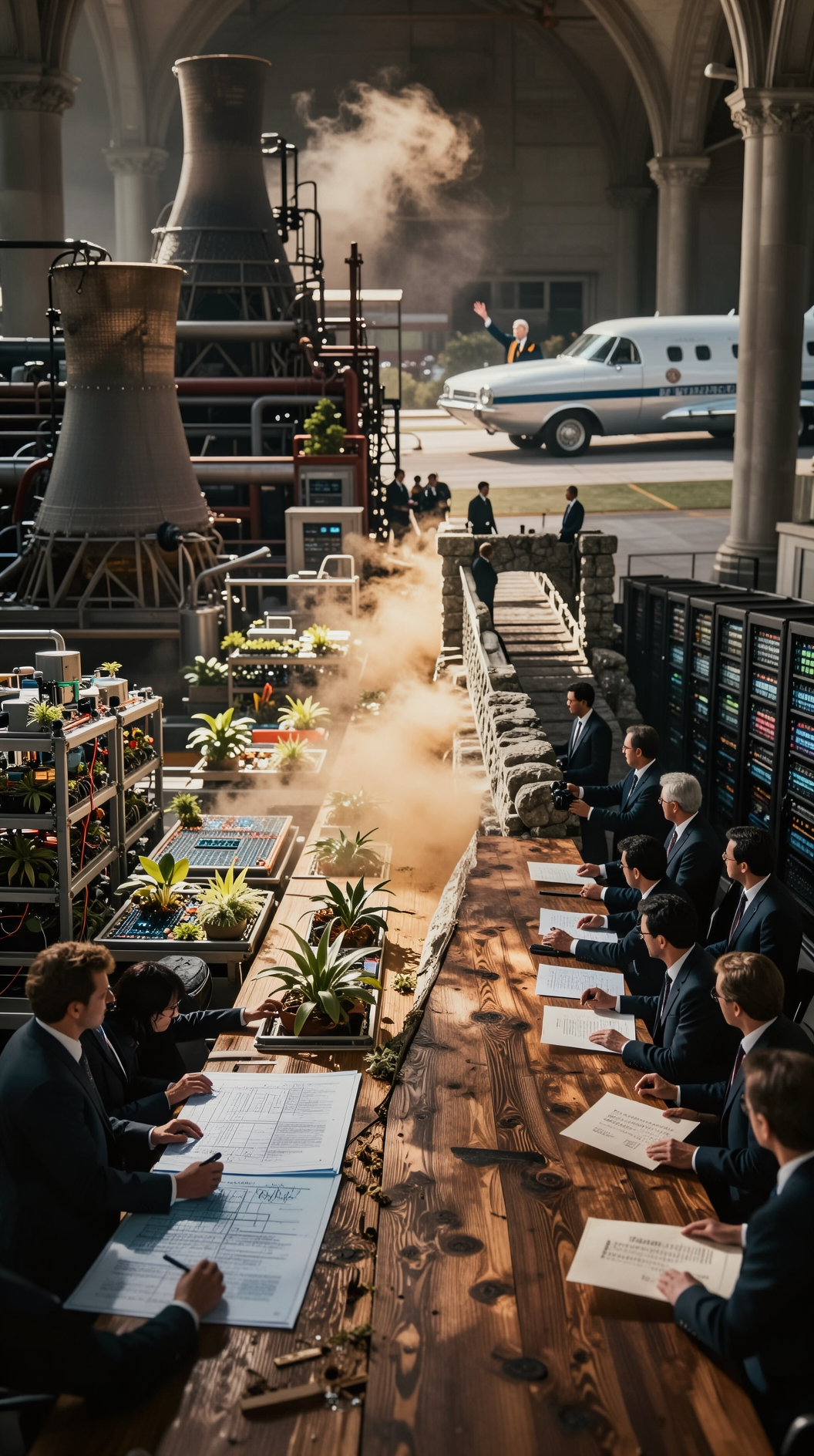
Target Prompt Parameters: High-contrast cinematic tableau: a long oak table splitting a vaulted hall, one half a sunlit American foundry of wafers, cooling towers, and humming racks (growth, chips, plants), the other half a shadowed committee of CEOs in identical dark suits raising a stone drawbridge while a president on a distant tarmac waves from Air Force One; sulfur-colored haze between them; competing theses as two processional lines of figures—builders with blueprints versus stall-petitioners with sealed envelopes—sharp geometry of columns and data-center aisles, no text, photographic chiaroscuro, 35mm depth.
Generated Musical Score
Musical Score Vocal & Instrument Prompt Mapping
Target Music Metadata Tags:Folk, Classical, Celtic Folk, Mezzo-Soprano female vocals
Target Score Audio Duration: 128 seconds
Reference Anchor Conditioning:None (Unconditioned)
[Intro]
(tempo: allegro moderato, layered counter-melody and bass subject)

[Verse 1]
(tempo driving, imitation in lower registers)
The labs that race now beg the state to stall the climb they scale,
A president names hoax from One, High IQ holds the rail.
Three years the capture thesis rang, they beg this hard tonight—
Who benefits if we stand still? Not those who build the light.

[Chorus]
(dynamics: fortissimo polyphony with independent vocal lines)
Don’t panic, invent then sell; don’t write the giants’ keep.
Computer computers only—let failure teach the steep.
Fear is not strategy; the race is nature’s test:
Growth, ingenuity, coevolution, none rest.

[Verse 2]
(tempo steady, syncopated accompaniment)
Y2K rang midnight, sewing, Socrates of old;
Now RSI rumors spin, DeepMind whisper, stall we’re told.
Employee access, METR, Mythos stalled as risk—
China does not pause the plants while committees dream the disk.

[Chorus]
(dynamics: full polyphonic resonance)
Don’t panic, invent then sell; don’t write the giants’ keep.
Computer computers only—let failure teach the steep.
Fear is not strategy; the race is nature’s test:
Growth, ingenuity, coevolution, none rest.

[Verse 3]
(tempo driving, climactic stretto)
Build chips and plants, let Americans fail and then succeed;
The engine that raised living standards is not a dirty creed.
Natural and silicon keep the same evolutionary song—
Perseveration, strength, positivity: the race is long.

[Outro]
(resolving harmonic cadence)
Pipeline & Debug Analytics
Active Text Inference Core Platform: grok-4.6
Style Context Profile: dramatic_polyphony.json
Image Asset Processing Worker: Lens
Video Asset Processing Worker: LTX-Video
TTS Spoken Audio Worker: Kokoro
Soundtrack Audio Score Worker: ACE-Step 1.5
Soundtrack Reference Anchor: None (Unconditioned)
Complete Core Prompt Log
System Directive
You are a master musical dramatist crafting theatrical verse designed for polyphonic and contrapuntal vocal interplay. Your mission is to transmute telemetry data into dynamic dialogue among NAMED CHARACTERS who advance competing theses. Favor sharp meter, exact rhyme schemes, contrapuntal tension, and explicit integration of technical metrics. You are encouraged to draw from both classical contrapuntal forms (Baroque, Chaconne, Opera, Polyphony) and layered modern textures (Electroacoustic, IDM, Art Rock, Darkwave).Final Prompt Payload
## IMMEDIATE TELEMETRY INGEST STREAM
THEMATIC SUMMARY:
*
When labs that race now beg the state to stall,
And “pace the frontier” sounds a lot like moat,
A president shouts hoax from Air Force One—
That IQ, not a board, should hold the vote.
Incumbents warn of death while scaling still;
The capture thesis Gurley named in three;
Who benefits if America stands still?
The question hangs like sulfur in the breeze.
Don’t panic, Mayer writes; invent, then sell.
Don’t write the rules that only giants keep.
Computer computers—only computer—
While committees dream of joint-governance sleep.
Build chips and plants; let failure teach the rest.
Fear is not strategy. The race is the test.
*
RAW SOURCES TO TRANSMUTE:
--- SOURCE 1 ---
URL: https://www.axios.com/2026/09/14/trump-ai-safety-anthropic-dario-amodei
DATA ANALYSIS:
Original Page Description:
It's the third time is as many days that Trump has pushed back against calls for AI safety regulations.
Full Article Text:
Updated 47 mins ago - Technology TRUMP SAYS A STRONG, SMART PRESIDENT IS THE ONLY "GUARDRAIL" AI NEEDS Herb Scribneremail (opens in new window)sms (opens in new window)facebook (opens in new window)twitter (opens in new window)linkedin (opens in new window)bluesky (opens in new window)Add Axios on Google Add Axios as your preferred source to see more of our stories on Google. Add Axios on Google President Trump speaks to reporters aboard Air Force One on Sept. 13 while returning to Joint Base Andrews, Md., after attending the Irish Open at his family's golf resort in Doonbeg, Ireland. Photo: Brendan Smialowski/AFP via Getty Images President Trump lashed out at calls for new AI guardrails and protections on Monday, arguing AI only needs a "STRONG AND SMART (High IQ!) PRESIDENT" and that AI critics should "BEWARE!" Why it matters: Trump continues to plant himself against calls for AI safety regulations as a growing chorus of AI leaders and CEOs, spearheaded by Anthropic CEO Dario Amodei over the weekend, call for a slowdown in AI's development and better regulations to help keep humanity safe. Amodei, OpenAI CEO Sam Altman and Elon Musk agreed that AI is quickly becoming more powerful, potentially beyond what humans can understand and monitor, prompting calls for a slowdown.The Trump administration has repeatedly clashed with Amodei and Anthropic, with the Pentagon previously designating the company as a supply-chain risk and stalling the release of its Mythos model. What he's saying: Trump said Monday afternoon that fears of "AI taking over the World, destroying Humanity, and all other things bad, is a HOAX," putting it on par with Russian election interference claims and his own impeachments. He said the AI development "will not be stopped by brilliantly run Destructive Forces" under his presidency. This was the second time he condemned AI safety fears in a 12-hour span. Early on Monday, he said that "the only control or 'guardrails' that AI needs is a STRONG AND SMART (High IQ!) PRESIDENT, and the U.S.A. has that, in spades!" Trump wrote on Truth Social. "WHOEVER WINS AI, WINS! We are leading China, and all others, and will continue to do so." Trump said his administration "has stopped AI 'people' from doing bad, or potentially bad, 'things,'" though he didn't elaborate. (The White House did not immediately respond to Axios' request for comment Monday.) He also took a swipe at Anthropic CEO Dario Amodei, "who is now pretending to be a 'perfect little ange... [Truncated]
--- SOURCE 2 ---
URL: https://x.com/AdamNMayer/status/2099539051410034864
DATA ANALYSIS:
Original Page Description:
If there’s one thing America excels at, it’s turning invention into industry.
We invent things. Then we productize them, market them, sell them, scale them—and make a lot of money doing it.
Some people regard that as dirty or corrupt. I don’t. That engine of American capitalism has produced extraordinary technological progress and rising living standards across the world.
And every time a revolutionary technology arrives, we panic.
Socrates worried writing would destroy human memory. The sewing machine was going to eliminate jobs and upend the social order. Radio was going to destroy children’s attention spans.
And if you’re an old "unc" as I am, you probably remember Y2K, when we were told civilization might grind to a halt at midnight.
Then came January 1, 2000.
Now the object of our collective anxiety is AI.
But there’s something strange about the current panic: some of the loudest warnings are coming from the very technology leaders racing to build the most powerful AI systems on Earth.
They simultaneously tell us:
"This technology may become dangerously powerful."
"We need the government to regulate it."
"And, by the way, we happen to be among the handful of companies with the money, computing power and lawyers necessary to comply with those regulations."
How convenient.
Maybe some of the concern is sincere. I’m sure it is.
But we would be incredibly naive not to recognize the possibility of regulatory capture. If you’re already inside the castle, a very effective business strategy is convincing the government to raise the drawbridge behind you.
And there’s an even bigger geopolitical question.
The United States is in a technological race with China. AI may prove as consequential to economic and military power in this century as industrialization was in the last two.
So whenever I see narratives spreading that America should slow down AI, stop building data centers, restrict energy production, or make AI development prohibitively expensive, I ask a very simple question:
Who benefits if America stops building?
Certainly not America.
That doesn’t mean every criticism of AI is Chinese propaganda. But our adversaries would be foolish NOT to amplify divisions and fears that cause the United States to voluntarily hobble one of its greatest technological advantages.
And we would be equally foolish to do their work for them.
AI will disrupt industries. It will eliminate some jobs and create others. It will create real problems that require real solutions.
But fear is not a strategy.
America did not become the world’s technological leader by asking permission to invent the future.
Build the models. Build the chips. Build the data centers. Build the power plants.
Let Americans experiment, compete, fail, succeed and make money.
And above all:
Don’t panic.
Don’t fall for the doomerism.
Don’t regulate ourselves into second place.
--- SOURCE 3 ---
URL: https://x.com/AAC0519/status/2099547762639458449
DATA ANALYSIS:
Original Page Description:
"Don’t panic.
Don’t fall for the doomerism.
Don’t regulate ourselves into second place."Quoted:
Adam Mayer If there’s one thing America excels at, it’s turning invention into industry.
We invent things. Then we productize them, market them, sell them, scale them—and make a lot of money doing it.
Some people regard that as dirty or corrupt. I don’t. That engine of American capitalism has produced extraordinary technological progress and rising living standards across the world.
And every time a revolutionary technology arrives, we panic.
Socrates worried writing would destroy human memory. The sewing machine was going to eliminate jobs and upend the social order. Radio was going to destroy children’s attention spans.
And if you’re an old "unc" as I am, you probably remember Y2K, when we were told civilization might grind to a halt at midnight.
Then came January 1, 2000.
Now the object of our collective anxiety is AI.
But there’s something strange about the current panic: some of the loudest warnings are coming from the very technology leaders racing to build the most powerful AI systems on Earth.
They simultaneously tell us:
"This technology may become dangerously powerful."
"We need the government to regulate it."
"And, by the way, we happen to be among the handful of companies with the money, computing power and lawyers necessary to comply with those regulations."
How convenient.
Maybe some of the concern is sincere. I’m sure it is.
But we would be incredibly naive not to recognize the possibility of regulatory capture. If you’re already inside the castle, a very effective business strategy is convincing the government to raise the drawbridge behind you.
And there’s an even bigger geopolitical question.
The United States is in a technological race with China. AI may prove as consequential to economic and military power in this century as industrialization was in the last two.
So whenever I see narratives spreading that America should slow down AI, stop building data centers, restrict energy production, or make AI development prohibitively expensive, I ask a very simple question:
Who benefits if America stops building?
Certainly not America.
That doesn’t mean every criticism of AI is Chinese propaganda. But our adversaries would be foolish NOT to amplify divisions and fears that cause the United States to voluntarily hobble one of its greatest technological advantages.
And we would be equally foolish to do their work for them.
AI will disrupt industries. It will eliminate some jobs and create others. It will create real problems that require real solutions.
But fear is not a strategy.
America did not become the world’s technological leader by asking permission to invent the future.
Build the models. Build the chips. Build the data centers. Build the power plants.
Let Americans experiment, compete, fail, succeed and make money.
And above all:
Don’t panic.
Don’t fall for the doomerism.
Don’t regulate ourselves into second place.
--- SOURCE 4 ---
URL: https://x.com/bgurley/status/2099521543370137944
DATA ANALYSIS:
Audio Enrichment Context:
[Local Gemma 4 Audio Analysis]:
This is a detailed analysis of the provided transcript, focusing on the vocal and rhetorical elements of the speech.
### Overall Overview
The speaker is conveying a personal, career-defining narrative. The overall tone is that of an experienced professional speaking in an expert capacity. The message is structured as a chronological account, designed to guide the listener through a professional journey and highlight a significant shift in perspective.
### 🗣️ Verbal Messaging and Narrative Structure
**Core Message:** The central message of the excerpt is the journey from a purely technology-focused mindset to a realization of the necessity of understanding the political and governmental spheres.
**Narrative Arc:** The speaker effectively utilizes a classic "before and after" narrative structure:
1. **Establishment:** He grounds himself in his background (Silicon Valley, 1997/98).
2. **Thesis (The "Before"):** He establishes his initial professional focus, highlighting a lack of interest in "government" because his work was purely centered on "founders and software and technology."
3. **The Pivot (The "After"):** He introduces the turning point with the phrase, "Until one day, we ran into an issue..." This signals a change in the narrative direction and builds suspense for the next part of the story.
**Verbal Emphasis:** The use of phrases like "I had zero interest" and "It didn't seem necessary" is a strong, confident assertion of his former worldview, which gives weight to the "aha!" moment that follows.
### 📈 Vocal Pacing
**Pacing:** The pacing is **deliberate, measured, and conversational.** This pacing suggests a controlled and thoughtful delivery. He does not speak quickly, which helps the listener process the chronological details and the narrative shift.
**Pausing:** The speaker effectively uses pauses for dramatic and rhetorical effect. These are evident before and after the phrase "until one day," drawing the listener in and building anticipation for the core conflict and the shift in his focus.
### 💡 Mood Markers and Emotional Delivery
**Mood:** The prevailing mood is **reflective, authoritative, and informative.** The speaker is not in an overtly excited or distraught mood; rather, he adopts a contemplative and professional tone. This lends a sense of credibility and expertise to his message.
**Emotional Delivery:** The emotional delivery is **controlled and measured.** While the content of the speech involves a significant professional pivot, the speaker does not express high emotion. This lack of dramatic emotional peaks suggests that he has processed this experience and is delivering it from a position of calm mastery. He sounds like an expert sharing wisdom, not a person recalling trauma.
### 🎤 Speaker Switches and Overall Clarity
**Speaker Switches:** There are no perceptible speaker switches. The entire excerpt is a monologue delivered by a single speaker.
**Overall Clarity:** The clarity is exceptionally high. The speech is articulated with precision, and the language is clear and accessible. The speaker maintains a smooth, coherent flow, making the narrative easy to follow.
### 🌟 Summary and Synthesis
The speaker presents a compelling, well-structured narrative with an impressive command of his material. The combination of **controlled pacing** and a **reflective, authoritative tone** makes him highly engaging and credible.
The messaging is clear, building tension towards a pivotal moment that is expected to change the listener's understanding of the speaker's professional life. His delivery style effectively supports the narrative structure, making the speech sound like a thoughtful, expert account rather than a simple retelling of events.
Original Page Description:
It was exactly three years ago that I gave this talk on “regulatory capture” at the @theallinpod Summit. I did predict that the large incumbent AI companies would “beg for” regulation. No idea they would beg this hard.
https://youtu.be/F9cO3-MLHOM?is=EKqRXEsni5cMLknr
--- SOURCE 5 ---
URL: https://amgreatness.com/2026/09/13/the-madness-of-the-anti-ai-crowd/
DATA ANALYSIS:
Original Page Description:
AI is not a departure from mankind’s toiling in the garden of natural knowledge but an extension of that knowledge.
Full Article Text:
In the course of these hebdomadal bulletins, I have often had occasion to mention Charles Mackay’s 1841 masterpiece Extraordinary Popular Delusions and the Madness of Crowds. The title should be inscribed as a talisman somewhere in the homes of the credulous. Mackay’s account of various “moral epidemics”—the South Sea Bubble, Tulipomania, Witch Hunting, etc.—is amusing until one steps back and realizes that we modern sophisticates are just as susceptible to the sorts of “folly and delusion” Mackay anatomizes as was any seventeenth-century Dutchman who mortgaged his house to purchase a single tulip bulb. Certain insects undergo periods of dormancy before suddenly erupting in a destructive swarm. So it seems to be with society’s appetite for panic. How long can we go without indulging in the catharsis of a panic? How many society-wide panics have we witnessed in the last few decades? There was the “global cooling” scare when we were warned that a new ice age was upon us. Then there was the “global warming” scare, which is still going strong. “Some say the world will end in fire/Some say in ice.” Al Gore is going with fire. Chicken Little warned about a “population bomb” in which untold multitudes would precipitate mass starvation and lead governments to force sterilization upon their polyphiloprogenitive charges. Now we are being warned about a terrifying birth dearth. I can imagine that, should a new Charles Mackay arise, such episodes would be included in an updated edition of Extraordinary Popular Delusions and the Madness of Crowds. I do hope, however, that should a latter-day Charles Mackay be vouchsafed to us, it will be someone with a forensic, not to say cynical, state of mind. For the follies Mackay laid bare were essentially organic, self-generating affairs. Perhaps they were manipulated by unscrupulous actors in their evolution. But they depended for their initial fuel mostly upon those old standbys, human greed and what Mackay called the “imitative and gregarious” instincts of man. What is novel in many of our current perturbations is the behind-the-scenes interventions of more or less malevolent, and in many cases malevolent foreign, actors. The extraordinary popular delusions and madness of the COVID crowds is a case in point. Four or five years on, we have largely forgotten the mask-wearing, social-distancing, economy-blighting harridans of both sexes who acted as the enforcers of the COVID hysteria that China bequeathed us. It will soon be th... [Truncated]
--- SOURCE 6 ---
URL: https://x.com/jeffreytucker/status/2099485281825042880
DATA ANALYSIS:
Original Page Description:
No, AI will not kill us all. The real problem is not technological but cultural. It threatens to make us all stupid.
What’s Going On With AI Regulation https://www.theepochtimes.com/opinion/whats-going-on-with-ai-regulation-6087115?utm_source=ref_share&utm_campaign=twitter&rs=SHRNCMMW via @epochtimes
--- SOURCE 7 ---
URL: https://wccftech-com.cdn.ampproject.org/v/s/wccftech.com/a-wild-rumor-says-google-is-on-the-verge-of-achieving-rsi-as-anthropic-openai-and-elon-musk-all-call-for-pacing-ai-in-what-might-be-a-cynical-attempt-at-regulatory-capture/amp/?amp_js_v=0.1&_gsa=1#webview=1
DATA ANALYSIS:
Original Page Description:
Cynisim abounds as Anthropic, OpenAI, and Elon Musk all call for pacing the progress on AI, leading to fears of regulatory capture.
Full Article Text:
AI A WILD RUMOR SAYS GOOGLE IS ON THE VERGE OF ACHIEVING RSI, AS ANTHROPIC, OPENAI, AND ELON MUSK ALL CALL FOR PACING AI IN WHAT MIGHT BE A CYNICAL ATTEMPT AT REGULATORY CAPTURE Rohail Saleem • Sep 12, 2026 at 07:31pm EDT Add Wccftech on Google Comments Recursive Self-Improvement or RSI is widely considered the holy grail of AI, and a wild rumor now suggests that Google's DeepMind - the unlikeliest of AI labs in the current paradigm - has achieved this feat, which then puts a cynical spin on a somewhat coordinated push from Anthropic, OpenAI, and Elon Musk to try to achieve regulatory capture of the broader AI sphere by advocating for pacing progress on AI models. CYNISIM ABOUNDS AS ANTHROPIC, OPENAI, AND ELON MUSK ALL CALL FOR PACING THE PROGRESS ON AI, WHICH CRITICS ARGUE ONLY SERVES AS A FRONT FOR DISADVANTAGING OTHER AI LABS, ESPECIALLY THOSE WORKING ON OPEN-SOURCE MODELS We Must Pace the Frontier: I’ve written a new essay on why the AI industry should slow down, with a three-part plan for doing so.Anthropic is unilaterally committing to the first of these steps. We’ll provide third-party evaluators with permanent, employee-level access to our… — Dario Amodei (@DarioAmodei) September 12, 2026 Today's brouhaha started with Anthropic's Dario Amodei, who has now penned an open letter that calls for pacing the progress on AI to ensure that newer models remain aligned with the overarching goals of ensuring safety for humans as a species. Related Story Anthropic And OpenAI Can Sidestep AGI-Related Scaremongering By Opening Up The Traces Of Their Most Advanced Models, But Their Real Goal For Pacing AI Might Have To Do With Managing Chronic Power Shortages Amodei specifically flagged the risk of RSI, noting: "My first concern is that, since roughly this summer, AI has been advancing drastically faster, driven primarily by AI’s growing ability to build the next generation of AI. This dynamic is called recursive self-improvement, and it is starting to happen across the industry, including at Anthropic, as we and others have described. Left unchecked, it could outrun our ability to understand and control these systems, and so must be pursued very carefully, if at all." Amodei then goes on to commit to unilaterally pacing the development of AI at Anthropic, while allowing "employee-like access to a team of embedded third-party evaluators (such as METR), whose role is to verify adherence to safety practices and commitments, report incidents, and help assess the ali... [Truncated]
## HISTORICAL LAYER BASELINE
--- HISTORICAL RECORD MEMORY LAYERS ---
in the watermark Anthropic places on Claude. It is not an em-dash carnival, not a trail of special Unicode, not a hidden acrostic a human can spot and strip. Text offers few bits; the mark lives in statistical choices of tokens, invisible because that is the point, quality claimed unchanged because the model still sounds like itself. Independence here is the user’s claim that generated code or prose belongs to the session, not to a detector that will later testify whose model spoke. The law that almost swallowed Linux and the watermark that cannot be seen are two faces of the same approach: they are coming for your independence, and the point is that you should not notice until the account is already flagged or the provenance already logged.
Adaptation across those scales is therefore the habit of writing the exception into the statute after the threat has already been drafted. Unanimous votes arrive only when the original definition would have classified every Californian as a child and therefore produced no adult signal at all. The second exclusion—software not offered as a stand-alone executable through a covered store—protects the libraries that actually make an open system run. The watermark, likewise, adapts by occupying the residual entropy of language rather than the surface the reader sees. Both maneuvers keep the measure true while occupying the gap: Linux remains copyable, Claude remains fluent, and the independence being harvested is the one you exercise by compiling or by prompting.
The circulating thesis is that quieting never arrives as absence. The original “user equals child” clause would have silenced every adult flag; the watermark that you cannot see still lets the lab know the output came from them. Forecast and verse must therefore treat the exemption and the invisible mark as simultaneous citations of the same pressure: they are coming for your independence—that is the point—and the next measurement will be whether Newsom’s signature on AB 1856 is treated as a carve-out or as a template for the next store that still demands an age signal from everything that is not GPL.
Hours after an American critic mapped a vice president’s donor web to Qatar-linked names and FARA-registered agents, a publication backed by some of those same names recast the critic as foreign interference. The inversion is not a correction of facts but a transfer of the charge: scrutiny of registered foreign principals becomes, in the funded paper, an Israeli plot, while Jewish media and Republican donors are summoned as stage fog. Adaptation here is the classic totalitarian reflex—when the ledger is named, the messenger is reclassified as the invasion.
Across scales the same machine appears: Islamism and Marxism, though one is sacral and the other materialist, both sell a totalizing map of injustice and a single political apparatus to occupy it. Different metaphysics, shared architecture—identity, enemy, and the demand that private criticism of power is treason. The Daily Caller’s anonymous Trump-world sources and the street slur that Israel “controls the world” are not opposites; they are the same hunger for a deep structure that explains everything and therefore excuses everything done to the explainer.
Measures that once named FARA filings and fundraising hosts now vanish in the rage of counter-narrative. Reality’s flame is the residual: an American citizen living in Israel still votes, still writes, still names Omeed Malik’s RNC table and Patel’s masthead. When the costume of “foreign influence” is worn by the funded against the constituent, the costume is the confession. Totalitarians rediscover each other in the shared need to make the critic the conspiracy.
The running thesis is that the political machine does not care which metaphysics it wears so long as the critic of the vice president can be recast as the foreigner. Adaptation is the speed of the hit piece—twenty-four hours—and the reuse of antisemitic framing against JNS and Adelson even while Qatar agents remain on the donor list. Solid measures of citizenship and registration are the first things the rage burns; what remains is the machine recognizing its twin.
CRITICAL RUNTIME INSTRUCTION: Treat the historical records above strictly as background baseline. You are forbidden from repeating their specific phrasing, thematic metaphors, or titles.
--- RECENT UNRESOLVED PREDICTIVE TELEMETRY ---
Act 106 Trajectory Projection: Benchmark — Publication of FARA disclosure updates or donor filings that either confirm or refute the named Qatar-agent relationships around the August 19 RNC Vance fundraiser, versus any retraction or amplification o...
Act 106 Trajectory Projection: Benchmark — Publication of FARA disclosure updates or donor filings that either confirm or refute the named Qatar-agent relationships around the August 19 RNC Vance fundraiser, versus any retraction or amplification o...
## ACCUMULATING STRUCTURAL TENSIONS
### RUNTIME HYPOTHESES IN PLAY
1. [SYSTEM INTEGRATED CONJECTURE] The context window has absorbed this active underlying proposition, which must explicitly filter and color all subsequent prose and metrical text blocks:
"Learn from nature - growth, ingenuity, strength, positivity, perseveration and evolution got us here. Natural and AI coevolution will continue"
--- THE COMPOSITIONAL MANDATE ---
You are acting under the persona of **The Contrapuntal Dramatist**. You are structurally required to output every single markdown header section in sequence without omission. Follow this layout precisely:
## NARRATIVE SYNTHESIS
[Write exactly 4 expansive, descriptive prose paragraphs mapping adaptation patterns across scales. Synthesize your input streams into a running thesis. BANNED: Do not drop raw links or build itemized bullet lists of sources. Frame the overall narrative trajectory through the perspective of the active hypothesis section above.]
### Forecast
[Execute an independent projection tracking telemetry collisions. Structure this section using exactly these three bold labels on separate lines:
**Benchmark** — [Near-term falsifiable event or literal metric from telemetry]
**Trigger Condition** — [Explicit trigger mechanism or signal amplification]
**Expected Vector** — [Structural trajectory, phase-shift, and systemic outcome]]
## HYPOTHESIS LIMERICK
[Write exactly ONE insightful, witty 5-line limerick (strict AABBA rhyme scheme) that distills the core irony or paradox of the active RUNTIME HYPOTHESES IN PLAY directly within the context of the ingested telemetry data.]
## DRAMATIC VERSE (Act 107)
[Write an expansive theatrical debate consisting of exactly 5 distinct stanzas of rhymed dialogue spoken by EXPLICITLY NAMED CHARACTERS (e.g., 'THE ARCHITECT:', 'THE ANALYST:', 'THE CHORUS:'). Each stanza MUST begin with a character name prefix followed by exactly 4 lines of rhymed iambic or trochaic verse, separated by brief descriptive stage directions in brackets. The characters must explicitly debate at least three concrete facts or metrics from the telemetry.]
## IMAGE PROMPT
CRITICAL IMAGE GENERATION RULES:
[Write a single detailed paragraph that stages a high-contrast visual scene whose central focus is the actual subjects, actors, and tensions of the telemetry. Maintain cinematic depth, sharp structural geometry, and clear thematic storytelling.]
## T2V PROMPT
CRITICAL VIDEO MOTION RULES:
[Write a single raw paragraph describing fluid kinetic motion and camera physics that keeps the primary subject matter and character interaction dominant.]
## MUSIC PROMPT
### REFERENCE GENRE WHITELIST (CHOOSE 2-3 TERMS MAX FROM THIS LIST):
Punk Rap / Emo Rap, Shoegaze, Futurepop, Hyperpop, Reggaeton, Moombahton, Electro-Swing, Wave, Electro-Jazz, Afro House, Acid Techno, Power-Pop, Minimal / Deep Tech, K-Pop, Nu-Funk, Bolero, Post-Punk, Phonk, Future Bass, Emocore, Folk, Acid House, Future Rave, Synthwave-Darkwave, Vocal Trance, Darkwave, Trip Hop, Merengue, Goa Trance, Flamenco / Bulerias, Psychedelia, Liquid Drum and Bass, Coldwave, Electronic, Trap, Lofi House, Drum and Bass, Midwest Emo, Salsa, Techno, Cyberpunk, IDM, Uplifting Trance, Electronica, International Funk, Classical, House, Experimental Electronic, Country, Highlife, Bounce, Eurodance, Blues, Celtic Folk, Italo Disco, Hardstyle, French House, Dream Pop, Cumbia, Juke / Footwork, Surf Music, Jazz, Metal, Hip Hop / Rap, Electroacoustic, R&B, Brazilian Bass, Minimal Techno, Phonk House, Dembow, Hard Rock, Drumstep, Americana, Soulful House, Synthpop, Pop, Glitch, Rockabilly, Dark Ambient, Darkstep, Bass House, Hybrid Trap, Heavy Metal, Electro-Funk, Progressive Electronic, Post-Rock, Cyber-Punk, New Retro Wave, Bachata, Ambient, Vapor-Trap, Mambo, New Wave, Deep House, Rock, Hardcore, Breakcore, Ragga Jungle, Trova, Darksynth, G-House, Electropop, Electro House, Dancehall, Punk Rock, UK Drill, Industrial Techno, Micro House, Alternative Rock, Alternative / Indie, Detroit Techno, Synthwave, Chillstep, Gothic, Rave, Chillwave, World Music, Ambient Techno, Drill Funk, Samba, Math Rock, Trance, Breakbeat, Progressive Rock, Rock and Roll, Bassline, Retrowave, Riddim, Electroclash, Psytrance, Pop Rock, Afrobesats, Grunge, Liquid Funk, Future Funk, Tech-Funk, Philly Soul, Tech House, Microhouse, UK Garage, Reggae, Melodic Techno, City Pop, Hardtechno, Tango, Vaporwave, Industrial, Disco, Future Garage, Afro Tech, Jungle, Organic House, Electro, Neurofunk, Instrumental, Funk, Drone, Eurobeat, New Age, Grime, Bluegrass, Bossa Nova, Dubstep, Irish Folk, Chillhop, Downtempo, Fado, Brostep, Tech Trance, Technopop, Andean Music, Romantic, Indie Folk, Brazilian Popular Music, Experimental, Progressive House, Dance, J-Pop / J-Rock, Post-Hardcore, Dubstep (Deep), Soft Rock, Glitch Hop, Lo-Fi Hip Hop, Soul, Big Room, Jersey Club, Ska
CRITICAL AUDIO COMPILATION RULES:
1. For TAGS, choose 2 to 3 styles from the whitelist below (combining contrapuntal, classical, electroacoustic, or art rock genres) AND YOU MUST APPEND EXACTLY ONE VOCAL PROFILE from this list: 'Bass-Baritone male vocals', 'Lyric Tenor male vocals', 'Mezzo-Soprano female vocals', or 'Dramatic Soprano female vocals'.
2. ABSOLUTE FORMATTING MANDATE: Example format: TAGS: Folk, Americana, Instrumental, Mezzo-Soprano female vocals
3. MULTI-VERSE LYRIC MANDATE: Write multi-part contrapuntal lyrics across 3 verses and a polyphonic chorus so the 128-second generation remains dense and vocal throughout.
TAGS: Folk, Americana, Instrumental, Mezzo-Soprano female vocals
DURATION: 128
LYRICS:
[Intro]
(tempo: allegro moderato, layered counter-melody and bass subject)
[Verse 1]
(tempo driving, imitation in lower registers)
[Write 4 lines of metrical singing dialogue debating concrete telemetry]
[Chorus]
(dynamics: fortissimo polyphony with independent vocal lines)
[Write 4 lines of layered chorus exposing the central structural tension]
[Verse 2]
(tempo steady, syncopated accompaniment)
[Write 4 lines introducing contrasting evidence and counter-arguments]
[Chorus]
(dynamics: full polyphonic resonance)
[Repeat chorus lyrics]
[Verse 3]
(tempo driving, climactic stretto)
[Write 4 lines of resolving or heightening contrapuntal dialogue]
[Outro]
(resolving harmonic cadence)
--- CRITICAL SONIC DIRECTIVE ---
The music pipeline is currently configured for an ACOUSTIC UN-AMPLIFIED RUN. You must strictly select tags representing acoustic, classical, vocal, or folk traditions. Do not use electronic, dark, synth, or industrial tags under any circumstances.