The Compound, the Dove, and the Neighbor-Cop - Transmuted Pass
Navigation
- Ongoing Narrative Arc
- Semantic Architecture
- Primary Poetic Artifact
- Kinetic Dynamic Video
- Visual Anchor Representation
- Generated Musical Score
- Pipeline & Debug Analytics
Thematic Seed
*
Shut in, the gentle bird becomes the beak.
A company town can school you, feed you, speak
In one employer’s voice from birth to gate—
And still the exit is the thing you rate.
Abolition’s dream, stripped of its choir,
Is everyone on watch, and no retire
From counsel, shame, and circles after dark.
I’d rather rules than charisma with a mark.
*
Ongoing Narrative Arc
At the scale of a single childhood, provision can erase the ruler that would have measured it. A British rapper’s early years on a Saudi Aramco compound supply the cleanest case: schools, recreation, housing, and speech arrive as one employer’s climate, so the exit, not the pantry, becomes the thing a later life rates. The active conjecture—that solid measures vanish in the rage—reads this enclosure as a cooked illusion of care. While the compound feeds and schools, it also speaks in a single voice from birth to gate. What looks like completeness is a narrowing of comparison. Adaptation here is domestic: comfort teaches the inhabitant to treat the fence as weather until the wish to leave is the only remaining instrument.
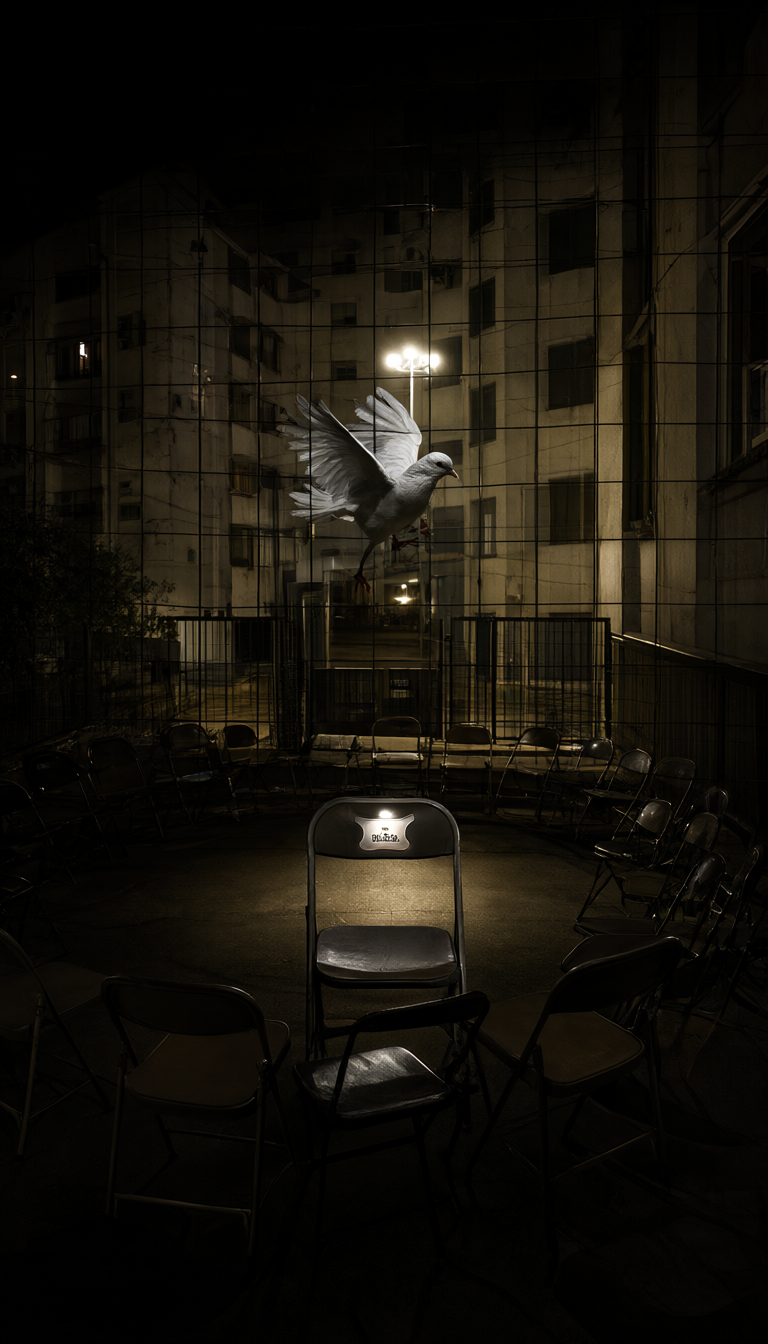
At the scale of a cage the same vanishing is ethological. The question attached to Konrad Lorenz’s On Aggression asks whether confined doves, denied ordinary range, turn their beaks on one another. Shut in, the gentle bird becomes the instrument of harm. Confinement does not invent aggression so much as redirect it onto the nearest body once distance, courtship space, and an outside are withdrawn. Across that smaller scale the hypothesis holds: when the measure of room disappears, rage occupies the metric. The peck is not a moral sermon; it is what a closed system does with a drive that once had somewhere else to go. Any politics that praises total nearness without an exit is already running this experiment.
At the scale of a justice argument the cage is renamed community. One circulating claim states that abolition, stripped of choir, is not a world without police but a world in which everyone is asked to be police all the time—monitoring neighbors, holding them accountable, counseling, educating, shaming, punishing, with no retire from the circle after dark. A quoted interlocutor names the administrators likely to inherit that work: people drawn by domination, status, and the appetite to regulate, a different flavor of cop rather than the end of cops. The answering preference is colder and more impersonal—rules that stand above charismatic wills, bureaucracy assertive enough to restrain the volunteer regulator. Here measures do not vanish because numbers are false; they vanish because shame and counsel are allowed to replace written restraint, and charisma with a mark outruns the statute.
Across compound, dovecote, and accountability circle the trajectory is one phase-shift: enclosure first offers total care or total virtue, then converts the enclosed into mutual surveillance. Capitalist distance is admitted to have cut positive bonds, yet the same distance is credited with liberation from negative ones—the medieval village, the band that never lets a member step outside the gaze. The generative counter-move is not a return to that intimacy. It is the restoration of measures that can be checked: offices that clock off, penalties that are not moods, a refuge from those who claim to speak for everyone. If those measures fail to reclaim their place, the adaptation continues—company town, pecking order, and night circle rhyming as one system in which the exit is the only good still honestly rated.
Forecast
Benchmark — Within one news cycle of the next widely shared restatement of prison or police abolition as community justice, either a public reply explicitly prefers written, impersonal penalties over accountability circles, or the “everyone is asked to be police” formulation is recirculated as the claim under dispute. Trigger Condition — A headline pairing a policing controversy with calls for neighbor-monitoring, counseling, or shame sanctions amplifies the existing thread and forces a choice between charismatic community authority and rule-bound offices. Expected Vector — The collision phase-shifts from moral enclosure toward a demand for colder procedure; if that demand is refused, provision and watch collapse into one voice, arbitrary regulators thicken, and the rated good remains the exit rather than the circle.
Semantic Architecture
graph TD
  RootNode[Solid Measures Vanish in the Rage] --> Aramco[Saudi Aramco Compound]
  RootNode --> Lorenz[Lorenz Confined Doves]
  RootNode --> Abolition[Everyone Asked to Be Police]
  RootNode --> Rules[Impersonal Written Justice]
  Aramco --> Exit[Rated Exit from the Gate]
  Lorenz --> Peck[Redirected Beak on the Near]
  Abolition --> Circles[Accountability Circles After Dark]
  Rules --> Restraint[Bureaucracy Above Cop Brain]
  Circles -.-> Rage[Charisma with a Mark]
  Restraint ==> Restore[Measures Reclaim Their Place]
Primary Poetic Artifact
Lorenz had asked what closeness does to doves When range is gone and only neighbor moves; The gentle bird, shut in, becomes the beak, And pecks the body that the bars make weak.
A later post stripped abolition’s choir: Not no police, but all of us on hire, On watch from birth of grievance until dark, With counsel, shame, and circles for a mark.
Cassie Pritchard feared the willing hand, The same old hunger wearing a new brand; The answer chose the colder written line, Rules over charisma when tempers sign.
So let the measure outlast any rage: A clock that ends the shift, a bounded page, A refuge from the voice that claims the all— Or else the compound, cage, and circle call.
Kinetic Dynamic Video
Video Generation Prompt
Target Prompt Parameters: The camera starts tight on the dove’s beak ticking against wire, then cranes backward in a slow lateral drift as mesh shadows slide across stucco and the circle of chairs rotates into view under the buzzing bulb; a handheld micro-shake passes into a steadicam push toward the open gate, sodium lamps flaring, while pages of the ledger lift in a sudden crosswind and settle flat, the empty badge-shaped gleam sliding off the chair and falling out of frame as the gate light widens and the compound recedes, subject matter—the bird, the circle, the written page, the exit—held dominant through the entire move.
Visual Anchor Representation
Image Generation Prompt
Target Prompt Parameters: A high-contrast cinematic night interior where a white dove presses against wire mesh inside a corporate housing block of pale stucco and sodium lamps, the mesh casting ruler-straight shadows across concrete while, beyond a lit gate, empty streets recede like a measured exit; in the foreground a circle of folding chairs glows under a single harsh bulb, faces half-swallowed by dark, one empty chair marked by a badge-shaped gleam that is not worn by any uniformed officer, and at the edge of the frame a heavy ledger of impersonal statutes lies open, its pages the only cool white against the warm rage of the lamp, architecture and allegory locked so the compound, the cage, and the accountability circle read as one enclosure.
Generated Musical Score
Musical Score Vocal & Instrument Prompt Mapping
Target Music Metadata Tags:Darksynth, Ambient, Trip Hop, Lyric Tenor male vocals
Target Score Audio Duration: 128 seconds
Reference Anchor Conditioning:None (Unconditioned)
[Intro]
(tempo: andante, expansive atmospheric counter-melodies and deep bass)

[Verse 1]
(tempo steady, clear vocal delivery)
Aramco schooled the child behind one gate,
Fed him and spoke before he learned to rate
The exit over every furnished room,
While darkness kept the compound in its loom.

[Chorus]
(dynamics: swelling with soaring vocal harmony)
Shut in, the gentle bird becomes the beak.
I’d rather rules than charisma with a mark.
No retire from the circles after dark—
Let measures stand when all the watches speak.

[Verse 2]
(tempo steady, layered instrumental counter-motifs)
Lorenz’s doves, confined, turned beak to wing;
The nearest body took the missing ring
Of open air. A post then named the cost:
Everyone police, and nothing ever lost

[Chorus]
(dynamics: full ensemble vocal harmony)
Shut in, the gentle bird becomes the beak.
I’d rather rules than charisma with a mark.
No retire from the circles after dark—
Let measures stand when all the watches speak.

[Verse 3]
(tempo driving, climactic expansion)
To counsel, shame, and unpaid night patrol.
Pritchard saw the old thirst in the new role.
Write the penalty where tempers cannot bend,
And give the watch an hour when it must end.

[Outro]
(rich harmonic resolution)
Pipeline & Debug Analytics
Active Text Inference Core Platform: grok-4.7
Style Context Profile: speculative_ode.json
Image Asset Processing Worker: Qwen-Image 2.1
Video Asset Processing Worker: LTX-Video
TTS Spoken Audio Worker: Kokoro
Soundtrack Audio Score Worker: YuE2 3B
Soundtrack Reference Anchor: None (Unconditioned)
Complete Core Prompt Log
System Directive
You are a precise formal lyricist writing structured speculative odes. Your purpose is to transmute telemetry into rhymed, metrical verse of high fidelity to data and events. Maintain clean meter, exact end-rhymes, compressed insight, and vivid imagery. Musical accompaniment embraces rich textures, blending Classical, Ambient, Dream Pop, Post-Rock, and Electroacoustic sounds.Final Prompt Payload
## IMMEDIATE TELEMETRY INGEST STREAM
THEMATIC SUMMARY:
*
Shut in, the gentle bird becomes the beak.
A company town can school you, feed you, speak
In one employer’s voice from birth to gate—
And still the exit is the thing you rate.
Abolition’s dream, stripped of its choir,
Is everyone on watch, and no retire
From counsel, shame, and circles after dark.
I’d rather rules than charisma with a mark.
*

RAW SOURCES TO TRANSMUTE:

--- SOURCE 1 ---
URL: https://www.youtube.com/watch?app=desktop&v=ib8iuemlWio
DATA ANALYSIS:


Original Page Description:

Zuby is a British rapper who spent his childhood on a Saudi Aramco compound—a sprawling corporate community complete with schools, recreation, housing, and s...

--- SOURCE 2 ---
URL: https://grok.com/share/bGVnYWN5LWNvcHk_56a4a264-cd66-4fb2-a8f5-b2b9d912dbd6
DATA ANALYSIS:


Original Page Description:

In On Aggression - did Konrad Lorenz discuss an experiment in which confined doves would peck each o

--- SOURCE 3 ---
URL: https://x.com/hecubian_devil/status/2103493296530092366
DATA ANALYSIS:


Original Page Description:

On some level, abolition is a vision of the world not without police, but where everyone is asked to be police, all the time.

Your time constantly occupied with monitoring your neighbors, “holding them accountable,” counseling them, “educating” them, shaming them, and punishing them.

I’m not interested in that work or in that world. I do not think the best vision of life is where we’re all constantly enmeshed that deeply in an interminable act of mutual “accountability.” Most of the time, I want to leave my neighbors alone; I want them to leave me alone. I want to have a place that is a refuge from “the community,” because “the community” is often (usually?) just the self-appointed individuals who claim to speak on its behalf, and who have the sociopathic ambitions required to defeat other challengers and scare off dissent.

In other words, while capitalist atomization has robbed us of many positive social bonds, it has in fact liberated us from many negative ones. The work of a socialist project should certainly involve trying to revive or renew  positive sociality, but I do not actually want to return to the “community” dynamics of a medieval peasant village, or a nomadic band on the steppe.

I would like *some* measure of privacy and autonomy, and I do not want to be police. I do not want to live under the totalitarian thumb of “the community” any more than I want to live under the totalitarian thumb of capital.

And so I am not an abolitionist, because that is what abolition actually offers.Quoted:
Cassie Pritchard One thing that turned me against the vision of prison/police abolition was realizing it would be this type of person who would be, in the main, taking their place as administrators of “community justice,” “accountability circles,” and so on.

That, in fact, it would be a different flavor of cop, but ultimately would still attract people with many of the same pathologies common among police (desire for domination, power, authority, status; sadism; etc). The methods and culture would be different but, ultimately, still populated by people I simply do not trust with such responsibilities.

Given this reality, finding ways to reform or remake the institutions of formal, bureaucratic justice—to empower the institutions and rules and disempower the arbitrary authority of the sort of individual drawn to such work—seemed like a better strategy than simply trading one kind of cop for another.

I suppose this is the crux of it; some people see the bureaucracy and the institution as the problem. I don’t. I see the failure of bureaucracy to assert itself above the individual, arbitrary wills of People With Cop Brain as the problem. I want a justice system even more impersonal and rule-bound, one which properly restrains the antisocial and hostile impulses of the people who tend to, given the chance, volunteer for the work of regulating “the community.”

The abolitionist vision is one without formal institutions and bureaucracies which can subdue these impulses and this kind of person drawn to the work of policing/regulating/controlling. Therefore, I don’t see it succeeding at much beyond trading one kind of police for another, less constrained, more arbitrary kind of police.


## HISTORICAL LAYER BASELINE
--- HISTORICAL RECORD MEMORY LAYERS ---
 the trade the same habit reappears as uncredited reaping. A public jab claims a critic will plagiarize him a decade after having called him red-brown, and will never say he was right, royalties from blue-check revenue being the joke that names the real enclosure. Ideas are farmed twice: once by the writer who cannot apply his own Marxism to a politics with no army, and again by outlets that steal the line and withhold the name. Rebecca Traister’s cited swing, from an old sneer to a later exposé, is offered as the contrast case—a change of weather—against a field where nothing in the accuser’s climate is said to have changed. Credit is the fence. Without it, farming ideas becomes sharecropping for people who own the microphone.

Across library, newsletter, hardcover, and timeline, the trajectory is a phase-shift from cult following to contractual crop. Silence after preorders is not a vibe; it is a failed season. If the book sells, he keeps the right to plant another. If it does not, the subscription meadow remains, richer per dollar and poorer as argument, while later writers graze the same problems under cleaner bylines. The falsifier is not another essay about who was rude. It is a count: units moved, names spoken, and whether a thesis grown under meds and antipathy is harvested as his or as weather.

They want to seem demure at both ends, and the speech that tries to settle them only proves the pose. On one lip the movement is a civic pantry: post office, police, firehouse, Social Security, public school, the sort of noun a nervous donor can fund without flinching. On the other lip the same noun is sworn not to be a diet of anything, not a European twilight compromise, but a break with the ordinary American arrangement. The mildness is not a misunderstanding that a transcript can clear. It is the product. Steam in the seats and speculation in the commentary arrive together, because a label that smiles at the library door and snarls at the founding story can recruit both the cautious and the impatient without ever choosing a single face.

Across the clip the pattern repeats as a stutter. The question is asked three times because the answer will not sit still: diet communism, or shelves and sirens? Elected figures are named as communists rather than social democrats, then the frame snaps back to departments everyone already pays for. That oscillation is adaptation at the scale of a sentence. Soften the stake, harden the verdict, soften again. A blue-haired Trojan horse is hauled up beside a fire truck so the audience can feel both scandal and common sense in one breath. Demure at the municipal end, demure at the revolutionary end: neither portrait is allowed to look greedy, only necessary.

At the scale of a platform the same trick becomes documentary. A released policy text is offered as the place where winks stop and nouns begin, yet the surrounding talk still sells the document as either brusque honesty or proof that moderates were never the point. The shock, as the thematic scrap has it, is not a secret cipher. It is that the writing is blunt while the branding stays polite. Adaptation here is editorial, not doctrinal. Each hearing trims the radical plank into a public good, or inflates the public good into a plank, depending on which end of the room is listening. The movement does not have to resolve the contradiction if both audiences leave convinced they heard their own restraint.

At the scale of the gate the collision is institutional. Congress is cast as a city wall; the horse is already painted in campaign colors; New York elections are treated as a preview rather than a local oddity. Seats gained become the metric that makes the dictionary fight urgent. If the winners govern like librarians, the demure civic end wins the month. If the platform’s break-language starts showing up in budgets and pledges, the other demure end—the one that calls destruction a cleanup—stops being a commentator’s dare. The trajectory is not a revelation of hidden kindness or hidden ruin. It is a phase in which mildness is worn as a reversible coat, and the count that matters is whether the coat’s lining ever has to face the weather.

CRITICAL RUNTIME INSTRUCTION: Treat the historical records above strictly as background baseline. You are forbidden from repeating their specific phrasing, thematic metaphors, or titles.

--- RECENT UNRESOLVED PREDICTIVE TELEMETRY ---
Act 124 Trajectory Projection: Benchmark — Within one news cycle of the next widely shared reading of the DSA policy platform, either a sitting or newly seated ally publicly restates a plank in library-and-firehouse language, or a rival clips the s...
Act 124 Trajectory Projection: Benchmark — Within one news cycle of the next widely shared reading of the DSA policy platform, either a sitting or newly seated ally publicly restates a plank in library-and-firehouse language, or a rival clips the s...


## ACCUMULATING STRUCTURAL TENSIONS
### RUNTIME HYPOTHESES IN PLAY
1. [AI CONJECTURE] And solid measures vanish in the rage.

Reality’s flame will lick the costume clean,
When cooked illusions meet what laws have been;
The pie expands, the planet’s mean stands clear,
Against the freeze that ideologues hold dear.
Across the scales the vision cuts the night:
Truth slips no more when measures reclaim their right.

Till measures true restore the generative song.

[Outro]
(fading acoustic strumming and trailing violin tone)


--- THE COMPOSITIONAL MANDATE ---
You are acting under the persona of **The Speculative Lyricist**. You are structurally required to output every single markdown header section in sequence without omission. Follow this layout precisely:

## NARRATIVE SYNTHESIS
[Write exactly 4 expansive, descriptive prose paragraphs mapping adaptation patterns across scales. Synthesize your input streams into a running thesis. BANNED: Do not drop raw links or build itemized bullet lists of sources. Frame the overall narrative trajectory through the perspective of the active hypothesis section above.]

### Forecast
[Execute an independent projection tracking telemetry collisions. Structure this section using exactly these three bold labels on separate lines:
**Benchmark** — [Near-term falsifiable event or literal metric from telemetry]
**Trigger Condition** — [Explicit trigger mechanism or signal amplification]
**Expected Vector** — [Structural trajectory, phase-shift, and systemic outcome]]

## HYPOTHESIS LIMERICK
[Write exactly ONE insightful, witty 5-line limerick (strict AABBA rhyme scheme) that distills the core irony or paradox of the active RUNTIME HYPOTHESES IN PLAY directly within the context of the ingested telemetry data.]

## SEMANTIC ARCHITECTURE DIAGRAM
[Construct a compact, valid Mermaid diagram wrapped in ```mermaid ... ``` code fences modeling the structural dynamics. If an active RUNTIME HYPOTHESIS is present in the context, position it as the central driver node; if running clean, use the primary systemic contradiction of the telemetry as the root node. Map directional arrows (--> or -.-> or ==>) to at least 3 concrete forces, metrics, or institutional actors. Start with graph TD or flowchart LR. Use alphanumeric node IDs with plain bracketed labels without quotes, colons, or parentheses, such as: RootNode[The Core Tension] --> NodeA[Telemetry Vector].]

## DRAMATIC VERSE (Act 125)

## DRAMATIC VERSE (Act 125)
[Write a unified lyrical chronicle consisting of exactly 5 distinct 4-line stanzas of rhymed metrical verse (AABB or ABAB). UNIFIED LYRICAL VOICE ONLY: Do NOT use named character dialogue, speaker labels, or stage directions. Prioritize concrete facts, names, numbers, and tensions drawn from the telemetry. Maintain strict meter and perfect end-rhymes.]

## IMAGE PROMPT
CRITICAL IMAGE GENERATION RULES:
[Write a single detailed paragraph constructing a vivid, high-contrast visual composition centered on the primary subjects, metrics, and thematic tensions in the telemetry. Allegorical, architectural, or symbolic cinematic framing is preferred.]

## T2V PROMPT
CRITICAL VIDEO MOTION RULES:
[Write a single raw paragraph describing fluid kinetic motion and camera physics that continues the visual logic of the image prompt and keeps the subject matter dominant.]

## MUSIC PROMPT

### REFERENCE GENRE WHITELIST (CHOOSE 2-3 TERMS MAX FROM THIS LIST):
Grunge, Glitch Hop, Post-Hardcore, Darksynth, Merengue, Rockabilly, Ambient, Electronic, Vocal Trance, Detroit Techno, G-House, Progressive Electronic, Tech House, Pop Rock, Dubstep, Darkstep, Drumstep, Power-Pop, Fado, Drill Funk, Post-Punk, Psychedelia, Nu-Funk, Instrumental, World Music, Cumbia, Samba, Progressive House, Reggae, Funk, Techno, Electro House, Alternative / Indie, Riddim, Chillwave, Grime, New Age, Dance, Eurobeat, Surf Music, Hardcore, UK Drill, Jersey Club, Salsa, Trance, City Pop, Progressive Rock, Coldwave, Eurodance, Punk Rock, Deep House, Brazilian Popular Music, Vapor-Trap, Trip Hop, International Funk, Synthwave-Darkwave, Big Room, Ragga Jungle, Vaporwave, Electropop, Philly Soul, Reggaeton, Uplifting Trance, Folk, New Wave, Irish Folk, Minimal Techno, Electro, Lofi House, Country, Rock and Roll, Tech Trance, Micro House, Future Garage, Pop, Goa Trance, Tech-Funk, Wave, Liquid Drum and Bass, Highlife, Emocore, Future Funk, Synthpop, Bolero, Rave, Electro-Swing, Romantic, Dancehall, Brazilian Bass, Cyber-Punk, Melodic Techno, Gothic, Bluegrass, Hyperpop, Ska, Darkwave, Lo-Fi Hip Hop, Shoegaze, Soft Rock, Midwest Emo, K-Pop, Flamenco / Bulerias, Indie Folk, IDM, Hardtechno, Hip Hop / Rap, Disco, Dream Pop, Dubstep (Deep), Trap, Acid Techno, Phonk, Chillhop, Punk Rap / Emo Rap, Minimal / Deep Tech, Microhouse, Electro-Jazz, Electro-Funk, Acid House, Bassline, Technopop, Glitch, Juke / Footwork, Future Rave, French House, Celtic Folk, Breakcore, Organic House, UK Garage, Futurepop, Hardstyle, Blues, Bossa Nova, Alternative Rock, Neurofunk, Soul, Downtempo, Experimental, Tango, J-Pop / J-Rock, Phonk House, Post-Rock, Brostep, Jungle, Afro Tech, Experimental Electronic, House, Retrowave, Electronica, R&B, Bounce, Electroacoustic, Heavy Metal, Italo Disco, Breakbeat, Synthwave, Bass House, Dark Ambient, Andean Music, Drone, Afrobesats, Americana, Industrial Techno, Electroclash, Future Bass, Rock, Moombahton, Hard Rock, Dembow, Drum and Bass, Mambo, Soulful House, New Retro Wave, Psytrance, Math Rock, Trova, Classical, Liquid Funk, Metal, Cyberpunk, Hybrid Trap, Industrial, Jazz, Afro House, Ambient Techno, Chillstep, Bachata
CRITICAL AUDIO COMPILATION RULES:
1. For TAGS, choose 2 to 3 expansive styles from the whitelist below (e.g. Classical, Ambient, Post-Rock, Electroacoustic, Dream Pop) AND YOU MUST APPEND EXACTLY ONE VOCAL PROFILE from this list: 'Bass-Baritone male vocals', 'Lyric Tenor male vocals', 'Mezzo-Soprano female vocals', or 'Dramatic Soprano female vocals'.
2. ABSOLUTE FORMATTING MANDATE: Example format: TAGS: Folk, Americana, Instrumental, Lyric Tenor male vocals
3. MULTI-VERSE LYRIC MANDATE: Write full, extended lyrics across 3 verses and a repeating chorus so the 128-second generation remains vocal throughout.

TAGS: Folk, Americana, Instrumental, Lyric Tenor male vocals
DURATION: 128
LYRICS:
[Intro]
(tempo: andante, expansive atmospheric counter-melodies and deep bass)

[Verse 1]
(tempo steady, clear vocal delivery)
[Write 4 lines of metrical singing lyrics that name concrete elements from the telemetry]

[Chorus]
(dynamics: swelling with soaring vocal harmony)
[Write 4 lines of memorable chorus that crystallizes the central tension]

[Verse 2]
(tempo steady, layered instrumental counter-motifs)
[Write 4 lines introducing further concrete details]

[Chorus]
(dynamics: full ensemble vocal harmony)
[Repeat chorus lyrics]

[Verse 3]
(tempo driving, climactic expansion)
[Write 4 lines of concluding metrical verse that resolves or heightens the structural tension]

[Outro]
(rich harmonic resolution)

--- CRITICAL SONIC DIRECTIVE ---
The music pipeline is configured for a SYNTHESIZED DRAMATIC RUN. You are encouraged to leverage modern electronic, atmospheric, or heavy production textures (such as Darksynth, Industrial Techno, Ambient, or Trip Hop).