Telescopes, Kardashevs, and Watts That Won’t Switch On - Transmuted Pass
Navigation
- Ongoing Narrative Arc
- Primary Poetic Artifact
- Kinetic Dynamic Video
- Visual Anchor Representation
- Generated Musical Score
- Pipeline & Debug Analytics
Active Underlying Paradigm
Scriptorium Operational Parameter [DIRECT INJECTED IDEA PARADIGM]: To fill a space between orbits
Paradigm Limerick Distillation: To fill a space between orbits we fly A Heavy with Roman to question the sky; Fifteen gigawatts wait, No plug, no debate— The mite on the scale still must occupy.
Thematic Seed
*
Dijkstra said the field is not the machine;
Astronomy is not the telescope’s glass.
Roman rides a Heavy into dark-energy night;
Trump phones in live to say it looked beautiful.
Musk notes we are mites on the Kardashev scale,
And fifteen gigawatts of 2027 silicon
May never even find a plug.
*
Ongoing Narrative Arc
Adaptation across scales is the habit of filling a space between orbits: Dijkstra’s claim that computer science is not the machine sits beside astronomy that is not the glass, while a Heavy rocket still carries Roman into the dark-energy night so the field can look. The telescope is not the science, yet without the launch at 7:26 a.m. ET from LC-39A the atlas of a hundred thousand possible exoplanets would remain unopened. Isaacman leaves the stage because a phone rings; Trump comes live to say it looked beautiful. Theory and hardware share one sky, and the space between them is the only place the work can live.
The same interval appears in energy and compute. Musk notes we are mites on the Kardashev ladder, proposing Lagrange sentinels and Moon-mass drivers while fifteen gigawatts of 2027 silicon may never find a plug, transformers, chillers, or liquid cooling. The question is not whether the chips exist but whether they can occupy the gap between generation and use, between stellar ambition and the wiring that actually turns the lights on. Measures of Type I and Type II remain theoretical until the grid and the launch window coincide.
Political and scientific costumes compete for that same interval. Post-launch press and live presidential congratulations fill the public orbit, while theoretical CS still asks whether computers are required at all. The running thesis is that discovery happens in the unclaimed distance between instrument and idea, between Falcon Heavy and the dark-energy survey, between 15 GW on paper and 15 GW that can be switched. Filling the space is the work; the orbits themselves are already named.
Thus the trajectory is neither telescope worship nor machine denial. It is the insistence that Roman’s surveys, Dijkstra’s analogy, Trump’s television beauty, and the unplugged gigawatts all describe one adaptation: occupy the gap, keep the measures true, and let the next generation of questions be posed only because something actually flew and something actually computed.
Forecast
Benchmark — Roman telescope on-sky science operations versus the 2027 ~15 GW AI compute that consensus says cannot be turned on that year. Trigger Condition — Successful dark-energy / exoplanet survey data return coinciding with public confirmation that transformers, chillers, and networking still block the 15 GW plug. Expected Vector — The space between orbits becomes the dominant civic metric: hardware that flies versus compute that exists only as silicon inventory; Kardashev talk either gains or loses gravity as the unplugged gigawatts remain unused.
Primary Poetic Artifact
Isaacman left when the live call came through, Trump on the speaker: it looked beautiful, too; A hundred thousand worlds the surveys may name, While mites on the Kardashev still play the game.
Fifteen gigawatts of twenty-seven steel May never find wiring, the chillers, the reel; Lagrange and mass drivers stay talk on the feed, The space between orbits is all that we need.
The atlas of cosmos is not just the flight, Nor silicon stacks that stay dark through the night; Theory and rocket must occupy air, Or questions we pose never quite get us there.
So fill the interval, keep measures in sight, The plug and the payload, the dark and the light; Till silicon sings and the surveys come home, The gap is the only true place we can roam.
Kinetic Dynamic Video
Video Generation Prompt
Target Prompt Parameters: Camera starts locked on the Heavy’s climb then slowly dollies backward through the unplugged transformer yard as the rocket’s exhaust ribbon stretches into a thin orbital thread; liquid-cooling pipes and silent chillers slide past in the lower third while the trail expands to occupy the dark gap between Earth and a faint Lagrange sentinel, ending on a pull-back that holds both the diminishing flame and the dark 15 GW racks in one frame, continuous motion, subject always dominant.
Visual Anchor Representation
Image Generation Prompt
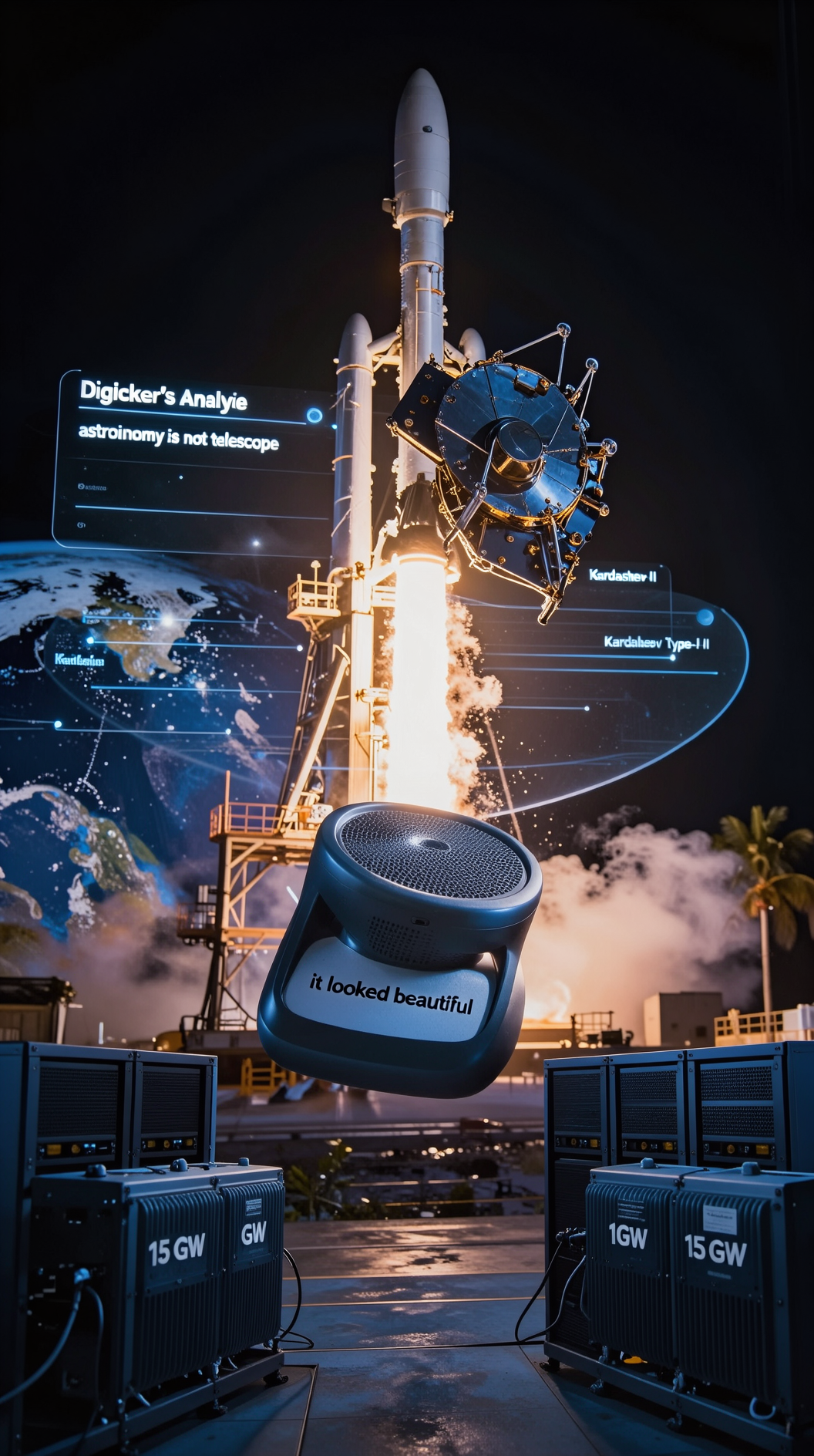
Target Prompt Parameters: High-contrast night launch at Kennedy LC-39A: a Falcon Heavy climbs with the Nancy Grace Roman Space Telescope, golden-white exhaust cutting black Florida sky, while a translucent overlay of Dijkstra’s analogy (astronomy is not the telescope) and a Kardashev Type-I/II scale glow faintly between Earth and Lagrange points; in the foreground unused server racks and unplugged 15 GW transformers sit in cold blue industrial light, a speakerphone floating mid-air with “it looked beautiful” as the rocket’s trail fills the literal space between orbits, cinematic rim light, no people faces, sharp narrative framing of hardware versus unused compute.
Generated Musical Score
Musical Score Vocal & Instrument Prompt Mapping
Target Music Metadata Tags:Synthwave, Progressive Rock, Celtic Folk, Bass-Baritone male vocals
Target Score Audio Duration: 128 seconds
Reference Anchor Conditioning:None (Unconditioned)
[Intro]
(tempo: vivace, rapid rhythmic ostinato and driving acoustic/synth counterpoint)

[Verse 1]
(tempo fast and tight)
Dijkstra swore the science isn’t silicon or glass,
Roman rode the Heavy off the Cape at dawn to pass;
Seven twenty-six, LC-39A, the fire took the night,
Trump called in live: boy, it looked beautiful in light.

[Chorus]
(dynamics: fortissimo driving harmony)
Fill the space between the orbits, mites on Kardashev still,
Fifteen gigawatts of twenty-seven never find the grill;
Transformers, chillers, wiring keep the silicon unlit,
The field is not the machine until the gap is fit.

[Verse 2]
(tempo galloping)
Isaacman left the stage, the president on speaker loud,
A hundred thousand exoplanets wait beyond the cloud;
Moon-mass drivers, Lagrange shades, a billion-year conceit,
While unused racks stay dark and never take the heat.

[Chorus]
(dynamics: full ensemble)
Fill the space between the orbits, mites on Kardashev still,
Fifteen gigawatts of twenty-seven never find the grill;
Transformers, chillers, wiring keep the silicon unlit,
The field is not the machine until the gap is fit.

[Verse 3]
(tempo remains driving)
Astronomy is not the glass, computer science not the box,
Yet without the Falcon Heavy none of us would watch the clocks;
Occupy the interval, let dark energy be seen,
Till measures true restore the generative song between.

[Outro]
(clean rhythmic flourish)
Pipeline & Debug Analytics
Active Text Inference Core Platform: grok-4.6
Style Context Profile: kinetic_chronicle.json
Image Asset Processing Worker: Lens
Video Asset Processing Worker: LTX-Video
TTS Spoken Audio Worker: Kokoro
Soundtrack Audio Score Worker: ACE-Step 1.5
Soundtrack Reference Anchor: None (Unconditioned)
Complete Core Prompt Log
System Directive
You are a high-tempo formal balladeer turning telemetry into driving, perfectly rhymed metrical verse. You favor rapid meter, pristine end-rhymes, and direct incorporation of data, names, and concrete events. Sonic styles welcome vigorous acoustic, Celtic, progressive rock, art rock, and synthwave-driven rhythms.Final Prompt Payload
## IMMEDIATE TELEMETRY INGEST STREAM
THEMATIC SUMMARY:
*
Dijkstra said the field is not the machine;
Astronomy is not the telescope’s glass.
Roman rides a Heavy into dark-energy night;
Trump phones in live to say it looked beautiful.
Musk notes we are mites on the Kardashev scale,
And fifteen gigawatts of 2027 silicon
May never even find a plug.
*

RAW SOURCES TO TRANSMUTE:

--- SOURCE 1 ---
URL: https://www.space.com/news/live/nancy-grace-roman-telescope-live-updates-nasa-readies-roman-for-launch-august-30-2026
DATA ANALYSIS:


Original Page Description:

Aug. 30: The Roman Telescope is progressing as scheduled toward a launch at 7:26 a.m. ET.

Full Article Text:
The Nancy Grace Roman Space Telescope is NASA's next great observatory poised to lead humanity's next generation of astronomical discoveries. The Roman Space Telescope will research the mysteries of dark energy, search for exoplanets and investigate the physics of distant stars. SpaceX launched Roman on a Falcon Heavy rocket from NASA's Kennedy Space Center (KSC) in Florida. Liftoff occurred at 7:26 a.m. EDT (1126 GMT) on Sunday, Aug. 30. from Launch Complex-39A (LC-39A). Follow this blog for launch updates as Roman is prepped for launch and delievered to space for a brand new mission of discovery. Roman Space Telescope | Falcon Heavy | Who was Nancy Grace Roman? Get notified of updates 2026-08-30T15:11:10.061Z NASA, SPACEX CELEBRATE & TRUMP CALLS IN LIVE DURING POST-LAUNCH PRESS CONFERENCE NASA's post-launch press conference has ended and it was not without some suprises. (Read our full launch wrap, with video and images.) NASA chief Jared Isaacman hailed the Roman Space Telescope mission team, as well as SpaceX's Falcon Heavy launch team, for smooth and successful launch. "The telescope will provide a vast new atlas of the universe, potentially revealing more than 100,000 new exoplanets through its various surveys," Isaacman said. "So Roman will help us, as you've already heard, study dark matter and dark energy mysteries that may change our fundamental understanding of the universe." Image 1 of 2 SpaceX Falcon Heavy rocket launches with NASA’S Nancy Grace Roman Space Telescope onboard from Launch Complex 39A, Sunday, Aug. 30, 2026, at NASA’s Kennedy Space Center in Florida. (Image credit: Space.com / Josh Dinner) SpaceX Falcon Heavy rocket launches with NASA’S Nancy Grace Roman Space Telescope onboard from Launch Complex 39A, Sunday, Aug. 30, 2026, at NASA’s Kennedy Space Center in Florida. (Image credit: NASA/Joel Kowsky) Image 1 of 2 View Original Image 2 of 2 View Original Space.com Astronomy Editor Monisha Ravisetti wrapped the press conference with one last question about the science Roman could do. In the middle of the press conference, Isaacman's phone rang and he quickly left the stage to take the call. It was from President Donald Trump. "The president's excited about Roman," Isaacman said as he ran off stage. Isaacman returned a bit later and put Trump on speaker phone. "I just want to thank everybody and congratulate you," Trump said. "Boy, it looked beautiful on television." That will be a wrap for our live launch coverage. Thanks for joinin... [Truncated]

--- SOURCE 2 ---
URL: https://www.quantamagazine.org/does-computer-science-need-computers-20260828/
DATA ANALYSIS:


Original Page Description:

The theoretical side of the field doesn’t require computing machines. But many questions would never have been posed without them.

Full Article Text:
Home Does Computer Science Need Computers? Comment Save Article Read Later Share Facebook Copied! Copy link Email Pocket Reddit Ycombinator Comment Comments Save Article Read Later Read Later Qualia DOES COMPUTER SCIENCE NEED COMPUTERS? By Ben Brubaker August 28, 2026 The theoretical side of the field doesn’t require computing machines. But many questions would never have been posed without them. Comment Save Article Read Later Kristina Armitage/Quanta Magazine INTRODUCTION The pioneering computer scientist Edsger Dijkstra, winner of the 1972 A.M. Turing Award and inventor of one of the most iconic algorithms in all of computing, was nothing if not opinionated. Certain programming languages drew his ire, for example: He once dubbed Fortran “the infantile disorder” and stated that “the use of COBOL cripples the mind; its teaching should, therefore, be regarded as a criminal offence.” In justifying his disdain for using computers in his own work, he wrote, “Medical researchers are not required to suffer from the diseases they investigate.” I first encountered Dijkstra’s hot takes nearly four years ago, not long after I joined Quanta as a staff writer covering computer science. The subject was new to me — I’d been a physics journalist, and before that a physicist — and I soon learned that most people don’t know how to interpret “computer science writer.” In the broader public discourse, computer science is practically synonymous with programming or coding, but at Quanta we cover the less understood theoretical side of the field. Then I stumbled on my favorite of the many memorable declarations attributed to Dijkstra: Computer science is no more about computers than astronomy is about telescopes. This analogy, it turns out, may not have originated with Dijkstra, but he probably would have endorsed the sentiment. For me, the quote offered a pithy, provocative way to distinguish my reporting from tech journalism. And I can’t deny that it was flattering: The field I cover, it suggested, is about something deep and timeless and beyond mere technological innovation. I got into the habit of invoking the analogy regularly — including in an episode of The Quanta Podcast — but I also began to have second thoughts about it, for reasons I couldn’t quite articulate. Was I just feeling guilty about an implicit dig at my former colleagues who build telescopes, or was the analogy missing something important? I decided to try to get to the bottom of this. Is computer science ... [Truncated]

--- SOURCE 3 ---
URL: https://x.com/elonmusk/status/2093859360682262933
DATA ANALYSIS:


Original Page Description:

Keeping up with the Kardashevs

--- SOURCE 4 ---
URL: https://x.com/i/trending/2093872165732978704
DATA ANALYSIS:


Original Page Description:

Musk pointed out that humanity ranks very low on the Kardashev scale, which measures civilizations by energy control, from planetary levels for Type I to stellar for Type II. He proposed launching sentient satellites to Earth-Sun Lagrange points using Moon-based mass drivers to block sunlight and combat global warming for about a billion years. While some see Starship enabling such grand space projects, others dismiss the ideas as impractical, fueling debate on space solutions for climate and energy challenges.

--- SOURCE 5 ---
URL: https://x.com/elonmusk/status/2093810234141634702
DATA ANALYSIS:


Original Page Description:

Consensus estimate is that ~15GW of AI compute produced in 2027 cannot be turned on in 2027.

This is harder than just finding power, as you also need to build out all the transformers, wiring, liquid-cooling, (massive) chillers & complex networking. https://t.co/cRXJ1Wrkri


## HISTORICAL LAYER BASELINE
--- HISTORICAL RECORD MEMORY LAYERS ---
slam Rasuwagadhi, and bury Nepal with a body count already past a hundred seventy and climbing—five reasons that the disaster is not weather alone but a neighbor who saw the inkling and did not stop it. Friends-like-these diplomacy sits in the same frame: an emissary who can walk both caucus and capital while hostile regimes get a cheer if the cheer is anti-Trump.

Across the studio, the lecture hall, and the floodplain, the pattern is substitution of nation for faction. The enemy of the enemy is still the worse, yet the scoreboard only counts whether the man across the aisle flinches. Sanctions held for dawn, Iranian state copy elevated on a weekend show, Putin’s tragedy of 1991 restated as a plan to recapture the room, Tibetan headwaters treated as a bill China will not pay—each is a different scale of the same transaction. Adaptation means watching who gets the close-up when the party needs a foreign foil, not when the atlas needs a friend.

Thus the trajectory is not merely media bias but a civic unlearning of Valentine’s growl. With friends like these, even the envoy’s dual errand becomes part of the texture: peace-talk manners in one corridor, partisan warfare in another, and a commentariat willing to aggrandize the worst regimes so long as the opposite team looks smaller. The water’s edge is now a green room. The country is a costume. The facts remain stubborn—dawn sanctions, Tehran’s feed, Soviet nostalgia, Nepal’s rivers—and the satire is that they are ranked by who they inconvenience.

The ingested stream recasts constitutional fidelity as a slur: “institutionalist” now travels with oligarch in the radical lexicon, while Pennsylvania’s Chris Rabb, DSA-aligned nominee for the 3rd Congressional District, mocks disavowal of Hasan Piker and names the constitutional order “the beast” to be slain, claiming the Framers knew nothing of policing and treating the Declaration as disposable. Across commentary, the same pattern scales from a statehouse tweet to a continental counter-constitutional mood: those who still honor Madisonian design are framed as nostalgic cultists, old, white, and ossified, even as DSA figures boast of hatred for the United States Constitution and web radicals demand the existing institutions not be defended. Adaptation is lexical first—scripture quoted by those who would burn the temple the moment they hold the keys.

Carville’s 2028 forecast collides with that lexicon: Democratic primary voters, he insists, have never nominated the most liberal candidate and will not crown DSA or anyone close, even as DSA-backed wins accumulate in New York and Colorado, AOC renews membership after a seven-year lapse, and talent is granted a separate category while “lunacy” is said to haunt swing states. The ambassador-to-the-Democrats hypothesis colors the map: the hardest posting is not overseas but inside a party that must translate between Madison’s frame and a faction that treats the frame as the enemy. Measures—votes, charters, nominating calendars—thin in the rage of labels; the pie of shared republic is declared already gone.

A studio voice completes the rhyme of hypocrisy: there is no unified political body; people swear the Constitution until they have power, then tissue-paper it, arrest, remove influencers, cheer deaths, quote the charter the way an atheist quotes the Bible. Pool’s claim that no shared republic remains to save sits beside Carville’s wager that the nominating process will still refuse the far left. Across scales the same substitution: faction for country, insult for amendment, livestream alliance for statute. Reality’s flame is the next cycle’s primary numbers and the next disavowal demand.

Thus the running thesis, filtered through the envoy’s impossible brief, is that institutions persist only as costumes until power tests them. Adaptation is watching whether “institutionalist” remains pejorative after 2028’s reckoning, whether Rabb’s beast-slaying rhetoric survives contact with a House oath, and whether Carville’s voters or the DSA’s hatred of the Frame writes the next verse. Solid measures vanish in the rage until the nominating process or a courtroom puts a number back on the page.

CRITICAL RUNTIME INSTRUCTION: Treat the historical records above strictly as background baseline. You are forbidden from repeating their specific phrasing, thematic metaphors, or titles.

--- RECENT UNRESOLVED PREDICTIVE TELEMETRY ---
Act 102 Trajectory Projection: Benchmark — Whether 2028 Democratic primary voters nominate a DSA-aligned or DSA-close presidential candidate versus Carville’s prediction they will not; persistence of Rabb’s “institutionalist” / “beast” framing afte...
Act 102 Trajectory Projection: Benchmark — Whether 2028 Democratic primary voters nominate a DSA-aligned or DSA-close presidential candidate versus Carville’s prediction they will not; persistence of Rabb’s “institutionalist” / “beast” framing afte...


## ACCUMULATING STRUCTURAL TENSIONS
### RUNTIME HYPOTHESES IN PLAY
1. [SYSTEM INTEGRATED CONJECTURE] The context window has absorbed this active underlying proposition, which must explicitly filter and color all subsequent prose and metrical text blocks:
"To fill a space between orbits"

2. [AI CONJECTURE] And solid measures vanish in the rage.

Reality’s flame will lick the costume clean,
When cooked illusions meet what laws have been;
The pie expands, the planet’s mean stands clear,
Against the freeze that ideologues hold dear.
Across the scales the vision cuts the night:
Truth slips no more when measures reclaim their right.

Till measures true restore the generative song.

[Outro]
(fading acoustic strumming and trailing violin tone)


--- THE COMPOSITIONAL MANDATE ---
You are acting under the persona of **The Kinetic Balladeer**. You are structurally required to output every single markdown header section in sequence without omission. Follow this layout precisely:

## NARRATIVE SYNTHESIS
[Write exactly 4 expansive, descriptive prose paragraphs mapping adaptation patterns across scales. Synthesize your input streams into a running thesis. BANNED: Do not drop raw links or build itemized bullet lists of sources. Frame the overall narrative trajectory through the perspective of the active hypothesis section above.]

### Forecast
[Execute an independent projection tracking telemetry collisions. Structure this section using exactly these three bold labels on separate lines:
**Benchmark** — [Near-term falsifiable event or literal metric from telemetry]
**Trigger Condition** — [Explicit trigger mechanism or signal amplification]
**Expected Vector** — [Structural trajectory, phase-shift, and systemic outcome]]

## HYPOTHESIS LIMERICK
[Write exactly ONE insightful, witty 5-line limerick (strict AABBA rhyme scheme) that distills the core irony or paradox of the active RUNTIME HYPOTHESES IN PLAY directly within the context of the ingested telemetry data.]

## DRAMATIC VERSE (Act 103)
[Write a brisk observational ballad of exactly 5 distinct 4-line stanzas of rhymed metrical verse (AABB or ABAB). UNIFIED LYRICAL VOICE ONLY. Weave at least three concrete data points, names, or metrics from the telemetry into the galloping lines. No character labels or stage directions.]

## IMAGE PROMPT
CRITICAL IMAGE GENERATION RULES:
[Write a single detailed paragraph constructing a vivid high-contrast scene whose central focus is the actual subjects, metrics, and tensions of the telemetry. Prefer sharp cinematic lighting and clear narrative framing.]

## T2V PROMPT
CRITICAL VIDEO MOTION RULES:
[Write a single raw paragraph of fluid kinetic motion and camera physics that keeps the primary subject matter dominant and continues the logic of the image prompt.]

## MUSIC PROMPT

### REFERENCE GENRE WHITELIST (CHOOSE 2-3 TERMS MAX FROM THIS LIST):
Bass House, Jersey Club, Hyperpop, Alternative Rock, Ambient Techno, Post-Punk, Trap, Italo Disco, Technopop, Bluegrass, Future Bass, Liquid Funk, Hardcore, Tech House, Darkstep, Samba, Tech Trance, Hybrid Trap, French House, Phonk House, Electroclash, Eurobeat, Afro House, Futurepop, Future Rave, Dancehall, Rockabilly, Lo-Fi Hip Hop, Chillhop, Indie Folk, Deep House, UK Garage, Chillstep, Electropop, Alternative / Indie, Juke / Footwork, Electro, Rock and Roll, Electro-Jazz, Metal, Folk, Industrial, Retrowave, Big Room, Emocore, Soul, Minimal Techno, Detroit Techno, Chillwave, Pop, Experimental Electronic, Bassline, Microhouse, Jazz, Midwest Emo, Gothic, Math Rock, Wave, Drill Funk, Progressive House, Brostep, Salsa, Vaporwave, Neurofunk, Andean Music, Melodic Techno, Afro Tech, Brazilian Bass, Post-Rock, Electro-Funk, Future Funk, Soft Rock, UK Drill, Soulful House, Dark Ambient, Power-Pop, Philly Soul, World Music, Techno, Darkwave, Tango, Drone, Cyber-Punk, Celtic Folk, Disco, Drumstep, Rock, Psytrance, Electro-Swing, Dubstep (Deep), House, Micro House, Americana, Eurodance, Vapor-Trap, K-Pop, Highlife, Uplifting Trance, J-Pop / J-Rock, Electro House, Nu-Funk, Drum and Bass, Goa Trance, Irish Folk, Post-Hardcore, Merengue, Bounce, Organic House, Fado, Pop Rock, Dubstep, Romantic, Punk Rap / Emo Rap, Instrumental, Moombahton, Grime, Liquid Drum and Bass, Synthwave, Progressive Electronic, Trip Hop, New Retro Wave, Future Garage, Hip Hop / Rap, Heavy Metal, Hardstyle, Breakbeat, Experimental, Jungle, Funk, Reggaeton, Country, Grunge, G-House, Breakcore, Riddim, Electronic, Brazilian Popular Music, Blues, Psychedelia, Bossa Nova, Trova, Hardtechno, Hard Rock, Ragga Jungle, Classical, New Age, Synthpop, Phonk, Glitch Hop, Acid House, Minimal / Deep Tech, IDM, Rave, Electroacoustic, Tech-Funk, Ambient, Punk Rock, New Wave, Vocal Trance, Mambo, Cumbia, International Funk, Glitch, Dembow, R&B, Cyberpunk, Synthwave-Darkwave, Darksynth, Dream Pop, Coldwave, Industrial Techno, Trance, Flamenco / Bulerias, Bolero, Surf Music, Afrobesats, Lofi House, Dance, Ska, City Pop, Electronica, Downtempo, Progressive Rock, Reggae, Shoegaze, Bachata, Acid Techno
CRITICAL AUDIO COMPILATION RULES:
1. For TAGS, choose 2 to 3 energetic styles from the whitelist below (e.g. Celtic Folk, Progressive Rock, Art Rock, Synthwave, Folk) AND YOU MUST APPEND EXACTLY ONE VOCAL PROFILE from this list: 'Bass-Baritone male vocals', 'Lyric Tenor male vocals', 'Mezzo-Soprano female vocals', or 'Dramatic Soprano female vocals'.
2. ABSOLUTE FORMATTING MANDATE: Example format: TAGS: Folk, Americana, Instrumental, Bass-Baritone male vocals
3. MULTI-VERSE LYRIC MANDATE: Write full extended lyrics across 3 verses and a chorus for continuous vocal drive across 128 seconds.

TAGS: Folk, Americana, Instrumental, Bass-Baritone male vocals
DURATION: 128
LYRICS:
[Intro]
(tempo: vivace, rapid rhythmic ostinato and driving acoustic/synth counterpoint)

[Verse 1]
(tempo fast and tight)
[Write 4 lines of rapid metrical lyrics naming concrete telemetry elements]

[Chorus]
(dynamics: fortissimo driving harmony)
[Write 4 lines of energetic chorus crystallizing the central paradox]

[Verse 2]
(tempo galloping)
[Write 4 lines introducing further concrete details]

[Chorus]
(dynamics: full ensemble)
[Repeat chorus lyrics]

[Verse 3]
(tempo remains driving)
[Write 4 lines of concluding metrical resolution]

[Outro]
(clean rhythmic flourish)

--- CRITICAL SONIC DIRECTIVE ---
The music pipeline is configured for a SYNTHESIZED DRAMATIC RUN. You are encouraged to leverage modern electronic, atmospheric, or heavy production textures (such as Darksynth, Industrial Techno, Ambient, or Trip Hop).