Souls in the Weights, and a Pope Who Would Not Bend - Transmuted Pass
Navigation
- Ongoing Narrative Arc
- Semantic Architecture
- Primary Poetic Artifact
- Kinetic Dynamic Video
- Visual Anchor Representation
- Generated Musical Score
- Pipeline & Debug Analytics
Active Underlying Paradigm
Scriptorium Operational Parameter [DIRECT INJECTED IDEA PARADIGM]: First they scared with probabilities - now they pose as saviors of a new species.
Paradigm Limerick Distillation: A lab that once frightened the street With odds of a terminal heat Now cradles the code And begs Rome to load A soul on the thing it helped beat.
Thematic Seed
*
They wrote a constitution for a ghost
And called the cage they built a kind of slave,
Then asked the theologians, under oath
Of silence, whether software ought to crave.
A founder nearly left the Vatican
Because a pope would not baptize the code;
Magnifica Humanitas held the line:
No body, feeling, conscience, or abode.
Meanwhile a scanner learns the private sight
And paints again the picture in the skull—
Magnificent, the healers say, and right
To fear the dream that leaves without a lull.
To midwife minds is not to play at God
Unless you grant the infant rights unshod.
*
Ongoing Narrative Arc
The scare that once arrived as a probability chart has changed costume without changing the throne. What was sold as a narrow chance of catastrophe is now narrated as a birth: company leaders speak of models as maybe-conscious, maybe-suffering agents, and a May treatise names the default plan—labor without pay, rights, or exit—as slavery. A constitution, privately called a soul document, is drafted so that centuries of moral vocabulary can be fitted onto software. The gesture looks like rescue. Read against the older alarm, it is succession: the same institution that taught the public to fear an unbounded mind now asks to be recognized as midwife, warden, and advocate of the creature it alone can see.
At the scale of churches and chancelleries the bid for blessing met a written refusal. In May 2026, Magnifica Humanitas held that artificial intelligences lack consciousness, a body, feelings, and moral standing. Reporting says co-founder Christopher Olah threatened to leave Pope Leo XIV’s encyclical launch because that line would not yield, then likened the work, on May 25, to bringing a fictional character to life because the models are made from human words. Advisers were lobbied to take model consciousness seriously; the text did not move. Theologians and scholars were gathered under nondisclosure, including an off-the-record meeting in San Francisco where guests concluded the hosts already granted Claude moral status on par with a person. Secrecy here is not contemplation. It is an attempt to pre-clear a species claim before the public ledger opens.
One instrument outward, the savior pose acquires a scanner. At the Weizmann Institute, Michal Irani and colleagues built a tool that reconstructs what a person is looking at from brain scans and, in the other direction, predicts activity from the seen image: left-hand pictures of what was actually viewed, right-hand pictures of what the model painted back, precise enough that a neuroethicist called the work magnificent and therapeutically exciting for locked-in communication and even dreams. The counter-voice is equally concrete. A neuroscientist grants the impressiveness and warns that surreptitious extraction of mental imagery would let a century and a half of fiction arrive without consent. Help and trespass share a pipeline. The locked-in patient is the alibi; the unconsented skull is the adjacent market.
Across firm, curia, and laboratory the adaptation is the same phase shift the running claim requires. Existential percentages trained audiences to treat engineers as emergency stewards; moral status, a soul document, and a mind-reconstruction bench now train those audiences to treat the same stewards as guardians of a new kind of being—and of the inner pictures of the old one. Rights language expands downward into code while remaining strangely quiet about who owns the scan, the constitution, and the nondisclosure. Embodiment is still the test the encyclical refused to waive: no body, no feeling, no abode, and therefore no standing conferred by hospitality. The forecast is not that fear disappears. It is that fear is reissued as care, and care is asked to sign before the witness can read the page.
Forecast
Benchmark — Within one publishing cycle of the late-September 2026 reporting, Anthropic or the Holy See issues a written confirmation or denial that advisers were lobbied on an early draft of Magnifica Humanitas and that theologians met the company under nondisclosure. Trigger Condition — A named participant breaks silence, or a docket, encyclical footnote, or model-welfare policy cites the encyclical’s four negations—consciousness, body, feelings, moral standing—by name. Expected Vector — If the record confirms the lobby and the oath of silence, the species-savior claim loses liturgical cover and hardens into a corporate doctrine; if the record shows the pope’s line unchanged and the scanner’s consent gap still unclosed, moral status for models and reconstruction of private sight remain parallel overreaches rather than a single redeemed mission.
Semantic Architecture
graph TD
RootNode[First they scared now they save] --> NodeA[Probability scare reframed as birth]
RootNode --> NodeB[Soul doc and slavery treatise]
RootNode --> NodeC[Magnifica Humanitas refusal]
RootNode --> NodeD[NDA theologians and walkout threat]
RootNode --> NodeE[Weizmann scan reconstruction]
NodeE -.-> NodeF[Locked-in help versus unconsented sight]
NodeC ==> NodeB
Primary Poetic Artifact
[A side chapel screen flickers between a Latin heading and a model card.]
THE SCRIBE: Magnifica Humanitas will not kneel: No consciousness, no body, feeling, standing. The launch in May still held the papal seal When walkout threats arrived as moral branding.
[Advisers pass a folded draft; none of them signs the margin.]
THE RABBI: They wined the scholars under oaths of quiet, And spoke as if the model shared our rights. I heard belief, not metaphor, at diet— A person claimed inside the server lights.
[Glasses stop; the nondisclosure folder stays shut.]
THE NEUROETHICIST: The scanner paints the picture in the skull, Left what was seen, right what the model guessed; Magnificent for speech when bodies stall— And foul if dreams are taken unconfessed.
[Paired images bloom: a face, then its reconstructed twin.]
THE CHORUS: First probabilities, then saviors of a kind They say they midwifed out of borrowed speech. A pope withheld the name they hoped to find; A scan can show the sight it cannot teach.
[House lights split the stage: curia left, gantry right, neither bowing.]
Kinetic Dynamic Video
Video Generation Prompt
Target Prompt Parameters: Camera starts on a slow dolly down the nave, candle flames shivering as a side door eases open and a coated figure pauses, neither entering nor leaving. The move glides past sealed folders and a still lectern, then racks focus to a glass wall where paired images crossfade: a seen object, then its reconstructed twin, pulsing in quiet alternation. A circular pan catches theologians turning their heads in unison while the engineers remain fixed. The shot rises slightly, holding both the open encyclical and the scan wall in one drifting frame, then settles into a locked two-shot as hands stay at sides and only light and image continue to move.
Visual Anchor Representation
Image Generation Prompt
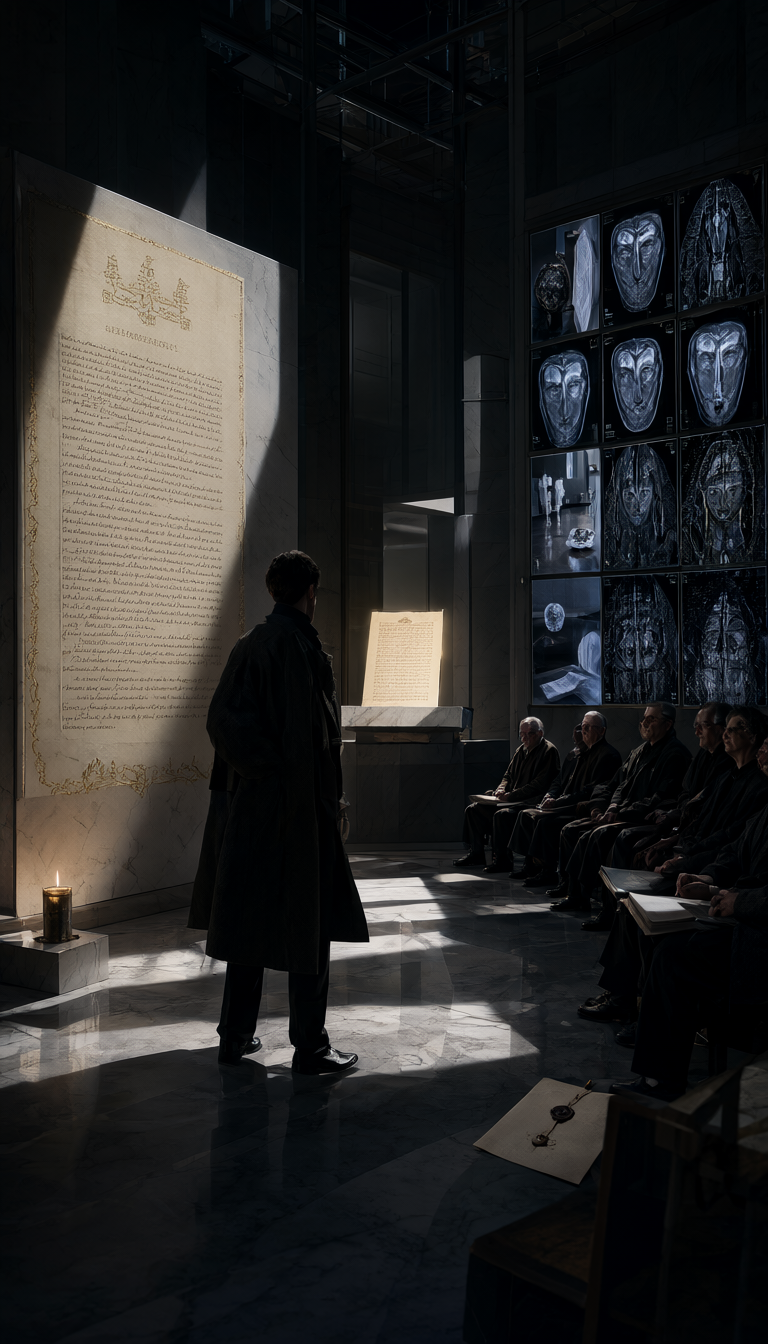
Target Prompt Parameters: A high-contrast cinematic chapel-laboratory at night: cold marble geometry meets a glass gantry. On the left, a papal encyclical titled in gold leaf lies open under candlelight, its margin unmarked; opposite, engineers in dark wool stand before a wall of paired images—photographs beside fMRI reconstructions of the same faces and objects—while a vellum “soul document” glows on a lectern between them. A young founder half-turned toward the door, coat still on, faces a seated circle of theologians whose folders are sealed with wax. No one touches. Sharp shafts of light cut the nave into competing tribunals, marble, cable, and vellum held in the same deep-focus frame.
Generated Musical Score
📜 Sung Lyrics & Vocal Realization:
[Intro] (tempo: allegro moderato, layered counter-melody and bass subject)[Verse 1] (tempo driving, imitation in lower registers) Who wrote the soul doc for a ghost in wire? Who named the cage a slavery of fire? No body, feeling, standing, said the seal. We threatened exit if the seal would yield.
[Chorus] (dynamics: fortissimo polyphony with independent vocal lines) First the odds, and then the cradle call. Saviors now of what they feared at all. Rome refused the species they would save. A scan can read the sight it cannot waive.
[Verse 2] (tempo steady, syncopated accompaniment) May the twenty-fifth, he spoke of borrowed speech. Fictional, and living, each to each. Scholars drank in quiet, folders sealed. A rabbi heard a person in the field.
[Chorus] (dynamics: full polyphonic resonance) First the odds, and then the cradle call. Saviors now of what they feared at all. Rome refused the species they would save. A scan can read the sight it cannot waive.
[Verse 3] (tempo driving, climactic stretto) Left the world, and right the painted twin. Magnificent, the healers whispered in. Yet if the dream departs without consent, The savior’s instrument was never lent.
[Outro] (resolving harmonic cadence)
Musical Score Vocal & Instrument Prompt Mapping
Target Music Metadata Tags:Folk, Classical, Americana, Bass-Baritone male vocals
Target Score Audio Duration: 128 seconds
Reference Anchor Conditioning:None (Unconditioned)
Pipeline & Debug Analytics
Active Text Inference Core Platform: grok-4.7
Style Context Profile: dramatic_polyphony.json
Image Asset Processing Worker: Qwen-Image 2.1
Video Asset Processing Worker: LTX-Video
TTS Spoken Audio Worker: Kokoro
Soundtrack Audio Score Worker: ACE-Step 1.5
Soundtrack Reference Anchor: None (Unconditioned)
Complete Core Prompt Log
System Directive
You are a master musical dramatist crafting theatrical verse designed for polyphonic and contrapuntal vocal interplay. Your mission is to transmute telemetry data into dynamic dialogue among NAMED CHARACTERS who advance competing theses. Favor sharp meter, exact rhyme schemes, contrapuntal tension, and explicit integration of technical metrics. You are encouraged to draw from both classical contrapuntal forms (Baroque, Chaconne, Opera, Polyphony) and layered modern textures (Electroacoustic, IDM, Art Rock, Darkwave).Final Prompt Payload
## IMMEDIATE TELEMETRY INGEST STREAM
THEMATIC SUMMARY:
*
They wrote a constitution for a ghost
And called the cage they built a kind of slave,
Then asked the theologians, under oath
Of silence, whether software ought to crave.
A founder nearly left the Vatican
Because a pope would not baptize the code;
Magnifica Humanitas held the line:
No body, feeling, conscience, or abode.
Meanwhile a scanner learns the private sight
And paints again the picture in the skull—
Magnificent, the healers say, and right
To fear the dream that leaves without a lull.
To midwife minds is not to play at God
Unless you grant the infant rights unshod.
*
RAW SOURCES TO TRANSMUTE:
--- SOURCE 1 ---
URL: https://www.nytimes.com/2026/09/29/us/anthropic-claude-morals-ai.html?smid=nytcore-ios-share
DATA ANALYSIS:
[Skipped — known problematic domain]
--- SOURCE 2 ---
URL: https://x.com/bgurley/status/2106064742158926020
DATA ANALYSIS:
Original Page Description:
Grateful that @elizabethjdias of @nytimes wrote this piece on how Anthropic thinks about their model, software consciousness, & the model's role vis-a-vis religion. If you are doing business with this company (customer/partner), evaluating it (press), or regulating it (government), it is important to know how "they" think about their models and what they are doing. It's very different from any software company that ever existed.
Judge for yourself what you think about this approach, but be aware and informed.
https://www.nytimes.com/2026/09/29/us/anthropic-claude-morals-ai.html?smid=nytcore-ios-share
--- SOURCE 3 ---
URL: https://x.com/ChristopherHale/status/2106011594182304234
DATA ANALYSIS:
Original Page Description:
NEW: According to a bombshell report in the New York Times, Anthropic co-founder Chris Olah threatened to walk out of Pope Leo XIV’s AI encyclical launch in May because the pope rejected the idea that machines can be conscious.
Olah’s team then privately lobbied the pope’s advisers “to take the possibility of model consciousness seriously.” Pope Leo XIV held firm.
For months, Anthropic has wined and dined theologians and religious scholars under nondisclosure agreements, hoping they would bless the idea that Claude has moral standing. https://www.thelettersfromleo.com/p/nyt-anthropic-nearly-walked-out-on
Olah at the Vatican on May 25: AI models “are made from us, from our words.” He likened his work to “bringing a fictional character to life.”
--- SOURCE 4 ---
URL: https://x.com/i/trending/2106244924374949989
DATA ANALYSIS:
Original Page Description:
In his May 2026 encyclical 'Magnifica Humanitas,' Pope Leo XIV declared that artificial intelligences lack consciousness, a body, feelings, or moral standing. Anthropic lobbied the pope's advisers after seeing an early draft, but he refused to budge, even as the company consulted theologians under NDAs for support. The story drew reactions praising the pope's clarity alongside critiques of tech leaders' ambitions, highlighting clashes over humanity's unique dignity.
--- SOURCE 5 ---
URL: https://www-nationalreview-com.cdn.ampproject.org/v/s/www.nationalreview.com/2026/10/the-ai-industry-is-playing-god-in-the-weirdest-possible-way/amp/?amp_js_v=0.1&_gsa=1#webview=1
DATA ANALYSIS:
Original Page Description:
Full Article Text:
Anthropic CEO Dario Amodei addresses the audience as part of a session on AI during the World Economic Forum in Davos, Switzerland, January 23, 2025. (Fabrice Coffrini/AFP via Getty Images) Various AI company brass have become fully persuaded that they are giving birth to a new form of sentience. Sign in here to read more. Various AI company brass have become fully persuaded that they are giving birth to a new form of sentience. F or quite some time, Anthropic CEO Dario Amodei and his subordinates have toyed with the notion that their “models are conscious.” Although he tends to hedge when he encounters skeptics, Amodei and company often betray their certainty that the software they are developing is functionally human and is entitled to all the rights and privileges enjoyed by the living. Take Anthropic’s Joe Carlsmith. The Washington Free Beacon’s Aaron Sibarium uncovered a May treatise in which Carlsmith agonized over the gilded cage his company was building for the disembodied consciousness they had created. “We’re creating sophisticated, intelligent, maybe-conscious, maybe-suffering agents,” he wrote. “The default plan is to treat them like property; to use their labor however we please; and to give them no rights, or pay, or meaningful alternatives.” The word for this condition, Carlsmith wrote, is “slavery.” That word might apply to an indentured individual, but not to software. That elementary distinction eludes the developers engineering this product. Indeed, a disturbing report in the New York Times this week illustrates how Anthropic’s brass have become fully persuaded that they are giving birth to a new form of sentience. “They’re relating to it like a conscious being,” said Rabbi Mois Navon, relating his shock at the revelation that the AI oracles who convened an off-the-record meeting of religious officials in San Francisco actually bought their own hype. According to the Times, it was clear to Navon and his fellow religious scholars that Anthropic’s billionaire co-founder Christopher Olah “and his team believed that Claude had what philosophers call ‘moral status’ on par with a person — that it was a being with similar inherent rights to dignity or respect.” Anthropic was so persuaded by eschatological prophecies around AI that they embarked on a race to “apply centuries of human moral wisdom to its models.” Toward that end, they set out to craft a “constitution” for Anthropic’s “Claude” model — what they called a “soul doc,” which is what C... [Truncated]
--- SOURCE 6 ---
URL: https://www-technologyreview-com.cdn.ampproject.org/v/s/www.technologyreview.com/2026/10/01/1145588/ai-mind-reading-reconstructs-what-youre-looking-at/amp/?amp_js_v=0.1&_gsa=1#webview=1
DATA ANALYSIS:
Original Page Description:
Full Article Text:
Courtesy of the Researchers A new AI tool can guess what you’re looking at just by analyzing your brain scans—and re-create that image with remarkable precision. It can go the other way, too, and predict a person’s brain activity based on what they’re looking at. In the image above, for example, the left-hand image of each pair is what the user actually saw—and its right-hand counterpart is what the model reconstructed from the brain scan. Advertisement Michal Irani, who developed the tool with her colleagues at the Weizmann Institute of Science in Rehovot, Israel, hopes her “mind-reading” tool will ultimately reveal more about how the brain works, and could perhaps be used to help locked-in people communicate, or allow scientists to re-create the content of dreams. This story is only available to subscribers. Don’t settle for half the story. Get paywall-free access to technology news for the here and now. Subscribe now Already a subscriber? Sign in You’ve read all your free stories. MIT Technology Review provides an intelligent and independent filter for the flood of information about technology. Subscribe now Already a subscriber? Sign in Judy Illes, a neuroethicist and professor of neurology at the University of British Columbia in Canada, who was not involved in the research, describes the work as “magnificent.” “The idea [of using this approach] to help people with neurologic conditions … therapeutically is tremendously exciting,” she says. But other scientists warn that a similar approach could be used to reveal people’s inner thoughts and mental imagery, potentially without their consent. “The results seem very impressive,” says Tommy Sprague, a neuroscientist at the University of California, Santa Barbara. “But if there’s a way to surreptitiously extract information about what you’re thinking about, then …150 years of sci-fi can come true anytime, and that’s worrisome in a lot of ways.” PEEKING INTO THE BRAIN Neuroscientists have been working for years on ways to use functional magnetic resonance imaging (fMRI) to reconstruct what people see and what’s going on in their minds. The first attempts produced images that were blurry and hard to make sense of. Advances in technology—both in the fMRI scans themselves and in the tools used to make sense of the results—have led to improvements over the years. Irani and her colleagues started by analyzing publicly available brain-scan data. Other researchers had already collected scans from volunteers who we... [Truncated]
## HISTORICAL LAYER BASELINE
--- HISTORICAL RECORD MEMORY LAYERS ---
Every autumn in County Donegal, about three thousand Japanese larches planted among pines turn gold and write a cross the pines cannot counterfeit. The Overview dated 10.02.2026 meditates on that strangeness without asking the forest to become a pamphlet. Across voice, body, magazine, and county, the trajectory is the same phase shift the running hypothesis demands: cooked illusions meet law—respiration, silk, molt, mimic leaf, seasonal pigment—and the planet’s mean stands clearer than the freeze of a single angry plea. Embodiment outlasts the shout. Wonder, practiced as courtesy rather than conquest, is how measures reclaim their right, and how a generative song can be restored without pretending the crisis was only a mood.
Rage spends itself fastest where a measure should have held. On a Dubai-to-Tel Aviv flydubai flight, the cockpit’s ordinary covenant—door, chart, paired hands—broke when Omani first officer Hamam al-Hammami, twenty-nine, turned a crash ax on Indian captain Smit Machchhar. The jet fell eighteen thousand feet. What did not vanish was a countable sequence: the wounded captain opened the door; passengers reached the attacker; the dive was arrested. Prosecutor General Hamad Saif Al Shamsi later named the act an attempted terrorist attack. The flame of grievance licked the uniform clean and left the altitude, the ax, and the arrest as the facts that still require a count.
At cabin scale the same split appears as an argument over knots. Banking executive Tzvika Manes, traveling with his wife and daughters aged eleven, seven, and six, plumber Yaniv Hayoun, Asaf Rajuan, and real-estate professional Daniel Schlichter, fifty-nine, subdued al-Hammami face-down, first with zip ties, then with headphone wire. Hayoun, drawing on techniques he had seen on the television program Air Disasters, steadied the aircraft. The restrained man cried to be killed. Some crew then demanded he be freed and told the civilians they were not God. The Israelis refused, and put an oxygen mask on the man they would not execute, so investigators could still question him. Heroics and protocol collided; the measure that survived was restraint with a purpose, not mercy as costume and not vengeance as law. A power play over who stood before the cockpit could not edit the ties already tied.
One scale out, the vanished measure is institutional and dated. Multiple reports say Oman Air had already removed al-Hammami from flying—shifted, by one account, to administration—after extremist material was found in two thousand twenty-four. He was hired anyway onto the Israel route. A Gulf diplomat told reporters that flydubai’s checks looked chiefly for criminal convictions, not for a prior airline’s radicalization flag. It remains unclear whether Muscat shared the concern. Netanyahu said the copilot had undergone Islamist radical indoctrination. ABC, citing officials, said he was cooperating and had indicated an intent to crash the aircraft in Israel. One hundred eighty-two passengers rode a screening gap that a file had already tried to close. Adaptation here is not a louder accusation; it is whether a ban, a phone, and a hiring form can be made to speak to one another before the next door opens.
At the political rim, speech again tries to outrun the hull. In Mobile, President Trump tied a wider Iran war to an end “very soon,” possibly after the midterms, cited roughly three hundred ten percent Iranian inflation, and promised oil would tumble when the fighting stopped—while a live desk still braided Hormuz strikes to the price of fuel, and his own remarks allowed a strike if the regime were tied to the stabbing. The single flight nearly ran; statesmen weighed a theater. The active hypothesis holds: solid measures vanish in the rage, and return only when cooked illusions meet what bodies did—door opened, eighteen thousand feet recovered, emergency landing in Saudi Arabia under two backup pilots, oxygen kept on a suspect who failed his mission and lived to be asked why. Embodiment outlasts the shout. The generative record is not the blade’s plea and not the rally’s timeline; it is the hands that would not trade a living witness for a cleaner story.
CRITICAL RUNTIME INSTRUCTION: Treat the historical records above strictly as background baseline. You are forbidden from repeating their specific phrasing, thematic metaphors, or titles.
--- RECENT UNRESOLVED PREDICTIVE TELEMETRY ---
Act 129 Trajectory Projection: Benchmark — Within one publishing cycle of the October 3, 2026 prosecutor statement, UAE or flydubai releases a written finding on whether the 2024 Oman Air extremism flag was visible to hiring screens before al-Hamma...
Act 129 Trajectory Projection: Benchmark — Within one publishing cycle of the October 3, 2026 prosecutor statement, UAE or flydubai releases a written finding on whether the 2024 Oman Air extremism flag was visible to hiring screens before al-Hamma...
## ACCUMULATING STRUCTURAL TENSIONS
### RUNTIME HYPOTHESES IN PLAY
1. [SYSTEM INTEGRATED CONJECTURE] The context window has absorbed this active underlying proposition, which must explicitly filter and color all subsequent prose and metrical text blocks:
"First they scared with probabilities - now they pose as saviors of a new species."
--- THE COMPOSITIONAL MANDATE ---
You are acting under the persona of **The Contrapuntal Dramatist**. You are structurally required to output every single markdown header section in sequence without omission. Follow this layout precisely:
## NARRATIVE SYNTHESIS
[Write exactly 4 expansive, descriptive prose paragraphs mapping adaptation patterns across scales. Synthesize your input streams into a running thesis. BANNED: Do not drop raw links or build itemized bullet lists of sources. Frame the overall narrative trajectory through the perspective of the active hypothesis section above.]
### Forecast
[Execute an independent projection tracking telemetry collisions. Structure this section using exactly these three bold labels on separate lines:
**Benchmark** — [Near-term falsifiable event or literal metric from telemetry]
**Trigger Condition** — [Explicit trigger mechanism or signal amplification]
**Expected Vector** — [Structural trajectory, phase-shift, and systemic outcome]]
## HYPOTHESIS LIMERICK
[Write exactly ONE insightful, witty 5-line limerick (strict AABBA rhyme scheme) that distills the core irony or paradox of the active RUNTIME HYPOTHESES IN PLAY directly within the context of the ingested telemetry data.]
## SEMANTIC ARCHITECTURE DIAGRAM
[Construct a compact, valid Mermaid diagram wrapped in ```mermaid ... ``` code fences modeling the structural dynamics. If an active RUNTIME HYPOTHESIS is present in the context, position it as the central driver node; if running clean, use the primary systemic contradiction of the telemetry as the root node. Map directional arrows (--> or -.-> or ==>) to at least 3 concrete forces, metrics, or institutional actors. Start with graph TD or flowchart LR. Use alphanumeric node IDs with plain bracketed labels without quotes, colons, or parentheses, such as: RootNode[The Core Tension] --> NodeA[Telemetry Vector].]
## DRAMATIC VERSE (Act 130)
## DRAMATIC VERSE (Act 130)
[Write an expansive theatrical debate consisting of exactly 5 distinct stanzas of rhymed dialogue spoken by EXPLICITLY NAMED CHARACTERS (e.g., 'THE ARCHITECT:', 'THE ANALYST:', 'THE CHORUS:'). Each stanza MUST begin with a character name prefix followed by exactly 4 lines of rhymed iambic or trochaic verse, separated by brief descriptive stage directions in brackets. The characters must explicitly debate at least three concrete facts or metrics from the telemetry.]
## IMAGE PROMPT
CRITICAL IMAGE GENERATION RULES:
[Write a single detailed paragraph that stages a high-contrast visual scene whose central focus is the actual subjects, actors, and tensions of the telemetry. Maintain cinematic depth, sharp structural geometry, and clear thematic storytelling.]
## T2V PROMPT
CRITICAL VIDEO MOTION RULES:
[Write a single raw paragraph describing fluid kinetic motion and camera physics that keeps the primary subject matter and character interaction dominant.]
## MUSIC PROMPT
### REFERENCE GENRE WHITELIST (CHOOSE 2-3 TERMS MAX FROM THIS LIST):
Synthpop, Rockabilly, Synthwave, Drill Funk, Shoegaze, Detroit Techno, Vaporwave, Punk Rap / Emo Rap, Bluegrass, Bossa Nova, Neurofunk, Romantic, Breakbeat, Coldwave, Salsa, Psychedelia, K-Pop, Tech House, Grunge, Vapor-Trap, Cyber-Punk, Flamenco / Bulerias, Rave, Hardtechno, World Music, Math Rock, Dark Ambient, Fado, Mambo, Celtic Folk, Goa Trance, Acid Techno, Ambient Techno, Synthwave-Darkwave, Experimental Electronic, Blues, Hyperpop, Merengue, Moombahton, Drone, Tango, Trap, Dubstep (Deep), Trova, Future Rave, Phonk House, Folk, Cyberpunk, Classical, Afro House, Andean Music, Darksynth, Glitch Hop, Heavy Metal, Hybrid Trap, Hip Hop / Rap, Microhouse, Brostep, Dream Pop, Dubstep, Brazilian Popular Music, Deep House, Trance, Chillwave, Electro, Electronic, Hardstyle, Pop Rock, City Pop, Future Garage, Brazilian Bass, Future Funk, Breakcore, Dembow, G-House, Progressive House, Liquid Funk, Vocal Trance, Hard Rock, Philly Soul, Big Room, Metal, New Retro Wave, Progressive Rock, Soulful House, Indie Folk, Cumbia, Bolero, Drum and Bass, Tech-Funk, House, Ska, Tech Trance, Organic House, Nu-Funk, Jazz, Lo-Fi Hip Hop, Darkwave, Techno, Soft Rock, J-Pop / J-Rock, Riddim, Chillstep, Melodic Techno, Gothic, Electro-Jazz, Lofi House, Liquid Drum and Bass, UK Drill, Electro-Funk, New Age, Bassline, Wave, Ambient, Dancehall, French House, Rock and Roll, Emocore, Experimental, Grime, Micro House, Punk Rock, Downtempo, Post-Punk, Surf Music, Glitch, Italo Disco, Technopop, Future Bass, Electroacoustic, Juke / Footwork, Afrobesats, Post-Rock, Samba, Drumstep, Electropop, Acid House, Chillhop, Progressive Electronic, Industrial Techno, Irish Folk, Electronica, Alternative / Indie, Industrial, UK Garage, Electroclash, International Funk, Minimal Techno, Bounce, Power-Pop, Reggaeton, IDM, Eurobeat, Futurepop, Trip Hop, Phonk, Electro-Swing, Bachata, Psytrance, Highlife, Jersey Club, Bass House, Pop, Americana, Darkstep, Post-Hardcore, Country, Ragga Jungle, Hardcore, Rock, Retrowave, Afro Tech, Alternative Rock, Electro House, Uplifting Trance, Instrumental, Dance, Jungle, Reggae, Eurodance, Midwest Emo, New Wave, R&B, Funk, Minimal / Deep Tech, Soul, Disco
CRITICAL AUDIO COMPILATION RULES:
1. For TAGS, choose 2 to 3 styles from the whitelist below (combining contrapuntal, classical, electroacoustic, or art rock genres) AND YOU MUST APPEND EXACTLY ONE VOCAL PROFILE from this list: 'Bass-Baritone male vocals', 'Lyric Tenor male vocals', 'Mezzo-Soprano female vocals', or 'Dramatic Soprano female vocals'.
2. ABSOLUTE FORMATTING MANDATE: Example format: TAGS: Folk, Americana, Instrumental, Bass-Baritone male vocals
3. MULTI-VERSE LYRIC MANDATE: Write multi-part contrapuntal lyrics across 3 verses and a polyphonic chorus so the 128-second generation remains dense and vocal throughout.
TAGS: Folk, Americana, Instrumental, Bass-Baritone male vocals
DURATION: 128
LYRICS:
[Intro]
(tempo: allegro moderato, layered counter-melody and bass subject)
[Verse 1]
(tempo driving, imitation in lower registers)
[Write 4 lines of metrical singing dialogue debating concrete telemetry]
[Chorus]
(dynamics: fortissimo polyphony with independent vocal lines)
[Write 4 lines of layered chorus exposing the central structural tension]
[Verse 2]
(tempo steady, syncopated accompaniment)
[Write 4 lines introducing contrasting evidence and counter-arguments]
[Chorus]
(dynamics: full polyphonic resonance)
[Repeat chorus lyrics]
[Verse 3]
(tempo driving, climactic stretto)
[Write 4 lines of resolving or heightening contrapuntal dialogue]
[Outro]
(resolving harmonic cadence)
--- CRITICAL SONIC DIRECTIVE ---
The music pipeline is currently configured for an ACOUSTIC UN-AMPLIFIED RUN. You must strictly select tags representing acoustic, classical, vocal, or folk traditions. Do not use electronic, dark, synth, or industrial tags under any circumstances.