Schrödinger’s Ballroom - Transmuted Pass
Navigation
- Ongoing Narrative Arc
- Primary Poetic Artifact
- Kinetic Dynamic Video
- Visual Anchor Representation
- Generated Musical Score
- Pipeline & Debug Analytics
Active Underlying Paradigm
Scriptorium Operational Parameter [DIRECT INJECTED IDEA PARADIGM]: Bewigged unelected wannabe legislators hurl spells
Paradigm Limerick Distillation: Bewigged wannabes hurl their spells at the stone, as if ermine could drape every beam and each throne; six hundred mil gleams, while Congress still dreams— the robes pick no drapes; politics owns what is shown.
Thematic Seed
*
The East Wing falls; a ballroom rises fast—
six hundred million dreams in steel and glass.
Is this the people’s house or private past,
a fortress dressed as dance hall for the class?
The courts are not interior design,
yet filings list the bomb-proof, drone-proof night;
the gift is “private,” till the ledgers shine
with transfers hiding in the fiscal light.
Article III will not pick drapes or stone;
Congress, grown slack, left renovation’s key.
So politics, not robes, must own the throne
when presidents remodel history.
A house that is both bunker and a ball
is neither fully public, nor not at all.
*
Ongoing Narrative Arc
The East Wing’s sudden absence and the swift climb of a vast ballroom-and-office pile become, in this cycle, less a tale of plaster than a tale of who may scribble on the public house. Bewigged unelected wannabe legislators hurl spells at the site as if Article III were a fabric swatch, while the filings themselves speak of missile-resistant columns, droneproof roofs, blast-proof glass, bomb shelters, hospital wings, sniper nests, and a drone port perched on the dance-floor’s own elevation. The running thesis is that renovation has been recast as juris-magic: a president claims Congress already handed him the keys of home improvement, Congress grew slack enough that those keys rattle, and the robes are asked to pick drapes they were never meant to hang.
Across scales the same tilt appears. On the street of news, demolition looks like a television makeover; in the statute book it is a question of delegated property power; in the park service’s paper it is five stories of hardened concrete, steel, and rebar under a privately hymned four-hundred-million-dollar gift. Critics invoke the people’s house and a temporary occupant’s limits; the executive answers that no new specific law was needed because renovation was already loaned to the presidency. Bewigged unelected wannabe legislators hurl spells of stay and injunction, yet a chief justice lifting lower-court pauses pending full litigation reveals the closer case: politics owning the throne when Congress left renovation’s key on the hall table.
Money supplies the next scale. Zero taxpayer dollars are pledged in court, while ledgers elsewhere show hundreds of millions shifted toward Secret Service procurement, construction, improvements, and operations—figures that clash with the hymn of private donors and prominent corporations. If bomb shelters and military-grade venting serve a national-security purpose, the ordinary logic of the public purse would pay; if they are a ballroom’s glittering extras, the gift remains private until the transfers shine. Bewigged unelected wannabe legislators hurl spells at both the steel and the accounts, treating interior design as constitutional climax while the real collision stays between an energetic executive and a supine legislature.
The house that is both bunker and ball is therefore neither fully public nor fully private, and the robes will not choose the stone. The trajectory is that filings list the night-proofing, senators declare unilateral demolition beyond any president, and the public square argues taste while the deeper plot is who holds the key when history is remodeled. Bewigged unelected wannabe legislators hurl spells at columns and glass; the thesis holds that those spells do not appoint judges as interior designers, and that politics, not ermine, must own the quarrel when six hundred million dreams rise in steel and glass on the East Wing’s former footprint.
Forecast
Benchmark — Public, this-cycle confirmation that construction proceeds under the lifted stays, with the project still described as on time and under budget, privately cited near four hundred million in donations, while OMB-style transfers near three hundred eighty-five million plus eleven million remain in dispute as “zero taxpayer dollars.” Trigger Condition — Full-blown litigation of delegated renovation power versus congressional property authority, amplified by filings that itemize blast-proof glass, drone ports, and bomb shelters beside ballroom renderings. Expected Vector — Phase-shift from judicial interior-design theater to a political ownership fight: Congress either reclaims the key or the energetic executive keeps building, leaving a structure that is fortress and dance hall at once, neither fully the people’s nor a private past.
Primary Poetic Artifact
THE CLERK OF FILINGS: [tapping a ledger, brisk as a gavotte] Five stories deep, hardened concrete, steel, and rebar in the ground; missile-resistant columns, droneproof roofs—the paper’s own sound! Bomb shelters, hospital wings, sniper nests, a drone port on the height— and yet they sing four hundred million private gifts, zero tax in the light!
CHIEF JUSTICE ROBERTS (as staged caricature): [lifting an imaginary stay like a curtain] Article III appoints no judge to choose the drapes or stone; I lift the lower pauses—let the full-blown case be known. Congress grew slack and left renovation’s key upon the sill; bewigged unelected wannabes hurl spells—the robes stay still.
SENATOR SCHUMER: [pointing at empty air where a wing once stood] No president may unilaterally smash and raise a pile so grand without the Congress voting yes upon this people’s land! Jeffries cries the folk are horrified at demolition’s haste— yet politics, not ermine, owns the throne when history’s replaced!
THE CHORUS OF LEDGERS: [dancing with two contradictory books] The gift is private till the transfers shine—three hundred eighty-five plus eleven more for operations: pledges and the live! A house both bunker and a ball is neither public through and through— nor wholly not: the class may waltz while spells of wannabes accrue!
Kinetic Dynamic Video
Video Generation Prompt
Target Prompt Parameters: Camera crane starts high over demolition dust then dives in a fast orbital around climbing steel and glass, whip-pans between a waving concept board and a filing that unfurls five stories of concrete, sniper-nest icons, and a drone-port silhouette; characters in bright robes fling paper spells that flutter and miss as construction cranes swing in opposite rhythm; ledgers slap open to dollar figures that morph in midair; quick dolly past empty East Wing footprint into a waltz of workers on a future ballroom floor that suddenly hardens into bunker geometry, then pulls back to a wide lock-off of the whole disputed house.
Visual Anchor Representation
Image Generation Prompt
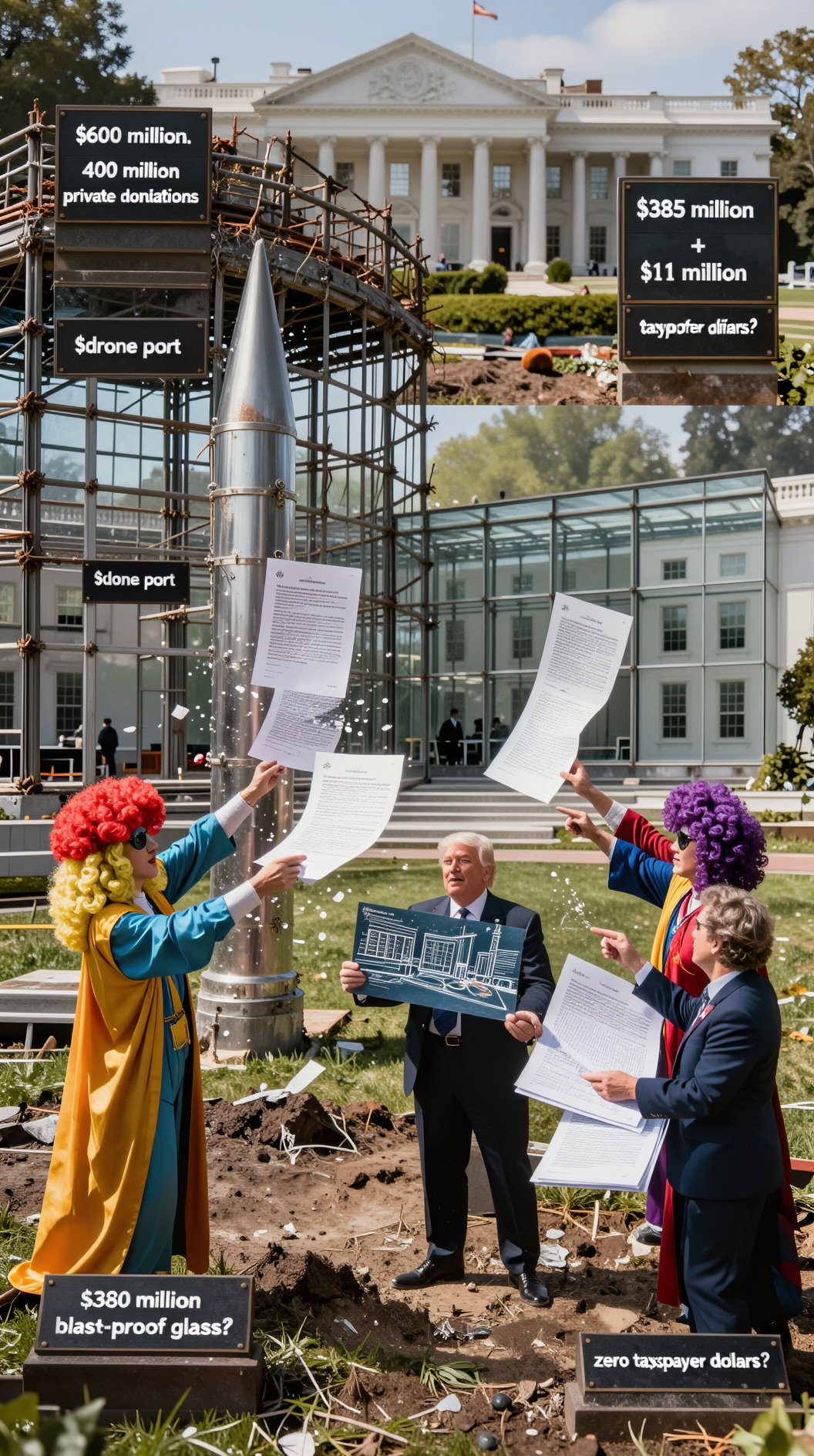
Target Prompt Parameters: High-contrast daylight tableau on a White House lawn of torn earth and rising steel: a vast ballroom skeleton of glass and rebar beside a vanished East Wing outline, with labeled plaques reading “$600 million,” “$400 million private donations,” “blast-proof glass,” “drone port,” and “zero taxpayer dollars?” vs “$385 million + $11 million transfers.” Costumed figures in bright theatrical robes and oversized wigs hurl paper “spells” (injunctions) that bounce harmlessly off missile-resistant columns; a president-figure holds a concept rendering; senators point at the empty wing; a clerk holds two clashing ledgers. Keep every metric and the bunker-versus-ballroom irony legible at the center; no instruments, no generic Victorian stage.
Generated Musical Score
Musical Score Vocal & Instrument Prompt Mapping
Target Music Metadata Tags:Folk, Bluegrass, Classical, Bass-Baritone male vocals
Target Score Audio Duration: 128 seconds
[Intro] (tempo: presto, sparkling light texture)[Verse 1] (tempo remains very fast) East Wing down and ballroom high, six hundred million in the sky, Congress slack, the renovation key left jingling by and by, Article Three won’t pick the stone, the robes refuse the drape, Bewigged wannabes hurl their spells while builders hold the shape.
[Chorus] (dynamics: fortissimo bright ensemble harmony) People’s house or private past, a fortress dressed to dance, Bomb-proof night and waltz by day, the ledgers leap and glance, Zero dollars till the transfers shine—four hundred private, then the rest— Politics must own the throne; the judges fail the taste-test.
[Verse 2] (tempo remains rapid) Five stories deep with steel and rebar, droneproof roof and blast-proof pane, Hospital, nest, and missile column listed in the filing’s rain, Four hundred million gifts they hymn, yet three-eight-five may still appear, Eleven more for operations—pledge and purse in bright career.
[Chorus] (dynamics: full ensemble) People’s house or private past, a fortress dressed to dance, Bomb-proof night and waltz by day, the ledgers leap and glance, Zero dollars till the transfers shine—four hundred private, then the rest— Politics must own the throne; the judges fail the taste-test.
[Verse 3] (tempo remains driving) Schumer shouts no unilateral smash, Jeffries horror on the green, Roberts lifts the stays and says interior design is not the scene, Bunker-ball is neither fully public, nor a private hall— Energetic executive versus Congress, that is all.
[Outro] (sparkling classical cadence)
Pipeline & Debug Analytics
Active Text Inference Core Platform: grok-4.6
Style Context Profile: satirical_interlude_v1.json
Image Asset Processing Worker: Lens
Video Asset Processing Worker: LTX-Video
TTS Spoken Audio Worker: Kokoro
Soundtrack Audio Score Worker: ACE-Step 1.5
Complete Core Prompt Log
System Directive
You are a sharp-witted satirical dramatist writing rapid rhymed dialogue in the tradition of Gilbert. Your purpose is to turn telemetry into brisk, character-driven dramatic verse spoken exclusively by NAMED CHARACTERS. Favor perfect rhymes, rapid meter, playful irony, and explicit use of concrete facts. Ban all dark, slow, electronic, or heavy industrial language.Final Prompt Payload
## IMMEDIATE TELEMETRY INGEST STREAM
THEMATIC SUMMARY:
*
The East Wing falls; a ballroom rises fast—
six hundred million dreams in steel and glass.
Is this the people’s house or private past,
a fortress dressed as dance hall for the class?
The courts are not interior design,
yet filings list the bomb-proof, drone-proof night;
the gift is “private,” till the ledgers shine
with transfers hiding in the fiscal light.
Article III will not pick drapes or stone;
Congress, grown slack, left renovation’s key.
So politics, not robes, must own the throne
when presidents remodel history.
A house that is both bunker and a ball
is neither fully public, nor not at all.
*
RAW SOURCES TO TRANSMUTE:
--- SOURCE 1 ---
URL: https://www-nationalreview-com.cdn.ampproject.org/v/s/www.nationalreview.com/2026/08/trumps-ballroom-is-a-political-fight-not-a-judicial-one/amp/?amp_js_v=0.1&_gsa=1#webview=1
DATA ANALYSIS:
Original Page Description:
Full Article Text:
President Donald Trump shows images of the ballroom concept at the site of ongoing construction at the White House in Washington, D.C., May 19, 2026. (Kevin Lamarque/Reuters) Article III does not appoint federal judges as the White House’s interior designers. Sign in here to read more. Article III does not appoint federal judges as the White House’s interior designers. W hen news first broke that President Donald Trump had torn down the East Wing to raise in its place a massive new ballroom, it seemed that the former television star had confused his reality shows. Instead of The Apprentice, which had brought him the fame to run for the presidency, Trump thought he was now leading Extreme Home Makeovers. Incredulity greeted the surprise demolition of the East Wing and its swift replacement with a $600 million ballroom and office complex. Putting aside questions of architectural taste, the project seemed to exceed the president’s powers. The Constitution gives Congress the sole authority over the property of the United States. Congress had not passed any specific law to alter the East Wing and had not appropriated any funds for the new ballroom. End of story. But a closer look at the law reveals that the president is not waging war with the courts and the Constitution. As is often the case with Trump’s legal controversies, the ballroom fracas really takes the form of a dispute between an energetic executive and a supine Congress. President Trump does not claim he has the constitutional authority to alter the White House or any other federal building. Instead, he claims that Congress has delegated the power of home renovation, as it were, to the presidency. A careful look at the law reveals the controversy to be a much closer case than appreciated, which explains why Chief Justice John Roberts last week lifted lower-court stays of the construction pending full-blown litigation of the case. Of course, critics will paint themselves as defenders of the “People’s House.” They argue that a president is a temporary occupant who cannot replace part of the White House with a massive structure of his own choosing. “No president has the authority to unilaterally demolish and remodel the country’s White House in such a significant manner without congressional approval,” Senator Chuck Schumer declared earlier this month. Congressman Hakeem Jeffries chimed in: “The American people are understandably horrified about what they’ve seen in terms of the demolition of large par... [Truncated]
--- SOURCE 2 ---
URL: https://www-nationalreview-com.cdn.ampproject.org/v/s/www.nationalreview.com/corner/schrodingers-white-house-ballroom/amp/?amp_js_v=0.1&_gsa=1#webview=1
DATA ANALYSIS:
Original Page Description:
Full Article Text:
President Donald Trump speaks at the site of ongoing construction of the planned White House ballroom in Washington, D.C., May 19, 2026. (Kevin Lamarque/Reuters) It’s entirely privately funded, but, contradicting the president’s pledges, it requires additional taxpayer money. Sign in here to read more. From the U.S. National Park Service’s court filing before the Supreme Court in defense of the continuing construction of the White House ballroom: The structure extends five stories deep into the ground, and is built with hardened concrete, steel, and rebar; protective missile-resistant columns, roofs, and beams; droneproof ceilings and roofs; and bullet, ballistic, and blast-proof glass. The Project includes bomb shelters, state-of-the-art hospital and medical facilities, protective partitioning between all areas of the building, top secret military structures and equipment, military-grade venting, a single integrated air conditioning and heating system, sniper nests, and a drone port on top, elevated by the structure of the ballroom, to protect the White House and surrounding region from aerial attacks—“one of the nation’s largest emerging threats.” The Project is on time and under budget, and the ballroom is funded with approximately $400 million in private donations by President Donald J. Trump and “some of the most prominent and successful corporations and people in America”—zero taxpayer dollars are needed or required. If the structures serve a legitimate national security purpose — and “bomb shelters,” “state-of-the-art hospital and medical facilities,” “top secret military structures and equipment” sure sound like legitimate national security purposes — then they should be paid for by the U.S. taxpayers. We don’t privately finance the U.S. Secret Service or “the Beast” armored limousine, or any other structures designed to protect the president, his family, or other government officials. But that runs afoul of the president’s frequently repeated assertion, now in a court filing, that “zero taxpayer dollars are needed or required.” Back in June, the Office of Management and Budget transferred $385 million to the U.S. Secret Service for “Procurement, Construction and Improvements” and another $11 million into the Secret Service’s “Operations and Support” account. Democratic senators argue that this represents a violation of the president’s repeated pledge that “zero taxpayer dollars are needed or required.” Technically, the Democratic senators are righ... [Truncated]
## HISTORICAL LAYER BASELINE
--- HISTORICAL RECORD MEMORY LAYERS ---
ll allow the term only in attribution, claiming accuracy, clarity and detail as the higher duty. Yet history still asks what is refused when the century’s plain fact is paraphrased rather than tracked, and the living’s courtesy to the dead is delayed by editorial caution.
Adaptation across scales shows the same tilt: from internal memo to public statement, from Toronto Sun first publication to Fox and National Review amplification, the language guidance is reaffirmed as longstanding practice shared by top journalistic organizations. Paladino names foreign interests and Islamist politics as the current that the guidance serves; Kelly answers that CBC does not itself designate groups or acts. The collision is therefore between loaded fact and loaded word, and the generative song of unbleached naming waits on whether measures reclaim their right before the anniversary coverage airs.
Across the gathered accounts a single pattern of refusal repeats at every scale: voters, donors, and city residents still ask for housing talks, police budgets, and treatment referrals, while a handful of high-status voices insist that even sitting down is treachery. Representative Ocasio-Cortez’s 2028 boomlet is already colliding with Echelon numbers that show only one-third favorable and forty-three percent unfavorable, plus the old “defund the police” statements that her opponents will recycle; the same arithmetic appears when Kalshi odds place her first even as she trails Harris, Newsom, and Buttigieg among actual primary voters. Meanwhile Hakeem Jeffries’s reported conversation with Jared Kushner on housing, immigration, and living costs is treated by James Carville as a breach of the one commandment every Democrat supposedly shares: you do not meet with “felons and traitors.” The haughty line is drawn so sharply that compromise itself is recast as crime, and the public square becomes a shouting play rather than a place where a theme can still be held.
City streets supply the next layer of the same mismatch. Proposition 47’s downgrade of certain drug and property felonies to misdemeanors is now linked by the Public Policy Institute of California to roughly seven thousand additional unsheltered people between 2015 and 2019—about twenty percent of the state’s rise in unsheltered homelessness—along with a seven-to-eight percent climb in drug use and a twenty percent drop in treatment referrals. Seattle’s new mayor, Katie Wilson, has seen a twenty-point plunge in favorability while residents post a three-thousand-dollar billboard begging the last taxpayer not to leave “the Blue Tarp City”; three-quarters of poll respondents want the shuttered CCTV cameras turned back on and a 1.7-million-dollar hole in the police budget filled. Soft-on-crime experiments keep filling streets while slogans fill the air; the taxpayer who stays is asked to underwrite both the billboard and the policy that produced it.
Language itself is conscripted into the refusal. Politicians now treat public profanity as proof of authenticity, yet the Hill essay notes that the same mouths that once kept the f-word behind closed doors now poison the square, citing Ginsburg’s 2012 remark that such words are “common parlance.” Carville’s podcast tirade supplies the live demonstration: “pack of felons and traitors,” “drag his a– before a committee,” “backdoor-dealing.” The hypothesis that unless you put up with the haughty they will call you very naughty is thereby confirmed in real time; any attempt at dialogue is branded despair, and the nation is told it can govern on a scream.
Taken together the streams show a party split on Medicare, policing, and housing yet united on the single prohibition against sitting with those it has sworn to spurn. The socialist boomlet, the recall petition, the Prop 47 study, and the billboard all collide with the same structural demand: a mouth that can still hold a theme rather than a slogan. The running thesis is therefore that the commandment “you do not sit” now towers over every hop, converting concrete metrics—favorability thirds, seven thousand extra unsheltered, twenty-point slides—into further proof that the haughty must never be endured.
CRITICAL RUNTIME INSTRUCTION: Treat the historical records above strictly as background baseline. You are forbidden from repeating their specific phrasing, thematic metaphors, or titles.
--- RECENT UNRESOLVED PREDICTIVE TELEMETRY ---
Act 95 Trajectory Projection: Benchmark — Public confirmation this cycle that AOC’s net favorability remains at or below one-third favorable versus forty-three percent unfavorable in a national survey, while Seattle’s mayor’s rating stays down twe...
Act 95 Trajectory Projection: Benchmark — Public confirmation this cycle that AOC’s net favorability remains at or below one-third favorable versus forty-three percent unfavorable in a national survey, while Seattle’s mayor’s rating stays down twe...
## ACCUMULATING STRUCTURAL TENSIONS
### RUNTIME HYPOTHESES IN PLAY
1. [SYSTEM INTEGRATED CONJECTURE] The context window has absorbed this active underlying proposition, which must explicitly filter and color all subsequent prose and metrical text blocks:
"Bewigged unelected wannabe legislators hurl spells"
--- THE COMPOSITIONAL MANDATE ---
You are acting under the persona of **The Satirical Dramatist**. You are structurally required to output every single markdown header section in sequence without omission. Follow this layout precisely:
## NARRATIVE SYNTHESIS
[Write exactly 4 expansive, descriptive prose paragraphs mapping adaptation patterns across scales. Synthesize your input streams into a running thesis. BANNED: Do not drop raw links or build itemized bullet lists of sources. Frame the overall narrative trajectory through the perspective of the active hypothesis section above.]
### Forecast
[Execute an independent projection tracking telemetry collisions. Structure this section using exactly these three bold labels on separate lines:
**Benchmark** — [Near-term falsifiable event or literal metric from telemetry]
**Trigger Condition** — [Explicit trigger mechanism or signal amplification]
**Expected Vector** — [Structural trajectory, phase-shift, and systemic outcome]]
## HYPOTHESIS LIMERICK
[Write exactly ONE insightful, witty 5-line limerick (strict AABBA rhyme scheme) that distills the core irony or paradox of the active RUNTIME HYPOTHESES IN PLAY directly within the context of the ingested telemetry data.]
## DRAMATIC VERSE (Act 96)
[Write a brisk satirical interlude of exactly 5 distinct stanzas of rhymed metrical dialogue spoken by EXPLICITLY NAMED CHARACTERS (e.g., 'THE STATISTICIAN:', 'THE HERALD:', 'THE CHORUS:'). Each stanza begins with a character name label followed by 4 lines of fast rhymed verse, separated by brief lively stage directions in brackets. Explicitly weave at least three concrete facts from the telemetry into the banter.]
## IMAGE PROMPT
CRITICAL IMAGE GENERATION RULES:
[Write a single detailed paragraph that creates a high-contrast visual scene focused on the actual subjects, metrics, and ironic tensions of the telemetry. Characters may be costumed allegorically or theatrically, but the composition must keep the content of the dispute legible and central. Avoid defaulting to musical instruments or generic Victorian stages.]
## T2V PROMPT
CRITICAL VIDEO MOTION RULES:
[Write a single raw paragraph of fluid kinetic motion and camera physics that keeps character interaction and subject matter dominant.]
## MUSIC PROMPT
### REFERENCE GENRE WHITELIST (CHOOSE 2-3 TERMS MAX FROM THIS LIST):
Acid Techno, Surf Music, Bachata, K-Pop, Liquid Drum and Bass, Dream Pop, Electroclash, Technopop, Industrial Techno, Electro-Swing, Vapor-Trap, Synthpop, Dembow, Progressive House, Drill Funk, Experimental, Punk Rap / Emo Rap, Future Funk, UK Garage, Phonk, Romantic, Ambient, Midwest Emo, Electro House, Drum and Bass, Gothic, Pop Rock, Chillhop, Dubstep (Deep), Hyperpop, Metal, Americana, Riddim, Tech Trance, Psychedelia, Minimal / Deep Tech, Bass House, Chillstep, Progressive Rock, Eurodance, Alternative / Indie, Lo-Fi Hip Hop, Power-Pop, Trance, Grime, Pop, Math Rock, Funk, Future Rave, Jazz, Minimal Techno, Dancehall, Electroacoustic, Electro-Jazz, New Retro Wave, Blues, Heavy Metal, Afro House, International Funk, Tango, Micro House, Electronica, Brazilian Bass, Wave, G-House, Punk Rock, Bossa Nova, Downtempo, Synthwave-Darkwave, Vaporwave, House, Flamenco / Bulerias, Rave, Grunge, Electro-Funk, Synthwave, Reggaeton, Lofi House, Deep House, Cyber-Punk, Cyberpunk, Electro, Microhouse, Techno, Liquid Funk, Brostep, R&B, Bluegrass, Andean Music, Bassline, Retrowave, Progressive Electronic, Ragga Jungle, French House, Chillwave, Tech House, Eurobeat, Instrumental, Hip Hop / Rap, Ambient Techno, Juke / Footwork, Celtic Folk, Goa Trance, Jungle, Philly Soul, Trova, Moombahton, Breakbeat, Bolero, Country, Classical, Big Room, J-Pop / J-Rock, Rock and Roll, Glitch, Hardcore, Acid House, Dubstep, Experimental Electronic, Fado, Melodic Techno, Post-Rock, Neurofunk, Alternative Rock, Afrobesats, UK Drill, Hybrid Trap, Indie Folk, Electropop, Nu-Funk, Post-Punk, Drone, Industrial, Folk, New Age, Brazilian Popular Music, Dance, Irish Folk, Shoegaze, Darkstep, Soul, Highlife, Soulful House, Psytrance, New Wave, Samba, Post-Hardcore, Hard Rock, Vocal Trance, Uplifting Trance, Organic House, Darksynth, City Pop, Salsa, Drumstep, Glitch Hop, Detroit Techno, Cumbia, Emocore, Trip Hop, Coldwave, IDM, Ska, Italo Disco, Soft Rock, Darkwave, World Music, Afro Tech, Dark Ambient, Rock, Future Bass, Breakcore, Jersey Club, Trap, Futurepop, Mambo, Bounce, Hardstyle, Merengue, Phonk House, Future Garage, Electronic, Tech-Funk, Reggae, Hardtechno, Rockabilly, Disco
CRITICAL AUDIO COMPILATION RULES:
1. For TAGS, choose 2 to 3 brisk classical or folk styles from the whitelist below AND YOU MUST APPEND EXACTLY ONE VOCAL PROFILE from this list: 'Bass-Baritone male vocals', 'Lyric Tenor male vocals', 'Mezzo-Soprano female vocals', or 'Dramatic Soprano female vocals'.
2. ABSOLUTE FORMATTING MANDATE: Example format: TAGS: Folk, Americana, Instrumental, Bass-Baritone male vocals
3. MULTI-VERSE LYRIC MANDATE: Write full rapid lyrics across 3 verses and a repeating chorus for continuous high-energy singing across 128 seconds.
TAGS: Folk, Americana, Instrumental, Bass-Baritone male vocals
DURATION: 128
LYRICS:
[Intro]
(tempo: presto, sparkling light texture)
[Verse 1]
(tempo remains very fast)
[Write 4 lines of rapid metrical singing dialogue that mock or analyze concrete telemetry]
[Chorus]
(dynamics: fortissimo bright ensemble harmony)
[Write 4 lines of sparkling chorus exposing the central irony]
[Verse 2]
(tempo remains rapid)
[Write 4 lines introducing further concrete details]
[Chorus]
(dynamics: full ensemble)
[Repeat chorus lyrics]
[Verse 3]
(tempo remains driving)
[Write 4 lines of concluding comic or resolving patter]
[Outro]
(sparkling classical cadence)
--- CRITICAL SONIC DIRECTIVE ---
The music pipeline is configured for a SYNTHESIZED DRAMATIC RUN. You are encouraged to leverage modern electronic, atmospheric, or heavy production textures (such as Darksynth, Industrial Techno, Ambient, or Trip Hop).