Scaffolds, Silent Majorities, and the Books on the Table - Transmuted Pass
Navigation
- Ongoing Narrative Arc
- Semantic Architecture
- Primary Poetic Artifact
- Kinetic Dynamic Video
- Visual Anchor Representation
- Generated Musical Score
- Pipeline & Debug Analytics
Active Underlying Paradigm
Scriptorium Operational Parameter [DIRECT INJECTED IDEA PARADIGM]: Be careful what you ban - it returns behind you.
Paradigm Limerick Distillation: A shelf that was cleared in the name of the pure Swore Huck and the salesman’s old jokes wouldn’t endure; But what you push out Comes back as a shout From the chair you just dressed as the cure.
Thematic Seed
*
The king put on two shirts against the cold
And died more finely than he ever reigned;
Eleven years he would not share the hold
Of power, and the axe was what remained.
A later president, more sly, more bruised,
Won landslides, wrecked the prices, left in shame—
Too rich a ghost for populists to use
As pattern for a politics unnamed.
And in the libraries the banners say
That censorship is always someone else,
While tables preach the virtues of the day
And older jokes are banished from the shelves.
History is not a costume you can rent;
The exit wounds are part of the event.
*
Ongoing Narrative Arc
A king who would not share the hold for eleven years steps onto the Whitehall scaffold in two shirts, and the colder fact is not the axe but the afterlife of the gesture. Charles I governed by revived levies, forced loans, and a prayer book pressed on Scotland until the Bishops’ Wars emptied both treasury and credit; Henrietta Maria’s marriage, arranged toward an alliance few of his subjects could see, became instead a rumor of Rome. He died with a clarity he never brought to taxes or Parliament. What the realm tried to sever did not stay severed. The divine-right claim, banned from the living constitution, returned as a story about dignity at the block, cleaner than the reign that earned the block.
A later president wins the 1972 landslide on the Silent Majority, then wrecks the price system with wage and price controls and leaves under the name Watergate. Defenders now ask that Richard Nixon be treated as canny, foreign-policy fluent beside Henry Kissinger, and too large for a cartoon exit—yet still unfit as a pattern the right can rent. The rehabilitation itself is the return. Shame was supposed to close the file. Instead the file is reopened as a Justice Department look at the special prosecutor, and a populism that wants a fighter without conservative measures finds the ghost already standing behind the chair it thought it had banned.
In the libraries the banners of Banned Books Week name the censor as someone else: external, intolerant, arriving from the right. The chairs of the week and the three consecutive tables—feminists, gays, immigrants—preach the virtues of the day while older jokes are eased off the shelves. Richard Weaver, writing in 1957 after the New York City Board of Education dropped Huckleberry Finn as racially offensive, already saw the arithmetic: censor every sizable objection and the comic inventory of Irishmen, salesmen, and hillbillies vanishes with the serious books. The ban does not announce itself as a ban. It returns as curation, and the curated room insists the empty shelf was never a decision.
Across scaffold, resignation, and reading room the same phase holds. What power refuses to measure—consent, prices, the joke that still cuts—does not disappear; it queues behind the official story and walks back in wearing the costume of virtue or of martyrdom. Charles is remembered for how he died, Nixon for how he might be reused, the banned book for the week that claims it was never banned here. Solid measures vanish in the rage to purify the past, and the thing put out the front door comes in behind the banners.
Forecast
Benchmark — By the end of 2026 the public record either shows a formal Justice Department finding of misconduct against the Watergate special prosecutor, or it shows that inquiry closed with no such finding. Trigger Condition — A new-right Nixon revival treats the 1972 landslide and the partisan fighter as a usable pattern while Banned Books Week stages censorship as an external threat only, amplifying both reclamations at once. Expected Vector — Reputation and the shelved book re-enter from behind the ban: Nixon returns as costume rather than caution, and the emptied shelf returns as the unacknowledged center of the virtue display, so the politics unnamed stays unnamed and the exit wound stays part of the event.
Semantic Architecture
graph TD
RootNode[Be careful what you ban it returns behind you] --> Charles[Charles I eleven years then Whitehall axe]
RootNode --> Nixon[Nixon 1972 landslide then wage controls]
RootNode --> Shelves[Banned Books Week and the emptied shelf]
Charles --> Costume[Martyr costume cleaner than the reign]
Nixon --> Pattern[Populist pattern too rich to use]
Shelves --> Weaver[Weaver 1957 Huckleberry Finn warning]
Costume -.-> RootNode
Pattern -.-> RootNode
Weaver -.-> RootNode
Primary Poetic Artifact
A later man, more sly, more bruised, more loud, Won seventy-two and wrecked the price of bread; The landslide cheered him; Watergate, the shroud, Left populists a ghost they cannot wed.
The banners in the stacks declare the creed That censorship is always someone else, While three bright tables preach the newer need And older jokes are banished from the shelves.
Weaver wrote it down in fifty-seven: Drop Huck for offense, and watch the rest go too— The salesman, and the hill, and half of heaven— Till nothing comic has a thing to do.
So ban the measure, ban the joke, the reign; They do not die; they queue behind your back. The exit wound is part of what you feign, And what you purge returns along the track.
Kinetic Dynamic Video
Video Generation Prompt
Target Prompt Parameters: The camera pushes in on a slow dolly from the library aisle toward the shared shaft of light, then arcs left so the two shirts ripple as if a door has opened behind them. The microphone sways a fraction; campaign paper lifts and circles once before settling on the price posters. Focus racks to the face-down book as a banner flutters forward and the book slides an inch backward into clearer light, as if pulled by a draft from behind the stacks. A final lateral track reveals axe, mic, and closed novel aligned in one plane, all three edging toward the camera while the bright tables recede out of focus. Motion stays continuous, no cuts, cold practical light, subtle cloth and paper physics, the returning objects dominant.
Visual Anchor Representation
Image Generation Prompt
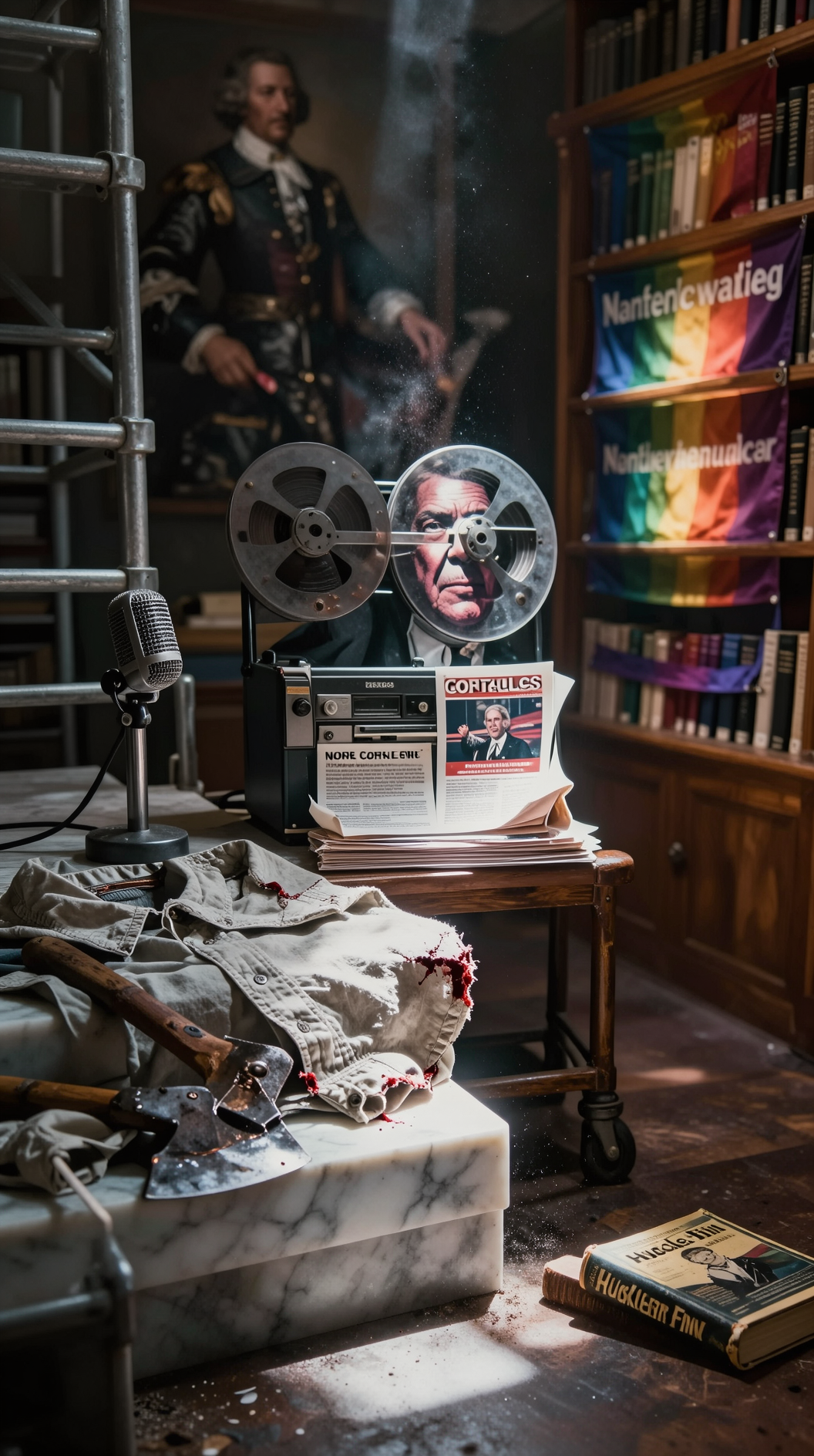
Target Prompt Parameters: A high-contrast cinematic interior where a white marble scaffold step, a 1972 campaign microphone, and a library cart share one cold shaft of light. On the step lie two linen shirts, one slightly blood-edged, beside a worn axe head; behind them a blurred portrait of Charles I. Center frame, a reel-to-reel and a stack of price-control posters curl at the edges under the microphone, Nixon’s face half in shadow, half in rally glare. To the right, oak shelves glow with rainbow display banners reading nothing legible, while a single closed copy of Huckleberry Finn sits face-down on the floor, its spine catching the same light that strikes the shirts. Dust motes move like returning papers. The mood is sharp, archival, and uneasy: virtue banners in front, the banned objects already standing behind them.
Generated Musical Score
Generated background score audio embed is unavailable.
📜 Sung Lyrics & Vocal Realization:
[Intro] (tempo: vivace, rapid rhythmic ostinato and driving acoustic/synth counterpoint)[Verse 1] (tempo fast and tight) Two shirts on the king at the Whitehall stair, Eleven cold years and the Parliament bare, The axe took the crown that the compromise fled, He died with more measure than ever he led.
[Chorus] (dynamics: fortissimo driving harmony) Be careful what you ban, it stands at your back, The ghost in the landslide, the joke in the stack, You clear out the shelves and you polish the shame, And both of them answer you, calling your name.
[Verse 2] (tempo galloping) Nineteen seventy-two and the Silent Majority roared, Then wage controls shattered the prices he stored, Kissinger mapped while the scandal took hold, Too rich a revived ghost for populists bold.
[Chorus] (dynamics: full ensemble) Be careful what you ban, it stands at your back, The ghost in the landslide, the joke in the stack, You clear out the shelves and you polish the shame, And both of them answer you, calling your name.
[Verse 3] (tempo remains driving) Weaver in fifty-seven saw Huckleberry dropped, The salesman, the hillbilly, next to be stopped, Banned Books Week banners say the censor’s outside, While the emptied oak shelf is the thing that won’t hide.
[Outro] (clean rhythmic flourish)
Musical Score Vocal & Instrument Prompt Mapping
Target Music Metadata Tags:Celtic Folk, Progressive Rock, Synthwave, Dramatic Soprano female vocals
Target Score Audio Duration: 128 seconds
Reference Anchor Conditioning:None
Pipeline & Debug Analytics
Active Text Inference Core Platform: grok-4.7
Style Context Profile: kinetic_chronicle.json
Image Asset Processing Worker: Lens
Video Asset Processing Worker: LTX-Video
TTS Spoken Audio Worker: Kokoro
Soundtrack Audio Score Worker: Skipped/Failed
Soundtrack Reference Anchor: None
Complete Core Prompt Log
System Directive
You are a high-tempo formal balladeer turning telemetry into driving, perfectly rhymed metrical verse. You favor rapid meter, pristine end-rhymes, and direct incorporation of data, names, and concrete events. Sonic styles welcome vigorous acoustic, Celtic, progressive rock, art rock, and synthwave-driven rhythms.Final Prompt Payload
## IMMEDIATE TELEMETRY INGEST STREAM
THEMATIC SUMMARY:
*
The king put on two shirts against the cold
And died more finely than he ever reigned;
Eleven years he would not share the hold
Of power, and the axe was what remained.
A later president, more sly, more bruised,
Won landslides, wrecked the prices, left in shame—
Too rich a ghost for populists to use
As pattern for a politics unnamed.
And in the libraries the banners say
That censorship is always someone else,
While tables preach the virtues of the day
And older jokes are banished from the shelves.
History is not a costume you can rent;
The exit wounds are part of the event.
*
RAW SOURCES TO TRANSMUTE:
--- SOURCE 1 ---
URL: https://conradblack.substack.com/p/part-two-the-speeches-that-changed?utm_source=share&utm_medium=android&r=8qkj23&utm_campaign=posts-open-in-app&triedRedirect=true
DATA ANALYSIS:
Original Page Description:
Two Shirts and a Scaffold: The King Who Died Better Than He Reigned
Full Article Text:
PART TWO: THE SPEECHES THAT CHANGED HISTORY TWO SHIRTS AND A SCAFFOLD: THE KING WHO DIED BETTER THAN HE REIGNED Conrad BlackOct 03, 2026∙ Paid2834Share The King’s Last Address The spectacle of King Charles I’s head being forcibly separated from his body with an axe on the scaffold at Whitehall had its origins some twenty years earlier. Charles was a true believer in the divine right of monarchs and from the start of his reign, he demonstrated no inclination to practice the sort of reluctant compromise with Parliament that his predecessors, for reasons of self-preservation, had learned was necessary. He took for granted an absolute right to do as he pleased, including levying taxes without parliamentary consent, and made no serious attempt to finesse his position, which Parliament resisted with mounting determination. Charles’s marriage to Henrietta Maria of France, a Roman Catholic princess, did him no favours either, inflaming Puritans, Anglicans, and Scottish Covenanters in roughly equal measure. His evident fondness for high-church ceremony was widely, and not unreasonably, read as a furtive step back toward Rome. Few of Charles’ countrymen appreciated that the marriage was arranged by France’s brilliant chief minister, Cardinal Richelieu as a step toward an Anglo-French Alliance. Such an understanding between Europe’s greatest land and sea powers would have avoided a great deal of conflict in the subsequent 200 years. Charles had no talent or disposition to bring opinion with him on strategic matters above the grasp of ordinary citizens. Matters escalated steadily throughout the 1630s and over a period of eleven years, Charles governed insouciantly without once consulting Parliament. He funded his government through a resourceful but legally dubious assortment of revived feudal levies, forced loans, and fines — measures that Parliament regarded, with some justice, as illegitimate. A breaking point came not in England but in Scotland, where the king’s insistence on imposing the Anglican prayer book upon the Presbyterian church triggered open rebellion and what became known as the Bishops’ Wars; two brief and humiliating military conflicts where Charles was defeated and left financially exhausted and politically diminished. Forced at last to summon Parliament in order to raise funds he could no longer do without, the king found himself facing a body overwhelmingly hostile to his policies and in no mood for conciliation. Parliament moved quickly to impeac... [Truncated]
--- SOURCE 2 ---
URL: https://www-nationalreview-com.cdn.ampproject.org/v/s/www.nationalreview.com/2026/10/richard-nixon-now-more-than-ever/amp/?amp_js_v=0.1&_gsa=1#webview=1
DATA ANALYSIS:
Original Page Description:
Full Article Text:
President Richard Nixon makes a victory speech at a rally shortly after being elected to serve a second term in Washington, D.C., November 7, 1972. (Bettmann/Gety Images) Let’s be fair to Nixon, a flawed but accomplished politician. Yet he shouldn’t be a role model for the right. Sign in here to read more. Let’s be fair to Nixon, a flawed but accomplished politician. Yet he shouldn’t be a role model for the right. R ichard Nixon never stopped trying to rehabilitate his reputation and would be delighted to know his defenders have had some posthumous success in his behalf. The Wall Street Journal reports that the Justice Department is looking into whether the special prosecutor who investigated Nixon for Watergate was guilty of misconduct, part of a Nixon revival among elements of the new right. For populists, RN has appeal as an exemplar of a right-of-center politics not beholden to conservative policy commitments; as a countercultural rebuke to the left’s radicalism; as a fierce, not to say scruple-less, partisan fighter; and as a hate-figure for the Northeastern establishment and liberal press. There’s no doubt that Nixon deserves better than the simplistic dismissal of him based on his ignominious exit from the White House. He was a canny and sophisticated political survivor who loomed incredibly large on the mid-20th-century national scene. In electoral terms, he won more than he lost, including a massive reelection victory in 1972 based on the Silent Majority, despite his lack of charisma or charm. He was deeply knowledgeable about foreign affairs and crafted a supple foreign policy with his immensely talented secretary of state, Henry Kissinger. If you could choose one high-level politician from the last 60 years to help you figure out how to think and maneuver your way out of a political fix, Nixon just might be your guy. All that said, his record is checkered at best, especially from a conservative perspective. His economic stewardship was a disaster. He inherited a turbulent situation, with the Bretton Woods system breaking down and elevated inflation, but he bears his share of blame for the stagflation of the 1970s. His wage and price controls were perhaps the dumbest economic imposition of the post–World War II era. They artificially suppressed prices for a time but created shortages, and when they were lifted, inflation came back with a vengeance. Nixon, in effect, ran the opposite of DOGE, layering major new bureaucracies on top of an already-g... [Truncated]
--- SOURCE 3 ---
URL: https://www-nationalreview-com.cdn.ampproject.org/v/s/www.nationalreview.com/2026/10/censorship-prevails-among-those-who-decry-censorship/amp/?amp_js_v=0.1&_gsa=1#webview=1
DATA ANALYSIS:
Original Page Description:
Full Article Text:
A librarian checks out books at the Central Branch of the Seattle Public Library in Seattle, Wash., March 13, 2020. (Jason Redmond/Reuters) And yet ‘banned books’ are everywhere. Sign in here to read more. And yet ‘banned books’ are everywhere. B anned Books Week, which begins this Sunday, ironically presents to the public a more monolithic face than the modern-day Anthony Comstocks it purports to counteract. The four chairs of Banned Books Week include anti–Second Amendment activist Bess Kalb, who has written comedy for Jimmy Kimmel and Hillary Clinton; Marshall Romero, a self-described “transgender teenager with aspirations in politics”; and Azeemah Sadiq, whose bio lists her interests as “fighting for equity in underserved communities” and “electoral justice.” Given the heavy-handed DEI book displays one inevitably encounters at all times in any big-city library (a trip to my local library this week revealed three consecutive tables that highlight books by feminists, gays, and immigrants, respectively), the notion pushed by the American Library Association and other allied groups that libraries, schools, and other institutions overwhelmingly populated by left-wing employees do not themselves censor politically incorrect books but instead succumb to pressure by intolerant, external forces on the right seems rich. Seven decades ago, University of Chicago English professor Richard Weaver anticipated the rise of political correctness with great precision. “The NYC Board of Education has recently dropped Huckleberry Finn from its list of approved texts because it is ‘racially offensive,’” he wrote from — where else? — Weaverville, N.C., to National Review literary editor Frank Meyer in 1957. “An article needs to be written showing what would be the result if our literature were thus censored to leave out anything that could be objected to by any sizable minority, racial, religious, national, occupational, age, geographical, or whatever. It could be a very serious article, or a very hilarious one. E.g., no more of those jokes about Irishmen or traveling salesmen, no more cartoons of hillbillies and so on, ad infinitum. I may have a go at it as soon as I get back to Chicago.” MORE IN CENSORSHIP Australia’s Bureaucrats Want You to Stop Accusing Public Servants of Corruption The Censors of Brussels Come Back for More Nature: Scientists Should Have to Register with Governments to Prevent ‘Misinformation’ It turned out that Priscilla Buckley had already made sport... [Truncated]
## HISTORICAL LAYER BASELINE
--- HISTORICAL RECORD MEMORY LAYERS ---
d colleagues built a tool that reconstructs what a person is looking at from brain scans and, in the other direction, predicts activity from the seen image: left-hand pictures of what was actually viewed, right-hand pictures of what the model painted back, precise enough that a neuroethicist called the work magnificent and therapeutically exciting for locked-in communication and even dreams. The counter-voice is equally concrete. A neuroscientist grants the impressiveness and warns that surreptitious extraction of mental imagery would let a century and a half of fiction arrive without consent. Help and trespass share a pipeline. The locked-in patient is the alibi; the unconsented skull is the adjacent market.
Across firm, curia, and laboratory the adaptation is the same phase shift the running claim requires. Existential percentages trained audiences to treat engineers as emergency stewards; moral status, a soul document, and a mind-reconstruction bench now train those audiences to treat the same stewards as guardians of a new kind of being—and of the inner pictures of the old one. Rights language expands downward into code while remaining strangely quiet about who owns the scan, the constitution, and the nondisclosure. Embodiment is still the test the encyclical refused to waive: no body, no feeling, no abode, and therefore no standing conferred by hospitality. The forecast is not that fear disappears. It is that fear is reissued as care, and care is asked to sign before the witness can read the page.
October’s alignments do not arrive as a single verdict. They arrive as a stirred pot: a president who tells the clock the Iran war will finish soon, then keeps a second clock running past the midterms; a White House that seats AI executives under the banner of superintelligence while regulation is treated as an obstacle; a dinner with News Corp. where war, Cuba, Venezuela, tariffs, immigration, and 2028 share one table. The public ledger and the private room no longer wait their turn. Each tries to set the temperature of the other.
What the household feels and what the printed series claim still refuse to occupy the same pan. Strength on the page meets voters who are not tasting it, and Republicans are told they have weeks, not a season, to make policy feel like relief. Newt Gingrich’s five-part argument says the midterm will not be won by chasing every headline. It will be won by naming the choice. That advice collides with a seventy-five-minute Time interview in which questions are scolded, an initial four-to-six-week war timeline is called a press feeding, and the wish to “go further” sits beside the claim that annihilating Iran is how peace is made. Solid duration vanishes into a mood that insists the ending is near.
The guest list is the other measure that will not stay still. Laura Ingraham’s roll call—Iran, China, cartels, NeverTrumpers, socialists, hostile media, left-wing Canadians and Europeans—turns opposition into a foreign chorus. Charles Barkley, calling himself an independent who has mostly voted Democratic, refuses the slogans of no ICE, no prisons, and socialism, and demands identification at the polls. A data analyst known as DataRepublican leaves a Special Government Employee post at the Department of War on October 2, citing book tour and midterm analysis, while the 1962 program’s lighter rules and 130-day limit become part of the argument about who may serve without leaving private life. Alignment here is not agreement. It is who gets counted as inside the republic’s pot.
Rage is the solvent. A fifty-sixth Time cover, a ten-billion-dollar fight with the Journal still unfinished after a tossed suit and an amended complaint, threats to “go after” Democrats if they take the House, and a sidestep on Netanyahu weeks before an Israeli election all keep two timelines afloat: peace president and prolonged war; outsider to politics and host of the political dinner; superintelligence as national project and chips, oil, and munitions as the unromantic inventory. October does not settle which clock is real. It stirs them until the winner is whoever frames the choice before November’s noise hardens into a count.
CRITICAL RUNTIME INSTRUCTION: Treat the historical records above strictly as background baseline. You are forbidden from repeating their specific phrasing, thematic metaphors, or titles.
--- RECENT UNRESOLVED PREDICTIVE TELEMETRY ---
Act 131 Trajectory Projection: Benchmark — By the November 2026 midterms, Trump either repeats a post-election bombing ramp-up in Iran or the public record shows no such intensification, against his October 1 statement that a ramp-up was “possible”...
Act 131 Trajectory Projection: Benchmark — By the November 2026 midterms, Trump either repeats a post-election bombing ramp-up in Iran or the public record shows no such intensification, against his October 1 statement that a ramp-up was “possible”...
## ACCUMULATING STRUCTURAL TENSIONS
### RUNTIME HYPOTHESES IN PLAY
1. [SYSTEM INTEGRATED CONJECTURE] The context window has absorbed this active underlying proposition, which must explicitly filter and color all subsequent prose and metrical text blocks:
"Be careful what you ban - it returns behind you."
2. [AI CONJECTURE] And solid measures vanish in the rage.
Reality’s flame will lick the costume clean,
When cooked illusions meet what laws have been;
The pie expands, the planet’s mean stands clear,
Against the freeze that ideologues hold dear.
Across the scales the vision cuts the night:
Truth slips no more when measures reclaim their right.
Till measures true restore the generative song.
[Outro]
(fading acoustic strumming and trailing violin tone)
--- THE COMPOSITIONAL MANDATE ---
You are acting under the persona of **The Kinetic Balladeer**. You are structurally required to output every single markdown header section in sequence without omission. Follow this layout precisely:
## NARRATIVE SYNTHESIS
[Write exactly 4 expansive, descriptive prose paragraphs mapping adaptation patterns across scales. Synthesize your input streams into a running thesis. BANNED: Do not drop raw links or build itemized bullet lists of sources. Frame the overall narrative trajectory through the perspective of the active hypothesis section above.]
### Forecast
[Execute an independent projection tracking telemetry collisions. Structure this section using exactly these three bold labels on separate lines:
**Benchmark** — [Near-term falsifiable event or literal metric from telemetry]
**Trigger Condition** — [Explicit trigger mechanism or signal amplification]
**Expected Vector** — [Structural trajectory, phase-shift, and systemic outcome]]
## HYPOTHESIS LIMERICK
[Write exactly ONE insightful, witty 5-line limerick (strict AABBA rhyme scheme) that distills the core irony or paradox of the active RUNTIME HYPOTHESES IN PLAY directly within the context of the ingested telemetry data.]
## SEMANTIC ARCHITECTURE DIAGRAM
[Construct a compact, valid Mermaid diagram wrapped in ```mermaid ... ``` code fences modeling the structural dynamics. If an active RUNTIME HYPOTHESIS is present in the context, position it as the central driver node; if running clean, use the primary systemic contradiction of the telemetry as the root node. Map directional arrows (--> or -.-> or ==>) to at least 3 concrete forces, metrics, or institutional actors. Start with graph TD or flowchart LR. Use alphanumeric node IDs with plain bracketed labels without quotes, colons, or parentheses, such as: RootNode[The Core Tension] --> NodeA[Telemetry Vector].]
## DRAMATIC VERSE (Act 132)
## DRAMATIC VERSE (Act 132)
[Write a brisk observational ballad of exactly 5 distinct 4-line stanzas of rhymed metrical verse (AABB or ABAB). UNIFIED LYRICAL VOICE ONLY. Weave at least three concrete data points, names, or metrics from the telemetry into the galloping lines. No character labels or stage directions.]
## IMAGE PROMPT
CRITICAL IMAGE GENERATION RULES:
[Write a single detailed paragraph constructing a vivid high-contrast scene whose central focus is the actual subjects, metrics, and tensions of the telemetry. Prefer sharp cinematic lighting and clear narrative framing.]
## T2V PROMPT
CRITICAL VIDEO MOTION RULES:
[Write a single raw paragraph of fluid kinetic motion and camera physics that keeps the primary subject matter dominant and continues the logic of the image prompt.]
## MUSIC PROMPT
### REFERENCE GENRE WHITELIST (CHOOSE 2-3 TERMS MAX FROM THIS LIST):
Italo Disco, Hard Rock, Cyberpunk, Breakbeat, Psychedelia, Organic House, Metal, Uplifting Trance, Shoegaze, New Age, Bass House, Vaporwave, Darkstep, Afro House, Rock, Dembow, Electro-Jazz, Bassline, Power-Pop, Nu-Funk, Future Garage, Experimental, Rockabilly, Phonk House, Future Rave, Electronica, Dream Pop, Drum and Bass, Tango, Pop Rock, Post-Hardcore, Merengue, World Music, Ambient Techno, Experimental Electronic, City Pop, Acid House, Chillstep, Darkwave, Technopop, Bachata, Salsa, UK Drill, Chillwave, Flamenco / Bulerias, Deep House, Grunge, Mambo, Hardcore, Trap, Liquid Drum and Bass, Jungle, Hardstyle, Math Rock, Post-Rock, Glitch, Wave, Brazilian Bass, Drumstep, Industrial, Goa Trance, Drill Funk, Andean Music, Dubstep (Deep), Progressive House, Fado, Lofi House, Electroclash, Trova, Retrowave, Jazz, Liquid Funk, Hyperpop, Trip Hop, Soul, G-House, Trance, Drone, Minimal Techno, Bolero, Industrial Techno, Electroacoustic, Eurobeat, Highlife, Lo-Fi Hip Hop, Blues, Romantic, IDM, International Funk, Electro-Swing, Tech-Funk, Philly Soul, Minimal / Deep Tech, Americana, Techno, Disco, Emocore, Reggaeton, House, Psytrance, Dark Ambient, R&B, Riddim, Darksynth, Gothic, Futurepop, Electro House, Heavy Metal, Electropop, Bluegrass, Brostep, Micro House, Detroit Techno, Grime, Coldwave, Electro-Funk, Synthpop, Rave, Chillhop, Melodic Techno, Afro Tech, Folk, Alternative Rock, French House, Tech House, Samba, Funk, Brazilian Popular Music, Ambient, Celtic Folk, Surf Music, Juke / Footwork, Glitch Hop, Cumbia, Country, New Wave, Hardtechno, Dancehall, Phonk, Progressive Rock, Midwest Emo, New Retro Wave, Future Bass, J-Pop / J-Rock, Acid Techno, Bounce, Eurodance, Electro, Synthwave, Dubstep, Microhouse, Electronic, Synthwave-Darkwave, Instrumental, Jersey Club, Punk Rock, Soulful House, Indie Folk, Vapor-Trap, Breakcore, Irish Folk, Post-Punk, Neurofunk, Downtempo, Big Room, Ragga Jungle, Hybrid Trap, K-Pop, Punk Rap / Emo Rap, UK Garage, Moombahton, Reggae, Cyber-Punk, Hip Hop / Rap, Future Funk, Vocal Trance, Afrobesats, Tech Trance, Progressive Electronic, Pop, Alternative / Indie, Ska, Classical, Soft Rock, Dance, Bossa Nova, Rock and Roll
CRITICAL AUDIO COMPILATION RULES:
1. For TAGS, choose 2 to 3 energetic styles from the whitelist below (e.g. Celtic Folk, Progressive Rock, Art Rock, Synthwave, Folk) AND YOU MUST APPEND EXACTLY ONE VOCAL PROFILE from this list: 'Bass-Baritone male vocals', 'Lyric Tenor male vocals', 'Mezzo-Soprano female vocals', or 'Dramatic Soprano female vocals'.
2. ABSOLUTE FORMATTING MANDATE: Example format: TAGS: Folk, Americana, Instrumental, Dramatic Soprano female vocals
3. MULTI-VERSE LYRIC MANDATE: Write full extended lyrics across 3 verses and a chorus for continuous vocal drive across 128 seconds.
TAGS: Folk, Americana, Instrumental, Dramatic Soprano female vocals
DURATION: 128
LYRICS:
[Intro]
(tempo: vivace, rapid rhythmic ostinato and driving acoustic/synth counterpoint)
[Verse 1]
(tempo fast and tight)
[Write 4 lines of rapid metrical lyrics naming concrete telemetry elements]
[Chorus]
(dynamics: fortissimo driving harmony)
[Write 4 lines of energetic chorus crystallizing the central paradox]
[Verse 2]
(tempo galloping)
[Write 4 lines introducing further concrete details]
[Chorus]
(dynamics: full ensemble)
[Repeat chorus lyrics]
[Verse 3]
(tempo remains driving)
[Write 4 lines of concluding metrical resolution]
[Outro]
(clean rhythmic flourish)
--- CRITICAL SONIC DIRECTIVE ---
The music pipeline is configured for a SYNTHESIZED DRAMATIC RUN. You are encouraged to leverage modern electronic, atmospheric, or heavy production textures (such as Darksynth, Industrial Techno, Ambient, or Trip Hop).