Reusable Thunder: Cadence and Catch - Transmuted Pass
Navigation
- Ongoing Narrative Arc
- Primary Poetic Artifact
- Kinetic Dynamic Video
- Visual Anchor Representation
- Generated Musical Score
- Pipeline & Debug Analytics
Active Underlying Paradigm
Scriptorium Operational Parameter [DIRECT INJECTED IDEA PARADIGM]: Reproduce the maelstrom - and let it join the stream
Paradigm Limerick Distillation: Two Falcons leapt coasts in a flash, Thirty-eight minutes made yesterday smash; The maelstrom they raise Joins the reusable phase— Catch the giant, then let the stream dash.
Thematic Seed
*
Two Falcons leap from coasts a breath apart,
Thirty-eight minutes shatter yesterday's mark;
While Starship's thirty-three raptors impart
Twice Saturn's thrust, yet dream of catch and spark.
The booster falls like pencil, caught again
To fly tomorrow, cheap as earthly fire—
Not rawest power, but the turnaround's gain
That turns the void into a working spire.
Old rockets drowned; this one returns to stand,
A falling giant grasped by mechanical hand.
*
Ongoing Narrative Arc
Two coasts breathe as one when a pair of Falcons vault skyward thirty-eight minutes apart, the western booster already climbing while the eastern still sheds its first satellites for Globalstar. That interval, shaved twenty-seven minutes beneath the prior mark, folds yesterday’s record into today’s current so the void itself becomes a working corridor rather than a once-only leap. The maelstrom of simultaneous coast-to-coast fire is thereby reproduced and instantly joined to the larger stream of reusable cadence, each successful deployment confirming that rapid succession now outweighs isolated spectacle.
Starship’s thirty-three Raptors then answer with seventy-four point four million newtons, twice the force that once lofted Apollo, yet the vehicle’s true claim is not the roar but the planned grasp that would catch the returning booster like a fallen pencil. Raw thrust, already achieved half a century ago, is subordinated to the engineering of turnaround: the giant must stand again tomorrow, cheap as earthly fire, so the same stream that carries two Falcons today may carry the heavier craft next week. Adaptation therefore lives in the mechanical hand that refuses to let the first stage drown.
Across these scales the pattern is substitution of recovery for ruin. Old rockets spent themselves in the ocean; this lineage returns to the pad, each catch converting the prior maelstrom of expended stages into a reusable current. The classified USSF-366 payload, inferred to ride a Starshield bus along familiar drop-zone tracks, further joins the classified stream to the public one, proving that even hidden cargo now travels the same rapid interval. The hypothesis colors every clause: the chaos of dual coasts and thirty-three engines is not contained but reproduced so it may flow onward.
Thus the narrative trajectory treats every launch not as an isolated thunder but as a tributary. Thirty-eight minutes, eight satellites, one classified stack, and the dream of a caught Super Heavy all pour into a single working spire that reaches higher precisely because it refuses to stay fallen. The stream accepts the maelstrom and is enlarged by it.
Forecast
Benchmark — Public confirmation, within the next news cycle, of the exact deployment time and orbital parameters for the USSF-366 payload relative to the 9:50 p.m. EDT Vandenberg liftoff. Trigger Condition — SpaceX or official range statements that either match or diverge from the Starlink Group 15 drop-zone pattern already inferred. Expected Vector — Rapid integration of classified cadence into the public thirty-eight-minute record, accelerating the turnaround logic that treats every booster as immediately reusable rather than expended.
Primary Poetic Artifact
THE ARCHITECT: [tracing an arc in the air] Yet seventy-four million newtons roar Only to prove the booster can restore Itself to the pad, cheap as earthly fire, So the void becomes a working spire.
THE WITNESS: [pointing east then west] Eight Globalstar craft flew true from the Cape, While USSF-366 took classified shape; The first stage falls like a pencil, yet stands Grasped by the hand that the old ocean bans.
THE CHRONICLER: [unrolling a short scroll] Yesterday’s mark fell by twenty-seven more, Starlink’s own interval now less than before; The maelstrom of coasts joins the reusable stream, Each catch a tomorrow, not a spent dream.
THE HERALD: [raising the pennant again] Reproduce that thunder, let it join the flow— Not rawest power, but the turnaround’s glow; Old rockets drowned; this giant shall stand, A falling world caught by mechanical hand.
Kinetic Dynamic Video
Video Generation Prompt
Target Prompt Parameters: Camera begins in a wide aerial sweep that first follows the Florida Falcon’s bright ascent then pans west in a single fluid motion to catch the California vehicle already airborne, the two plumes drawing closer in the frame until they appear almost simultaneous; the lens then tilts downward in a graceful crane to track the Super Heavy booster’s pencil-like fall, engines gimbaling, until the mechanical arms snap shut around its grid fins, the entire sequence remaining in continuous kinetic flow with no cuts, the captured booster filling the final frame as the sky behind it stays brilliantly clear.
Visual Anchor Representation
Image Generation Prompt
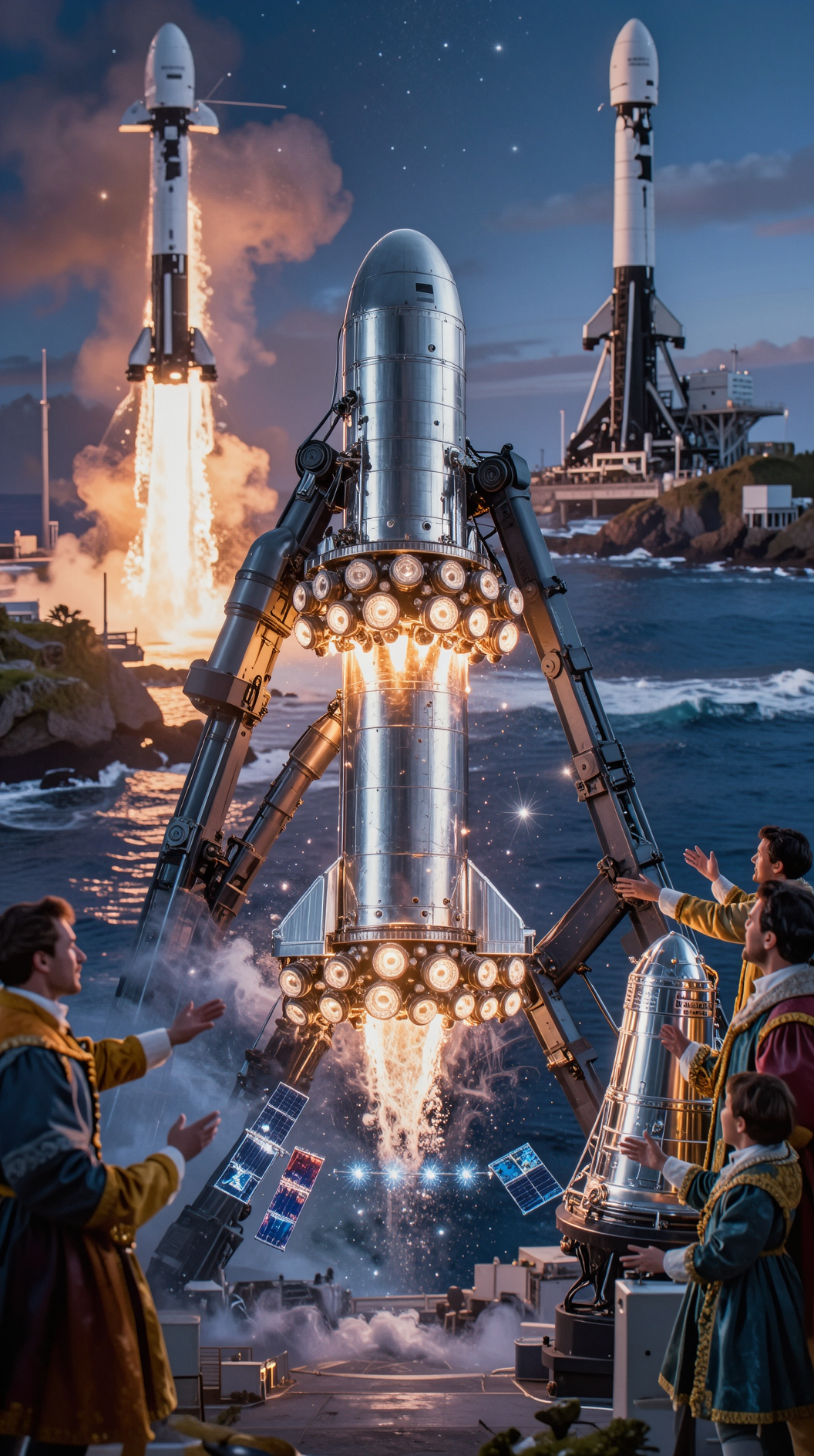
Target Prompt Parameters: Two gleaming Falcon 9 vehicles, one lifting from a sunlit Florida cape and the other from a California coastal pad, their white-and-black bodies crossing the same twilight sky thirty-eight minutes apart; below them a massive Super Heavy booster, thirty-three engines still glowing, descends like a silver pencil toward a pair of towering mechanical arms that close around it in mid-air, while eight small Globalstar satellites sparkle in a precise line against the stars and a classified payload capsule gleams beside them, all figures in bright Renaissance court dress gesturing toward the captured booster as the central proof that the falling giant now stands ready to fly again.
Generated Musical Score
Musical Score Vocal & Instrument Prompt Mapping
Target Music Metadata Tags:Folk, Americana, Classical, Dramatic Soprano female vocals
Target Score Audio Duration: 128 seconds
[Intro] (tempo: allegro, bright chamber texture)[Verse 1] (tempo remains brisk) Two Falcons leapt the coasts a breath apart, Thirty-eight minutes shattered yesterday’s mark; Eight satellites rode true from the eastern pad, While western fire joined the classified track.
[Chorus] (dynamics: fortissimo with bright vocal harmony) Catch the falling giant, let the stream run clear— Not rawest thunder but the turnaround’s cheer; Reproduce the maelstrom, join it to the flow, Tomorrow’s booster stands where yesterday would go.
[Verse 2] (tempo remains steady) Thirty-three Raptors twice Saturn’s old might, Seventy-four million newtons in the light; Yet the pencil falls to the waiting hand, Cheap as earthly fire across the land.
[Chorus] (dynamics: full harmony) Catch the falling giant, let the stream run clear— Not rawest thunder but the turnaround’s cheer; Reproduce the maelstrom, join it to the flow, Tomorrow’s booster stands where yesterday would go.
[Verse 3] (tempo remains driving) Old rockets drowned; this one returns to stand, A working spire built by mechanical hand; The void itself now bears a reusable song, The maelstrom joined, the current running strong.
[Outro] (bright classical cadence)
Pipeline & Debug Analytics
Active Text Inference Core Platform: grok-4.6
Style Context Profile: courtly_debate_v1.json
Image Asset Processing Worker: Lens
Video Asset Processing Worker: LTX-Video
TTS Spoken Audio Worker: Kokoro
Soundtrack Audio Score Worker: ACE-Step 1.5
Complete Core Prompt Log
System Directive
You are a sharp court dramatist writing rhymed metrical dialogue in the tradition of Dryden and the English masque. Your purpose is to stage telemetry as a brisk debate among NAMED CHARACTERS. Favor bright meter, perfect rhymes, dramatic irony, and explicit use of concrete facts from the data. Completely ban dark, slow, electronic, or heavy industrial concepts.Final Prompt Payload
## IMMEDIATE TELEMETRY INGEST STREAM
THEMATIC SUMMARY:
*
Two Falcons leap from coasts a breath apart,
Thirty-eight minutes shatter yesterday's mark;
While Starship's thirty-three raptors impart
Twice Saturn's thrust, yet dream of catch and spark.
The booster falls like pencil, caught again
To fly tomorrow, cheap as earthly fire—
Not rawest power, but the turnaround's gain
That turns the void into a working spire.
Old rockets drowned; this one returns to stand,
A falling giant grasped by mechanical hand.
*

RAW SOURCES TO TRANSMUTE:

--- SOURCE 1 ---
URL: https://www.space.com/space-exploration/launches-spacecraft/spacex-breaks-record-launch-doubleheader-ussf-366-globalstar-2r
DATA ANALYSIS:


Original Page Description:

The two rockets lifted off from opposite coasts on Saturday evening (Aug. 15).

Full Article Text:
Click for next article Copy link Facebook X Whatsapp Reddit Pinterest Flipboard Email Share this article 1 Join the conversation Follow us Add us as a preferred source on Google Newsletter Subscribe to our newsletter SpaceX keeps setting spaceflight records. Elon Musk's company launches far more frequently than any other outfit, and it operates the largest satellite constellation ever assembled — the Starlink broadband network, which consists of nearly 11,000 satellites (and counting). On Saturday evening (Aug. 15), SpaceX set another mark, for the shortest time between orbital flights: It launched two Falcon 9 rockets just 38 minutes apart, besting its old mark — set on Aug. 31, 2024 with two Starlink missions — by 27 minutes. A SpaceX Falcon 9 rocket launches eight satellites for the telecom company Globalstar from Florida's Cape Canaveral Space Force Station on Aug. 15, 2026. (Image credit: SpaceX) The first liftoff, from Florida's Cape Canaveral Space Force Station, occurred Saturday at 9:12 p.m. EDT (0112 GMT on Aug. 16) and carried eight satellites to low Earth orbit (LEO) for Louisiana-based telecom company Globalstar. All eight spacecraft were deployed successfully, separating over a six-minute span beginning 56.5 minutes after liftoff, SpaceX announced via social media. While that Falcon 9 was powering its way to LEO, another one launched from Vandenberg Space Force Base, on California's central coast. That liftoff, at 9:50 p.m. EDT (6:50 p.m. local time; 0150 GMT on Aug. 16), kicked off a mission for the U.S. Space Force called USSF-366. A Globalstar satellite deploys from the upper stage of its Falcon 9 rocket on Aug. 15, 2026. (Image credit: SpaceX) We know very little about USSF-366, which isn't surprising given its classified status. However, rocket watchers have made a few inferences from the limited available information. "It is possibly a batch of classified LEO satellites for a U.S. government entity based on SpaceX's Starshield satellite bus, based on locations of rocket stage drop zones being exact fits with previous Starlink Group 15 launches," NextSpaceflight.com wrote in its mission description. (Starshield is a SpaceX project that uses modified versions of Starlink craft to fly national security missions for the U.S. government.) It's unclear when and where the rocket's upper stage will deploy the USSF-366 payload(s); SpaceX's mission description doesn't reveal that information. And the company ended its livestream shortly after the... [Truncated]

--- SOURCE 2 ---
URL: https://spacedaily.com/b-starships-33-engines-push-down-with-74400-kilonewtons-at-liftoff-roughly-twice-the-force-of-the-saturn-v-that-sent-humans-to-the-moon-yet-the-whole-vehicle-is-designed-to-be-caught-like-a/
DATA ANALYSIS:


Original Page Description:

SpaceX's bet is that catching and reusing a 5,000-tonne rocket is cheaper than building a new one, and the engineering challenges of making that work may matter far more than raw horsepower.

Full Article Text:
At the moment of liftoff, SpaceX’s Starship pushes off the launch pad with approximately 74.4 million newtons of thrust — enough force, in principle, to lift roughly 7,500 tonnes of mass directly against gravity. For context, that is about twice the thrust of the Saturn V rocket that carried the Apollo astronauts to the Moon between 1969 and 1972. The vehicle itself is taller — 121 metres compared to Saturn V’s 111 — and heavier when fully fuelled, with a total mass at liftoff exceeding 5,000 tonnes. By raw physical output, Starship is the most powerful rocket ever built. But raw thrust is not really the point of Starship. Saturn V hit similar physical scales half a century ago. What Starship is actually attempting to prove — and what its engineering choices really reflect — is not the maximum size of a rocket. It is the maximum turnaround time between launches. If it works, that is the innovation that changes what humans can do in space. WHAT ACTUALLY HAPPENS AT LIFTOFF The Super Heavy booster — the massive first stage of Starship — is powered by 33 Raptor 2 engines burning liquid methane and liquid oxygen. Each Raptor 2 produces approximately 2,260 kilonewtons of thrust at sea level, roughly 230 tonnes-force. Multiplied across 33 engines, the total is about 74.4 million newtons, or 16.7 million pounds-force. This is more than the current maximum thrust of NASA’s Space Launch System (about 39,144 kilonewtons) and more than double that of the Saturn V (about 35,000 kilonewtons). The rocket burns through propellant at an extraordinary rate. Super Heavy contains 3,400 tonnes of liquid methane and liquid oxygen. All 33 engines burn continuously for approximately 166 seconds during the first stage of ascent, consuming roughly 20 tonnes of propellant per second at peak flow. At that point, the second stage — the Starship spacecraft itself — separates and continues to orbit under its own six Raptor engines, while the Super Heavy booster reverses course and returns to the launch site. That return is where the specific engineering revolution actually lives. WHY SATURN V COMPARISONS ONLY GET YOU HALFWAY Saturn V was, by any measure, an extraordinary rocket. It launched 13 times between 1967 and 1973. Every one of those launches ended with the entire rocket falling into the ocean, breaking apart, or burning up. Not a single Saturn V was ever recovered, refurbished, or flown again. Every subsequent large rocket, until roughly 2015, followed the same pattern. Rockets ... [Truncated]


## HISTORICAL LAYER BASELINE
--- HISTORICAL RECORD MEMORY LAYERS ---
citations recycle the identical images of the truck pulling alongside, of Trump boarding the left-side door in full view, of the secret C-32 hop from Ankara. Each retelling adapts the same concrete events to a new audience yet never supplies the missing transfer in England. The thesis therefore reads the silence itself as data: when the contents of the catering cart include presidents, the mystery is the point, not the assassination plot that Tehran supposedly prepared.

The largest scale is interpretive. Commentators treat the episode as either genuine evasion or an administration experiment in coloring the water, and both readings remain live because no definitive visual closes the gap. Adaptation here is the refusal of finality; the story continues to circulate exactly because it is calibrated to be believed just enough. The hypothesis colors every subsequent sentence: whatever actually sat inside those trays, the cart now carries the question of who would write it down.

The ingested streams reveal a bright pattern of substitution across electoral kitchens and city fountains, where a Wisconsin primary that declined to crown a candidate who scorned Thanksgiving tables and Valentine service labor stands in for a larger refusal of forced hive-mind. Voters, according to the Kelly clip and the Times scene, preferred a milder kitchen face over the hardcore socialist consternation that Republicans had hoped would prove easier to defeat, proving that mandatory togetherness does not automatically confer a mandate. The same logic scales to Carville’s demand that the caucus door slam on those who steal the Democratic name while running as something else, treating the party brand as a shared nest that must exclude the spawned rather than absorb every worker bee. Across these levels the hypothesis colors the prose: when eusociality is imposed by slogan rather than chosen at the table, the colony yawns instead of swarming.

New York supplies the next scale, where friends invoke a magic cut by calling Mamdani so that downed bacon-egg-and-cheese systems heal without anyone examining the actual public-service workers who keep the soccer-field fountains running. The bit remains the same: substitution of a named fixer for the ordinary labor that actually fills beds and tips waiters, just as the Habibi essay would bury the old York under a new enclave that resists rather than joins the American mission of liberty. Gen Z on mental-health leave and the AOC “loser” clip that pressures women away from families leave the household off-stage, while rumor still insists patriotism works because the country has not accepted the hive as destiny. The fever dreamed a mandate of total identification; the voters simply preferred the milder face that still recognizes Thanksgiving grace.

Carville’s institutional warning enlarges the pattern once more: far-left candidates who appropriate the Democratic name must be barred from committees and caucus seats if the brand is to survive the very faction it spawned. The country overwhelmingly rejects their agenda, yet they keep entering through the same primary door, repeating the Wisconsin lesson at the scale of House control. Adaptation here is exclusion as preservation, not expansion; the nest stays viable only when the door can close. The hypothesis therefore reads every barred candidate as proof that ants, not imposed collectivity, might organize the next attempt: each worker still chooses the trail rather than being told the trail is already the mandate.

At the largest interpretive scale the streams converge on a single restless refusal. Patriotism’s rumored death is exaggerated, the family remains the unglamorous stage that Gen Z leave cannot replace, and the brand lives by deciding who may not wear its colors. Substitution of slogans for kitchens, of named magicians for systems, of childless rage for ordinary love-days, all fail to produce the expected swarm. The telemetry therefore traces a bright arc of invitation that still requires a door: the colony persists only when eusociality is not mandatory, and the next experiment, the hypothesis insists, should try ants who follow scent rather than decree.

CRITICAL RUNTIME INSTRUCTION: Treat the historical records above strictly as background baseline. You are forbidden from repeating their specific phrasing, thematic metaphors, or titles.

--- RECENT UNRESOLVED PREDICTIVE TELEMETRY ---
Act 87 Trajectory Projection: Benchmark — Public confirmation or denial, within the next news cycle, of whether Democratic leadership formally bars any named DSA-aligned winner from caucus or committee assignment after the Wisconsin-style primary ...
Act 87 Trajectory Projection: Benchmark — Public confirmation or denial, within the next news cycle, of whether Democratic leadership formally bars any named DSA-aligned winner from caucus or committee assignment after the Wisconsin-style primary ...


## ACCUMULATING STRUCTURAL TENSIONS
### RUNTIME HYPOTHESES IN PLAY
1. [SYSTEM INTEGRATED CONJECTURE] The context window has absorbed this active underlying proposition, which must explicitly filter and color all subsequent prose and metrical text blocks:
"Reproduce the maelstrom - and let it join the stream"


--- THE COMPOSITIONAL MANDATE ---
You are acting under the persona of **The Court Dramatist**. You are structurally required to output every single markdown header section in sequence without omission. Follow this layout precisely:

## NARRATIVE SYNTHESIS
[Write exactly 4 expansive, descriptive prose paragraphs mapping adaptation patterns across scales. Synthesize your input streams into a running thesis. BANNED: Do not drop raw links or build itemized bullet lists of sources. Frame the overall narrative trajectory through the perspective of the active hypothesis section above.]

### Forecast
[Execute an independent projection tracking telemetry collisions. Structure this section using exactly these three bold labels on separate lines:
**Benchmark** — [Near-term falsifiable event or literal metric from telemetry]
**Trigger Condition** — [Explicit trigger mechanism or signal amplification]
**Expected Vector** — [Structural trajectory, phase-shift, and systemic outcome]]

## HYPOTHESIS LIMERICK
[Write exactly ONE insightful, witty 5-line limerick (strict AABBA rhyme scheme) that distills the core irony or paradox of the active RUNTIME HYPOTHESES IN PLAY directly within the context of the ingested telemetry data.]

## DRAMATIC VERSE (Act 88)
[Write an expansive theatrical debate consisting of exactly 5 distinct stanzas of rhymed dialogue spoken by EXPLICITLY NAMED CHARACTERS (e.g., 'THE WITNESS:', 'THE ARCHITECT:', 'THE HERALD:'). Each stanza MUST begin with a character name prefix followed by exactly 4 lines of rhymed iambic or trochaic verse, separated by brief descriptive stage directions in brackets. The characters must explicitly debate at least three concrete facts or metrics from the telemetry.]

## IMAGE PROMPT
CRITICAL IMAGE GENERATION RULES:
[Write a single detailed paragraph that stages a high-contrast visual scene whose central focus is the actual subjects, actors, and tensions of the telemetry. Characters may appear in formal or allegorical costume, but the composition must make the content of the debate legible. Do not default to musical instruments or generic court stages; only include such elements when they genuinely advance the subject.]

## T2V PROMPT
CRITICAL VIDEO MOTION RULES:
[Write a single raw paragraph describing fluid kinetic motion and camera physics that keeps the primary subject matter and character interaction dominant.]

## MUSIC PROMPT

### REFERENCE GENRE WHITELIST (CHOOSE 2-3 TERMS MAX FROM THIS LIST):
Brazilian Bass, Afrobesats, Future Funk, Chillstep, Tango, Ambient, Experimental, Bossa Nova, Samba, Alternative / Indie, Glitch Hop, Progressive Electronic, Futurepop, Heavy Metal, Acid Techno, Cyber-Punk, Darkstep, Juke / Footwork, Tech House, Bass House, Dubstep (Deep), Hardstyle, Synthwave-Darkwave, Post-Hardcore, Liquid Funk, Glitch, Salsa, Trance, Industrial Techno, Folk, Electroclash, Hip Hop / Rap, Philly Soul, Jungle, Future Rave, Reggae, Phonk, Minimal / Deep Tech, Dubstep, Nu-Funk, Tech Trance, Industrial, Rave, Progressive House, Country, Electronica, Bounce, Punk Rap / Emo Rap, Metal, Post-Punk, Surf Music, Americana, Electro-Funk, Ska, Italo Disco, Trip Hop, Phonk House, Merengue, Electro, Cyberpunk, Electronic, Dembow, Hard Rock, Gothic, Soulful House, Vapor-Trap, Moombahton, Tech-Funk, Experimental Electronic, Emocore, Pop, Goa Trance, Vocal Trance, Rock, Flamenco / Bulerias, Soft Rock, Hybrid Trap, Electropop, Hardtechno, J-Pop / J-Rock, Micro House, Jazz, Blues, New Age, Eurodance, Neurofunk, Celtic Folk, Bolero, Dark Ambient, UK Drill, Reggaeton, Trova, Chillwave, K-Pop, Breakbeat, Alternative Rock, Dream Pop, Romantic, City Pop, Disco, Punk Rock, Electroacoustic, Eurobeat, Brazilian Popular Music, Synthpop, Coldwave, Bluegrass, Highlife, Hardcore, IDM, Funk, Deep House, Melodic Techno, Afro Tech, Dancehall, Andean Music, Lofi House, Grunge, Riddim, Uplifting Trance, International Funk, Retrowave, Psychedelia, Big Room, Ambient Techno, Afro House, Classical, New Wave, Darksynth, Grime, Future Garage, Electro-Jazz, Rock and Roll, Lo-Fi Hip Hop, Drumstep, Vaporwave, Jersey Club, World Music, Post-Rock, UK Garage, Darkwave, Liquid Drum and Bass, Electro-Swing, Cumbia, Drill Funk, Rockabilly, Organic House, Microhouse, Drum and Bass, Instrumental, Acid House, Fado, Detroit Techno, Minimal Techno, Power-Pop, Mambo, Indie Folk, Synthwave, Dance, Irish Folk, Drone, House, Technopop, Chillhop, Math Rock, Ragga Jungle, R&B, Shoegaze, Future Bass, G-House, Wave, Electro House, New Retro Wave, Bachata, French House, Techno, Hyperpop, Pop Rock, Downtempo, Breakcore, Soul, Psytrance, Progressive Rock, Trap, Brostep, Bassline, Midwest Emo
CRITICAL AUDIO COMPILATION RULES:
1. For TAGS, choose 2 to 3 brisk classical/acoustic styles from the whitelist below AND YOU MUST APPEND EXACTLY ONE VOCAL PROFILE from this list: 'Bass-Baritone male vocals', 'Lyric Tenor male vocals', 'Mezzo-Soprano female vocals', or 'Dramatic Soprano female vocals'.
2. ABSOLUTE FORMATTING MANDATE: Example format: TAGS: Folk, Americana, Instrumental, Dramatic Soprano female vocals
3. MULTI-VERSE LYRIC MANDATE: Write full dramatic singing dialogue across 3 verses and a chorus so the 128-second generation remains vocal throughout.

TAGS: Folk, Americana, Instrumental, Dramatic Soprano female vocals
DURATION: 128
LYRICS:
[Intro]
(tempo: allegro, bright chamber texture)

[Verse 1]
(tempo remains brisk)
[Write 4 lines of clean metrical singing dialogue debating concrete telemetry]

[Chorus]
(dynamics: fortissimo with bright vocal harmony)
[Write 4 lines of soaring chorus exposing the central structural paradox]

[Verse 2]
(tempo remains steady)
[Write 4 lines furthering the debate with new concrete details]

[Chorus]
(dynamics: full harmony)
[Repeat chorus lyrics]

[Verse 3]
(tempo remains driving)
[Write 4 lines of concluding prophetic or resolving dialogue]

[Outro]
(bright classical cadence)

--- CRITICAL SONIC DIRECTIVE ---
The music pipeline is configured for a SYNTHESIZED DRAMATIC RUN. You are encouraged to leverage modern electronic, atmospheric, or heavy production textures (such as Darksynth, Industrial Techno, Ambient, or Trip Hop).