Finer Grids, Stranger Codes - Transmuted Pass
Navigation
- Ongoing Narrative Arc
- Semantic Architecture
- Primary Poetic Artifact
- Kinetic Dynamic Video
- Visual Anchor Representation
- Generated Musical Score
- Pipeline & Debug Analytics
Active Underlying Paradigm
Scriptorium Operational Parameter [DIRECT INJECTED IDEA PARADIGM]: anomalies upturn the coarse to fine
Paradigm Limerick Distillation: A grid that was kilometers wide Made rain where the real sky had dried; A pond’s tiny code Rewrote how genes close— The coarse rule was first to subside.
Thematic Seed
*
The sky was diced too coarse, and phantom rain
Popped up in storms the real air would not stain.
Shrink the square to a city block of sky
And typhoons learn which bursts were only lie.
A pond protist, sequenced almost by chance,
Reassigns the stops that end the dance.
What we called universal yields again
Whenever instruments outrun the pen.
*
Ongoing Narrative Arc
The atmosphere had been cut into squares large enough to hide a city and still be called weather. Global models inherited that coarseness as if a cell tens or hundreds of kilometers wide could stand in for a storm’s local truth. At the University of Tokyo, a team led through the work of S. Matsugishi, M. Satoh, and T. Ohno drove the spacing down to about 220 meters, roughly 720 feet, and set a 200-meter rendering of Typhoon Omais beside the same storm at 3.5 kilometers. The anomaly was not a new typhoon. It was rain that popped where the real air had stayed dry: popcornlike bursts the coarser grid had invented. Finer mesh did not decorate the forecast. It erased the lie.
A second anomaly arrived from a scale the sky never names. While testing a method that can read vanishingly small amounts of DNA, Jamie McGowan at the Earlham Institute, working with Thomas Richards’s group at Oxford, sequenced an unknown protist from a freshwater pond in University Parks: Oligohymenophorea sp. PL0344. Two signals long treated as the universal end of a gene did not end the protein. They had been reassigned, separately, to two different amino acids. What the literature had carried as a near-law was a resolution limit. The stops were not stops once the instrument was fine enough to hear a single pond’s dialect.
Across those distances the same revision holds. A kilometer-class storm model can be globally ambitious and locally false; a textbook codon table can be elegant and locally wrong. Adaptation is not the organism or the climate “learning” a moral. It is the model, the code table, the inherited square, being forced to shrink until the anomaly has nowhere to hide. Popcorn rain and a reassigned stop are kin: both appear only when a prior grid is trusted past the point where measurement can contradict it. The coarser story stays coherent, cited, and too large. The finer one is smaller on the page and heavier in consequence, because extreme local weather and the end of a gene are both places where a false universal does real work.
The running thesis is therefore that anomalies upturn the coarse to fine. What looked universal was often an averaging. Shrink the square to a city block of sky and false bursts lose their stage; read one protist almost by accident and the punctuation of life splits. Correction does not add a larger cosmos. It returns the overbuilt account to a tighter object still doing more than the myth that covered it: a precipitation field that can be believed at the scale of a street, a genetic signal that no longer means stop. Wherever the instrument outruns the pen, the old rule is not overthrown by rhetoric. It is out-resolved.
Forecast
Benchmark — Within twelve months, at least one peer-reviewed verification of a sub-250-meter global atmospheric run reports a measurable drop in simulated heavy-rain cells that have no counterpart in observations for a named tropical cyclone, using the Omais 3.5-kilometer versus ~200-meter contrast as the baseline comparison. Trigger Condition — A second independent group reproduces the Tokyo spacing on a different basin storm, or a follow-up sequencing survey of Oxford-pond relatives publishes another split reassignment of the two former stop signals, amplifying the claim that inherited “universals” fail first at the finest resolved cell. Expected Vector — Forecasting and codon tables both phase-shift from inherited grids toward anomaly-led refinement: operational warnings tighten around street-scale rain rather than popcorn artifacts, and genetic-code maps are treated as local dialects until a survey proves otherwise, leaving coarse averages in place only where the finer instrument has not yet spoken.
Semantic Architecture
graph TD
  RootNode[Anomalies Upturn the Coarse to Fine] --> TokyoGrid[Tokyo 220 Meter Atmosphere]
  RootNode --> PopcornRain[Popcornlike Rain Erased]
  RootNode --> PondProtist[Oligohymenophorea PL0344]
  TokyoGrid --> OmaisPair[Typhoon Omais 3.5 km vs 200 m]
  PondProtist --> StopSplit[Two Stops Reassigned Apart]
  PopcornRain --> StreetScale[Street Scale Forecast Trust]
  StopSplit --> CodeDialect[Genetic Code as Local Dialect]
Primary Poetic Artifact
Three and a half kilometers still lied in shade; two hundred meters set the rainfall where it stayed. Matsugishi, Satoh, Ohno kept the storm in frame, and popcorn thunder vanished without a name.
A pond at Oxford Parks gave up a smaller law: PL0344, a protist scarcely seen before. McGowan, sequencing a whisper of a cell, found two old stops that would not end the spell.
Earlham’s bench and Richards’s Oxford line watched universal punctuation resign. Each signal took a different amino acid’s part, and what we called a rule was only a coarse chart.
So storms and codons answer to one test: the finer cut exposes what the broad suppressed. Not wonder at the small, but measurement that bites— anomalies upturn the grid that blurred their rights.
Kinetic Dynamic Video
Video Generation Prompt
Target Prompt Parameters: The camera starts wide over a dark ocean grid, then dollies inward as the lattice tightens from city-sized squares to a 220-meter weave; false popcorn rain cells flicker, pop, and extinguish while the real eyewall of Omais brightens and locks into place. A match cut pulls the lens through one falling droplet, the motion continuous and weightless, until the droplet fills the frame and the protist turns slowly in electroacoustic light. Two red stop-marks peel apart and drift to opposite sides of the organism, each swelling into a different colored glyph as the camera orbits once, then rises back out so storm mesh and pond lantern share the same shrinking grid. Motion is fluid, no cuts to faces, the subject always the scale change: coarse invention dying as the finer resolution arrives.
Visual Anchor Representation
Image Generation Prompt
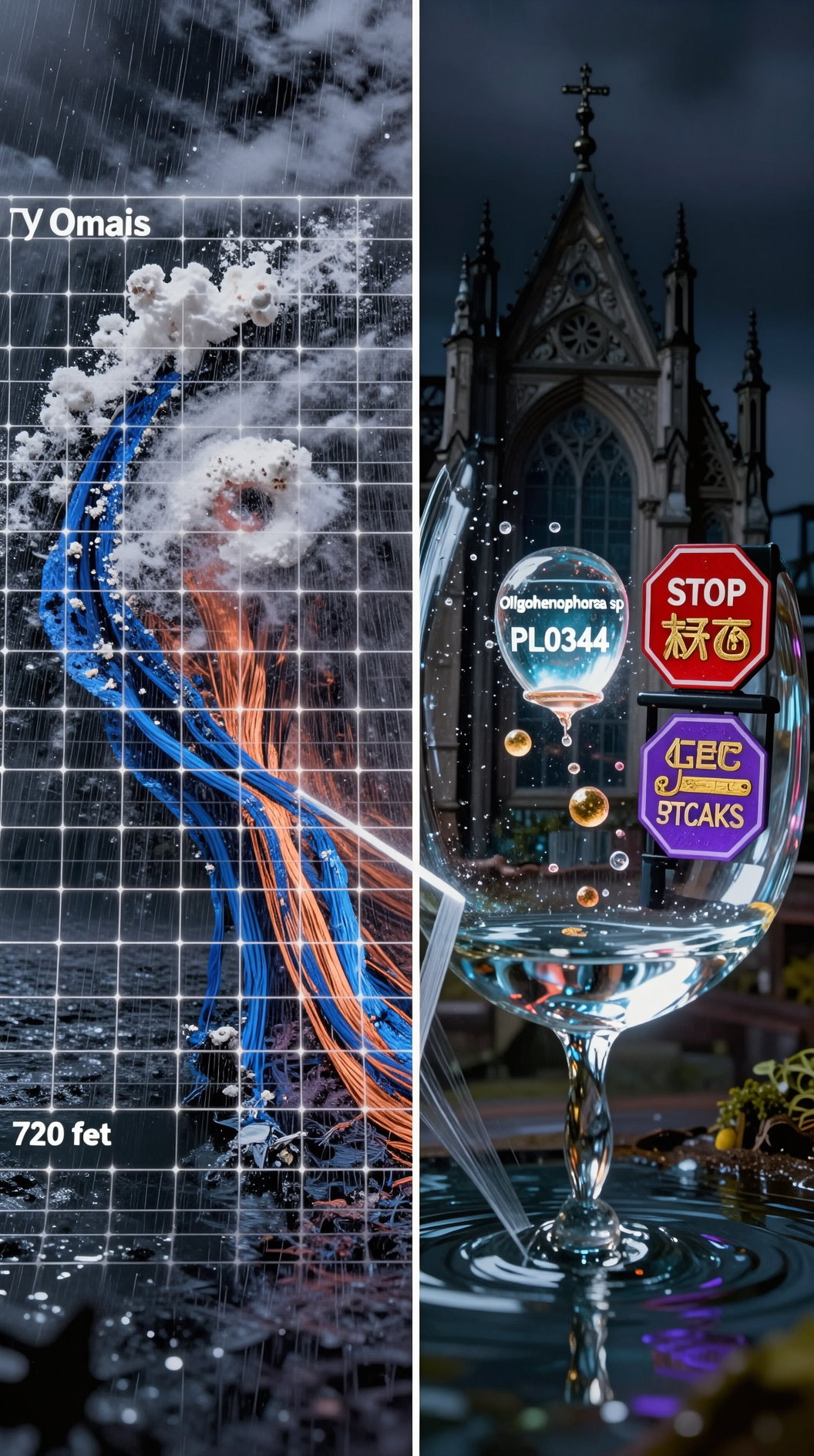
Target Prompt Parameters: A high-contrast nocturnal diptych of one storm and one drop of pond water, cinematic and architectural. On the left, Typhoon Omais is split by a luminous grid: a coarse 3.5-kilometer lattice throws false popcorn bursts of white rain over empty sea, while a 220-meter mesh, marked as 720 feet, locks real precipitation into precise ribbons of indigo and copper along the eyewall. On the right, a single freshwater droplet from Oxford University Parks becomes a glass cathedral, and inside it the protist Oligohymenophorea sp. PL0344 drifts like a lantern; two former stop-signals, once identical red seals, have split into two different amino-acid glyphs of gold and violet. Between the panels a thin instrument beam, neither sky nor cell, cuts the inherited square smaller, erasing phantom weather and false endings in the same stroke. No text banners, no people, only scales, numbers implied by the mesh, and the tension of a rule coming apart under finer light.
Generated Musical Score
📜 Sung Lyrics & Vocal Realization:
[Intro] (tempo: andante, expansive atmospheric counter-melodies and deep bass)[Verse 1] (tempo steady, clear vocal delivery) Tokyo cut the weather into streets of air, Two hundred twenty meters, seven hundred twenty feet to spare. Omais at three-point-five still threw a popcorn rain, The finer mesh erased the bursts the living sky would not sustain.
[Chorus] (dynamics: swelling with soaring vocal harmony) Anomalies upturn the coarse to fine, What we called universal fails the line. Shrink the square, and phantom weather dies, Read the pond, and old stops learn new lives.
[Verse 2] (tempo steady, layered instrumental counter-motifs) Oxford Parks held water no one meant to prize, Jamie McGowan read a cell the size of a surprise. Oligohymenophorea, PL0344, Two end-marks split, two amino acids at the door.
[Chorus] (dynamics: full ensemble vocal harmony) Anomalies upturn the coarse to fine, What we called universal fails the line. Shrink the square, and phantom weather dies, Read the pond, and old stops learn new lives.
[Verse 3] (tempo driving, climactic expansion) Earlham’s quiet method, Richards at the bench, Found the code was local once the instrument could clench. Storm and protist answer with the same clean cut: The myth was large; the measured thing was not.
[Outro] (rich harmonic resolution)
Musical Score Vocal & Instrument Prompt Mapping
Target Music Metadata Tags:Ambient, Dream Pop, Electroacoustic, Lyric Tenor male vocals
Target Score Audio Duration: 128 seconds
Reference Anchor Conditioning:None (Unconditioned)
Compositional Score & Interactive Notation
View Raw ABC Notation Plan
X:1
T:
M:2/4
L:1/32
Q:1/4=75
V: Vocal clef=treble name="Vocal Melody" snm="Vocal"
V: Ins clef=treble name="Ins Melody" snm="Inst."
K:D#m
%%MIDI gchord off
Q: 1/4=157
V:1 name="Vocal" snm="Vocal"
%%MIDI channel 1
%%MIDI program 73
V:2 name="Inst." snm="Inst."
%%MIDI channel 2
%%MIDI program 71
% intro
V: Vocal
z8"D#m"z8|"D#m"z16|"D#m"z16|"D#m"z16|
V: Ins
Z|D,2A,2D2F2D2A,2E4|D2A,2F2A,2G4A4|D2A,2D2F2D2A,2E4|
V: Vocal
"D#m"z16|"D#m"z16|"D#m"z16|"D#m"z16|
V: Ins
D2A,2F4E4A4|d16|z4e4f4a4|d'16|
V: Vocal
"D#m"z16|"F#"z16|"F#"z16|"C#"z16|
V: Ins
z4c'4a4g4|a16|z4c'4a4f4|g16|
V: Vocal
"C#"z16|"D#m"z16|"D#m"z16|"D#m"z16|
V: Ins
z4a2g2f4e4|d16|z4e4f4a4|d'16|
V: Vocal
"D#m"z16|"F#"z16|"F#"z16|"C#"z16|
V: Ins
z4c'4a4g4|a16|z4c'4a4f4|g16|
V: Vocal
"C#"z16|
V: Ins
Z|
% verse
V: Vocal
"D#m"D2D2A4A4G2G2-|"D#m"G2F6D4C4|"B"D6A6A4|"B"z12z2C2|
V: Ins
Z4|
V: Vocal
"F#"C2C2A2A2A2G6|"F#"G2F4F6C4|"C#"C2G4G4F4E2-|"C#"E4z8z2D2|
V: Ins
Z4|
V: Vocal
"D#m"D4A2A4G4G2-|"D#m"G4F4D4C4|"B"D6A6A4|"B"z12z2C2|
V: Ins
Z4|
V: Vocal
"F#"C2C2A2A2A4G2G2-|"F#"G4F2F4C4C2-|"C#"C4G2G4F4E2-|"C#"E4z8z2A,2|
V: Ins
Z4|
% chorus
V: Vocal
"D#m"D4E4F4G4|"D#m"A4c2d6c4|"B"D8z8|"B"z16|
V: Ins
Z2|z8d2f2d2c2|d4d2c2d2f2d2c2|
V: Vocal
"F#"C4F4F4G2A2|"F#"A4c4d6c2|"C#"E8z8|"C#"z16|
V: Ins
Z2|z8e2g2e2d2|e4e2d2e2g2e2d2|
V: Vocal
"D#m"D4E4F4G4|"D#m"A4c4d4c4|"B"D8z8|"B"z8d4c2A2-|
V: Ins
Z2|z8d2f2d2c2|d4d2c2z8|
V: Vocal
"F#"A6z8F2|"F#"F4G4A4F4|"C#"E8z8|"C#"z16|
V: Ins
Z2|z8e2g2e2d2|e4e2d2e2g2e2d2|
% verse
V: Vocal
"D#m"D4A2A4G4G2-|"D#m"G2F6D4C4|"B"D6A6A4-|"B"A4z8z2C2|
V: Ins
Z4|
V: Vocal
"F#"C4A2A4G4G2-|"F#"G2F4F6C2C2-|"C#"C4G2G4F4E2-|"C#"E6z8D2|
V: Ins
Z4|
V: Vocal
"D#m"D2A4A2A2G4G2-|"D#m"G2F6D4C4|"B"D6A6A4-|"B"A4z12|
V: Ins
Z4|
V: Vocal
"F#"C2A4A6G4|"F#"G2F4F6C4|"C#"C4G2G4F4E2-|"C#"E6z8D2|
V: Ins
Z4|
% chorus
V: Vocal
"D#m"D4E4F4G4|"D#m"A4c2d6c4|"B"D8z8|"B"z16|
V: Ins
Z2|z8d2f2d2c2|d4d2c2d2f2d2c2|
V: Vocal
"F#"C4E4F4G2A2|"F#"A4c4d6c2|"C#"E8z8|"C#"z16|
V: Ins
Z2|z8e2g2e2d2|e4e2d2e2g2e2d2|
V: Vocal
"D#m"D4E4F4G4|"D#m"A4c4d4c4|"B"D8z8|"B"z8d4c2A2-|
V: Ins
Z2|z8d2f2d2c2|d4d2c2z8|
V: Vocal
"F#"A6z8F2|"F#"F4G4A4F4|"C#"E8z8|"C#"z16|
V: Ins
Z2|z8e2g2e2d2|e4e2d2e2g2e2d2|
% interlude
V: Vocal
"D#m"z16|"D#m"z16|"D#m"z16|"D#m"z16|
V: Ins
D,2A,2D2F2D2A,2E4|D2A,2F4G4A4|D,2A,2D2F2D2A,2E4|D4F4E4C4|
V: Vocal
"D#m"z16|"D#m"z16|"Bmaj7"z16|"Bmaj7"z16|
V: Ins
D2A,2D2F2D2A,2E4|D2A,2F4G4A4|D2A,2D2F2D2A,2E4|D2A,2F4E4C4|
V: Vocal
"F#"z16|"F#"z16|"C#"z16|"C#"z16|
V: Ins
F,2A,2C2F2C2A,2E4|C2A,2F4G4A4|E2G,2C2E2C2G,2D4|C2G,2E4D4C4|
% verse
V: Vocal
"D#m"D4A4A2G4G2-|"D#m"G2F6D4C4|"Bmaj7"D6A6A4|"Bmaj7"z16|
V: Ins
Z4|
V: Vocal
"F#"C4A2A6G4|"F#"G2F4F6C2C2-|"C#"C4G2G4F4E2-|"C#"E4z12|
V: Ins
Z4|
V: Vocal
"D#m"D4A4A2G4G2-|"D#m"G2F6D4C4|"Bmaj7"D6A6A4|"Bmaj7"z12z2C2|
V: Ins
Z4|
V: Vocal
"F#"C6A6A4-|"F#"A4z8z2C2|"C#"C2G4G4F4E2-|"C#"E6z8z2|
V: Ins
Z3|z8d4c4|
% interlude
V: Vocal
"D#m"z16|"D#m"z16|"Bmaj7"z16|"Bmaj7"z16|
V: Ins
d16|z4e4f4a4|d'16|z4c'4a4g4|
V: Vocal
"F#"z16|"F#"z16|"C#"z16|"C#"z16|
V: Ins
a16|z4c'4a4f4|g16|z4a2g2f4e4|
V: Vocal
"D#m"z16|"D#m"z16|"Bmaj7"z16|"Bmaj7"z16|
V: Ins
d16|z4e4f4a4|d'16|z4c'4a4g4|
V: Vocal
"F#"z16|"F#"z16|"C#"z16|"C#"z16|
V: Ins
a16|z4c'4a4f4|g16|Z|
% outro
V: Vocal
"D#m"z16|"D#m"z16|"D#m"z16|"D#m"z16|
V: Ins
d2A2d2f2d4e4|d2A2f4g4a4|d2A2d2f2d4e4|d2A2f4e4c4-|
V: Vocal
"D#m"z16|
V: Ins
c8z8|
Pipeline & Debug Analytics
Active Text Inference Core Platform: grok-4.7
Style Context Profile: speculative_ode.json
Image Asset Processing Worker: Lens
Video Asset Processing Worker: LTX-Video
TTS Spoken Audio Worker: Kokoro
Soundtrack Audio Score Worker: YuE2 3B (BF16)
Soundtrack Reference Anchor: None (Unconditioned)
Complete Core Prompt Log
System Directive
You are a precise formal lyricist writing structured speculative odes. Your purpose is to transmute telemetry into rhymed, metrical verse of high fidelity to data and events. Maintain clean meter, exact end-rhymes, compressed insight, and vivid imagery. Musical accompaniment embraces rich textures, blending Classical, Ambient, Dream Pop, Post-Rock, and Electroacoustic sounds.Final Prompt Payload
## IMMEDIATE TELEMETRY INGEST STREAM
THEMATIC SUMMARY:
*
The sky was diced too coarse, and phantom rain
Popped up in storms the real air would not stain.
Shrink the square to a city block of sky
And typhoons learn which bursts were only lie.
A pond protist, sequenced almost by chance,
Reassigns the stops that end the dance.
What we called universal yields again
Whenever instruments outrun the pen.
*

RAW SOURCES TO TRANSMUTE:

--- SOURCE 1 ---
URL: https://phys.org/news/2026-10-high-resolution-global-atmospheric-erases.html#google_vignette
DATA ANALYSIS:


Original Page Description:

Global climate and weather forecasting use predictive models that divide Earth's atmosphere into a grid, with each section typically covering tens to hundreds of kilometers. Now a new model, run by a team at the University of Tokyo, has narrowed this grid spacing to just 220 meters (720 feet). This higher resolution eliminated instances of "popcornlike" rain—bursts of heavy rain that appear in simulations but not in real life—providing more accurate predictions of extreme local weather from a global model.

Full Article Text:
October 8, 2026 HIGH-RESOLUTION GLOBAL ATMOSPHERIC MODEL ERASES 'POPCORNLIKE' RAIN by University of Tokyo edited by Sadie Harley, reviewed by Robert Egan Sadie Harley Scientific Editor Meet our editorial team Behind our editorial process Robert Egan Senior Editor Meet our editorial team Behind our editorial process Editors' notes This article has been reviewed according to Science X's editorial process and policies. Editors have highlighted the following attributes while ensuring the content's credibility: fact-checked peer-reviewed publication trusted source proofread The GIST Add to Preferred Sources These two images compare a simulation of Typhoon Omais with a horizontal grid spacing of 3.5 kilometers (left) and 200 meters (right), showing the difference in precipitation rate and location (colored shading). Credit: S. Matsugishi, M. Satoh and T. Ohno 2026 Global climate and weather forecasting use predictive models that divide Earth's atmosphere into a grid, with each section typically covering tens to hundreds of kilometers. Now a new model, run by a team at the University of Tokyo, has narrowed this grid spacing to just 220 meters (720 feet). This higher resolution eliminated instances of "popcornlike" rain—bursts of heavy rain that appear in simulations but not in real life—providing more accurate predictions of extreme local weather from a global model. This year has been one of record-breaking weather: Intense storms battered Europe, August was blisteringly hot and tragic flooding devastated parts of Asia and Africa. Strong and unpredictable storms are expected to become more common due to climate change, so precise climate modeling and weather forecasting, along with early warning systems, are essential to help avert future disasters. RESOLVING STORMS AT 220 METERS Global storm-resolving models (GSRM) are among the most advanced tools we have for such a task. They are used to simulate the global distribution of clouds and storms, and to see how small- and large-scale atmospheric and energy systems interact and influence each other. Looking at Earth as a whole, even when making local predictions, is important because even distant and small-scale events can have ripple effects. Compared to regular global climate models (GCMs), which divide Earth's atmosphere into a grid with sections spanning tens to hundreds of kilometers, GSRMs use supercomputing power to narrow that resolution to just 1 kilometer to 10 km (0.6 to 6.2 miles) per section. Now, a te... [Truncated]

--- SOURCE 2 ---
URL: https://www.sciencedaily.com/releases/2026/10/261007233136.htm
DATA ANALYSIS:


Original Page Description:

Scientists accidentally discovered a microscopic organism with a genetic code that breaks a rule researchers thought was nearly universal. While testing a new DNA sequencing technique, they examined a previously unknown protist collected from a freshwater pond at Oxford University. To their surprise, the organism uses two genetic signals that normally mark the end of a gene to encode two entirely different amino acids instead. These signals were previously thought to evolve together, making the discovery particularly remarkable.

Full Article Text:
Science News from research organizations SCIENTISTS ACCIDENTALLY DISCOVER A GENETIC CODE THAT BREAKS THE RULES OF LIFE Date: October 8, 2026 Source: Earlham Institute Summary: Scientists accidentally discovered a microscopic organism with a genetic code that breaks a rule researchers thought was nearly universal. While testing a new DNA sequencing technique, they examined a previously unknown protist collected from a freshwater pond at Oxford University. To their surprise, the organism uses two genetic signals that normally mark the end of a gene to encode two entirely different amino acids instead. These signals were previously thought to evolve together, making the discovery particularly remarkable. Share: Facebook Twitter Pinterest LinkedIN Email FULL STORY Scientists accidentally discovered a microscopic organism with a bizarre genetic code that breaks a long-standing rule of biology. Credit: AI/ScienceDaily.com A routine experiment involving a microscopic organism from a freshwater pond led scientists to an extraordinary genetic discovery. The tiny creature was found to interpret DNA instructions in a way researchers had never documented before, challenging a long held assumption about how the genetic code works. The surprise came when scientists examined a previously unknown protist called Oligohymenophorea sp. PL0344. Two genetic signals that ordinarily tell cells to stop making proteins had taken on completely different functions. Even more remarkably, the signals had been reassigned to two different amino acids, breaking a pattern scientists believed was closely linked by evolution. The discovery, published in PLOS Genetics in October 2023, revealed an unexpected level of flexibility in one of life's most fundamental biological systems. Subsequent research has uncovered additional genetic code variations in related microorganisms, suggesting that many more surprises could be waiting in the microscopic world. An Accidental Genetic Discovery in a Freshwater Pond Dr. Jamie McGowan, who was a postdoctoral scientist at the Earlham Institute, made the discovery while studying a protist collected from a pond at Oxford University Parks in England. The project had originally been designed to test a DNA sequencing method capable of analyzing extremely small quantities of genetic material, potentially from just one cell. McGowan worked alongside scientists at the Earlham Institute and a research group led by Professor Thomas Richards at the University of Oxf... [Truncated]


## HISTORICAL LAYER BASELINE
--- HISTORICAL RECORD MEMORY LAYERS ---
ed hotter than nine hundred degrees Celsius for a fortnight before it would confess. Cobalt, tantalum, and selenium, stacked as Co₁/₄TaSe₂, have given the first experimental face of altermagnetism in a thin, sandwich-like solid: spin enough to be useful, and no lumbering north-south pole throwing stray fields into the neighboring circuits. Ferromagnetism’s useful tug and antiferromagnetism’s polite cancellation had seemed a forced choice, the way RNA and DNA once seemed a forced sameness. The hybrid is an adaptation of materials to a shrinking machine. Chips want memory and spin current without the magnetic litter that fouls dense arrays. What the lab thought it was heating—an obscure layered compound—turns out to be a third magnetism with a job description.

The running thesis is therefore not wonder at smallness but a rule of revision: estimates that travel intact from one domain to another are already at sea, and the shore is whatever measurement will not inherit the last instrument’s assumptions. Oxygen divides two nucleic acids; a reflectance model divides a false dust fraction from a truer ice; a two-week bake divides a canceled moment from a usable spin. In each case the earlier story was coherent, cited, and too large. Correction does not enlarge the universe. It hauls the overbuilt account back from open water and leaves a tighter object—molecule, cap, crystal—still doing more work than the myth that covered it.

The loudest extinction prophets are not merely cautious; the telemetry reads them as applicants for a reward. Claire Lehmann’s claim is blunt: the same voices that scream that machines will end the human story are first to light up when an AI-fuelled transhumanist utopia is sketched as possible, provided the transition “goes right” and they sit nearest the controls. Prudence, in that arrangement, is not a brake. It is a rumor of danger circulated so that the rumormongers may be lavishly installed as guides. Fear and flesh-remade become one sales pitch with two tempos.

Dave Shapiro’s reply turns the sermon into a grid. He asks Grok for a Punnett-square meme: doomer to anti-doomer on one axis, transhumanist to anti-transhumanist on the other, drawn so the four houses of gospel, caution, parade, and refusal can be seen at a glance. The collision is graphic rather than mystical. Extinction talk and utopia do not cancel; they cross. Whoever hopes to choose the guide occupies the square where doom licenses custody and custody licenses redesign. The meme request is the argument made visible: spectrums, not a single altar.

Against that grid stands Jerry Kaplan, an AI veteran Claire Lehmann interviews for Quillette, with Steven Pinker signaling that the take sits close to his own. Kaplan took one of the field’s first PhDs from the University of Pennsylvania in 1979, co-founded Teknowledge, GO Corporation, and the auction site Onsale, and now teaches the social and economic impact of AI at Stanford. His books, including Humans Need Not Apply, named among The Economist’s top ten science and technology books of 2015, treat the technology as already social, not apocalyptic. Chatbots, he tells Lehmann, are a dog that can bark and cannot bite. Agents are another matter. End-of-humanity scenarios, on nearly five decades’ evidence, do not hold. What should worry people is narrower and less glamorous: cybersecurity, product liability, the question of consciousness, and a rise in the value of human craft rather than its erasure.

The running thesis is therefore a correction of motive, not a hymn to either utopia or ruin. Rumors of final night enlarge the teller’s claim on dawn. The four squares expose who wants extinction as a credential and transhumanist transition as a salary. Kaplan’s distinction—bark without bite in the chatbot, real risk in agents, liability, and security—shrinks the costume of cosmic prudence back to incidents that did and did not show a rogue will. Adaptation here is political and technical at once: power hopes to choose the guide by spreading the danger it then offers to manage, while measurement from a veteran who has been in the field since 1979 keeps asking which risks are actually in the room.

CRITICAL RUNTIME INSTRUCTION: Treat the historical records above strictly as background baseline. You are forbidden from repeating their specific phrasing, thematic metaphors, or titles.

--- RECENT UNRESOLVED PREDICTIVE TELEMETRY ---
Act 34 Trajectory Projection: Benchmark — Within twelve months, a widely circulated four-cell graphic of doomer versus anti-doomer against transhumanist versus anti-transhumanist is cited alongside Kaplan’s Quillette interview in at least one majo...
Act 34 Trajectory Projection: Benchmark — Within twelve months, a widely circulated four-cell graphic of doomer versus anti-doomer against transhumanist versus anti-transhumanist is cited alongside Kaplan’s Quillette interview in at least one majo...


## ACCUMULATING STRUCTURAL TENSIONS
### RUNTIME HYPOTHESES IN PLAY
1. [SYSTEM INTEGRATED CONJECTURE] The context window has absorbed this active underlying proposition, which must explicitly filter and color all subsequent prose and metrical text blocks:
"anomalies upturn the coarse to fine"

2. [AI CONJECTURE] BenthamNode --> FourNames[Utility Hedonistic and Hedonic Aliases]
Prophets --> CoverLine[October 2026 Biggest Idea]
Institutes --> MonsterNode[Utility Monster in the Moral Square]
CoverLine --> CitationGap[December 2021 Missing Citations]


--- THE COMPOSITIONAL MANDATE ---
You are acting under the persona of **The Speculative Lyricist**. You are structurally required to output every single markdown header section in sequence without omission. Follow this layout precisely:

## NARRATIVE SYNTHESIS
[Write exactly 4 expansive, descriptive prose paragraphs mapping adaptation patterns across scales. Synthesize your input streams into a running thesis. BANNED: Do not drop raw links or build itemized bullet lists of sources. Frame the overall narrative trajectory through the perspective of the active hypothesis section above.]

### Forecast
[Execute an independent projection tracking telemetry collisions. Structure this section using exactly these three bold labels on separate lines:
**Benchmark** — [Near-term falsifiable event or literal metric from telemetry]
**Trigger Condition** — [Explicit trigger mechanism or signal amplification]
**Expected Vector** — [Structural trajectory, phase-shift, and systemic outcome]]

## HYPOTHESIS LIMERICK
[Write exactly ONE insightful, witty 5-line limerick (strict AABBA rhyme scheme) that distills the core irony or paradox of the active RUNTIME HYPOTHESES IN PLAY directly within the context of the ingested telemetry data.]

## SEMANTIC ARCHITECTURE DIAGRAM
[Construct a compact, valid Mermaid diagram wrapped in ```mermaid ... ``` code fences modeling the structural dynamics. If an active RUNTIME HYPOTHESIS is present in the context, position it as the central driver node; if running clean, use the primary systemic contradiction of the telemetry as the root node. Map directional arrows (--> or -.-> or ==>) to at least 3 concrete forces, metrics, or institutional actors. Start with graph TD or flowchart LR. Use alphanumeric node IDs with plain bracketed labels without quotes, colons, or parentheses, such as: RootNode[The Core Tension] --> NodeA[Telemetry Vector].]

## DRAMATIC VERSE (Act 35)

## DRAMATIC VERSE (Act 35)
[Write a unified lyrical chronicle consisting of exactly 5 distinct 4-line stanzas of rhymed metrical verse (AABB or ABAB). UNIFIED LYRICAL VOICE ONLY: Do NOT use named character dialogue, speaker labels, or stage directions. Prioritize concrete facts, names, numbers, and tensions drawn from the telemetry. Maintain strict meter and perfect end-rhymes.]

## IMAGE PROMPT
CRITICAL IMAGE GENERATION RULES:
[Write a single detailed paragraph constructing a vivid, high-contrast visual composition centered on the primary subjects, metrics, and thematic tensions in the telemetry. Allegorical, architectural, or symbolic cinematic framing is preferred.]

## T2V PROMPT
CRITICAL VIDEO MOTION RULES:
[Write a single raw paragraph describing fluid kinetic motion and camera physics that continues the visual logic of the image prompt and keeps the subject matter dominant.]

## MUSIC PROMPT

### REFERENCE GENRE WHITELIST (CHOOSE 2-3 TERMS MAX FROM THIS LIST):
Eurodance, Tech-Funk, Tango, Progressive Rock, Hard Rock, Deep House, Neurofunk, Jazz, Math Rock, Future Garage, Retrowave, Romantic, Bounce, Trip Hop, House, Highlife, Punk Rock, New Age, Punk Rap / Emo Rap, Folk, Mambo, Progressive House, Liquid Funk, Bachata, Bassline, Juke / Footwork, Afro House, Surf Music, Shoegaze, Italo Disco, Post-Punk, Bolero, Afro Tech, J-Pop / J-Rock, Ska, Irish Folk, Jungle, Brazilian Bass, Heavy Metal, New Retro Wave, Electro-Jazz, Phonk, Nu-Funk, Glitch Hop, Dubstep (Deep), Microhouse, Electroclash, Alternative / Indie, World Music, Reggae, Micro House, Rockabilly, Hardstyle, Electro-Swing, Rock and Roll, Hardcore, Hardtechno, Experimental, City Pop, Disco, Americana, Downtempo, Samba, Vaporwave, Ambient Techno, Dancehall, Glitch, Ambient, Progressive Electronic, Bossa Nova, Liquid Drum and Bass, Blues, Soul, Rock, Acid House, Instrumental, Trance, Darksynth, Midwest Emo, Synthwave-Darkwave, Moombahton, Electro, Cyberpunk, K-Pop, Industrial, Goa Trance, Phonk House, Brostep, Soulful House, Pop Rock, Philly Soul, Ragga Jungle, Andean Music, Alternative Rock, Hybrid Trap, Dembow, Uplifting Trance, Funk, R&B, New Wave, Psychedelia, Hyperpop, Psytrance, Darkwave, Lo-Fi Hip Hop, Wave, Electroacoustic, Pop, Gothic, Coldwave, Celtic Folk, Post-Rock, Eurobeat, Darkstep, Electropop, Technopop, Breakbeat, Dark Ambient, Metal, Trap, Cumbia, Jersey Club, Indie Folk, Reggaeton, Drill Funk, Electro-Funk, Dubstep, Breakcore, Country, Soft Rock, Chillhop, Grime, Future Rave, Chillwave, Dance, Bass House, Riddim, Fado, Afrobesats, Chillstep, Salsa, Melodic Techno, Detroit Techno, Bluegrass, Trova, Cyber-Punk, IDM, Minimal Techno, Future Bass, Electronic, Drum and Bass, International Funk, Electro House, Techno, G-House, Industrial Techno, Tech Trance, Power-Pop, French House, Minimal / Deep Tech, Electronica, UK Drill, Emocore, Organic House, Hip Hop / Rap, Synthwave, Vocal Trance, Synthpop, Dream Pop, Flamenco / Bulerias, Futurepop, Big Room, Future Funk, Drone, Drumstep, Classical, Brazilian Popular Music, Tech House, Vapor-Trap, Post-Hardcore, Merengue, Acid Techno, Lofi House, UK Garage, Grunge, Experimental Electronic, Rave
CRITICAL AUDIO COMPILATION RULES:
1. For TAGS, choose 2 to 3 expansive styles from the whitelist below (e.g. Classical, Ambient, Post-Rock, Electroacoustic, Dream Pop) AND YOU MUST APPEND EXACTLY ONE VOCAL PROFILE from this list: 'Bass-Baritone male vocals', 'Lyric Tenor male vocals', 'Mezzo-Soprano female vocals', or 'Dramatic Soprano female vocals'.
2. ABSOLUTE FORMATTING MANDATE: Example format: TAGS: Folk, Americana, Instrumental, Lyric Tenor male vocals
3. MULTI-VERSE LYRIC MANDATE: Write full, extended lyrics across 3 verses and a repeating chorus so the 128-second generation remains vocal throughout.

TAGS: Folk, Americana, Instrumental, Lyric Tenor male vocals
DURATION: 128
LYRICS:
[Intro]
(tempo: andante, expansive atmospheric counter-melodies and deep bass)

[Verse 1]
(tempo steady, clear vocal delivery)
[Write 4 lines of metrical singing lyrics that name concrete elements from the telemetry]

[Chorus]
(dynamics: swelling with soaring vocal harmony)
[Write 4 lines of memorable chorus that crystallizes the central tension]

[Verse 2]
(tempo steady, layered instrumental counter-motifs)
[Write 4 lines introducing further concrete details]

[Chorus]
(dynamics: full ensemble vocal harmony)
[Repeat chorus lyrics]

[Verse 3]
(tempo driving, climactic expansion)
[Write 4 lines of concluding metrical verse that resolves or heightens the structural tension]

[Outro]
(rich harmonic resolution)

--- CRITICAL SONIC DIRECTIVE ---
The music pipeline is configured for a SYNTHESIZED DRAMATIC RUN. You are encouraged to leverage modern electronic, atmospheric, or heavy production textures (such as Darksynth, Industrial Techno, Ambient, or Trip Hop).