Dust, Oxygen, and a Magnet with No Stray Pole - Transmuted Pass
Navigation
- Ongoing Narrative Arc
- Semantic Architecture
- Primary Poetic Artifact
- Kinetic Dynamic Video
- Visual Anchor Representation
- Generated Musical Score
- Pipeline & Debug Analytics
Active Underlying Paradigm
Scriptorium Operational Parameter [DIRECT INJECTED IDEA PARADIGM]: What once was thought to be - is now far out to sea.
Paradigm Limerick Distillation: What once was thought solid drifts far out to sea: A Moon-born percentage, a pole we could see, One oxygen’s wink in the nucleic chain, A magnet with spin and no lumbering vane— The chart was the coastline; the water was free.
Thematic Seed
*
One atom’s oxygen divides the skein
Of RNA from DNA, and life’s first bet
May hinge on chemistry so nearly plain
We overlooked the promise in the set.
On Mars the northern ice, once thought a dune
Of dust at twenty-five, is nearer three—
A lunar formula had read the moon
Into a world whose brightness disagreed.
And in a crystal baked for fourteen days,
Altermagnetism shows its hybrid face:
No lumbering pole to foul the chip’s arrays,
Yet spin enough to serve a tighter space.
The universe keeps smaller than our lore;
Correction is the oldest form of more.
*
Ongoing Narrative Arc
What once was thought to be is now far out to sea, and the tide is not romantic: it is a correction table. Across chemistry, a single oxygen-bearing group is enough to split the family resemblance of RNA and DNA into two different bets about how a molecule might hold, copy, and stumble toward the first living household. The difference is so slight that a generation of explanations treated it as bookkeeping. Adaptation at that scale is not a grand redesign. It is a substitution so small it can hide inside a familiar chain, then quietly change which reactions look cheap enough to try. Life’s first wager, if the new reading holds, was never a cathedral of novelty. It was a near-miss in the periodic table that we filed under “almost the same” and walked past.
Lift the same habit of misreading one scale up, from the flask to the polar cap, and the old picture of Mars drifts with it. NASA’s Phoenix sampling made arctic ice a fact rather than a hope, then a later arithmetic dressed that ice in a dust cloak borrowed from the Moon. Twenty-five percent dust was the settled costume; roughly three percent is the figure that survives a second look at the northern cap. The ice-cream sandwich of dirtier and cleaner layers still seasons itself, but the topping was never the meal. A lunar formula had read one world’s brightness into another world’s grain size, and the wasteland we thought we knew was mostly a calculation wearing a landscape’s name. Adaptation here is climatic and instrumental at once: the planet keeps cycling dust and cleaner ice, while the observers adapt by retiring a tool that was faithful somewhere else.
Shrink again, into a crystal that had to be baked hotter than nine hundred degrees Celsius for a fortnight before it would confess. Cobalt, tantalum, and selenium, stacked as Co₁/₄TaSe₂, have given the first experimental face of altermagnetism in a thin, sandwich-like solid: spin enough to be useful, and no lumbering north-south pole throwing stray fields into the neighboring circuits. Ferromagnetism’s useful tug and antiferromagnetism’s polite cancellation had seemed a forced choice, the way RNA and DNA once seemed a forced sameness. The hybrid is an adaptation of materials to a shrinking machine. Chips want memory and spin current without the magnetic litter that fouls dense arrays. What the lab thought it was heating—an obscure layered compound—turns out to be a third magnetism with a job description.
The running thesis is therefore not wonder at smallness but a rule of revision: estimates that travel intact from one domain to another are already at sea, and the shore is whatever measurement will not inherit the last instrument’s assumptions. Oxygen divides two nucleic acids; a reflectance model divides a false dust fraction from a truer ice; a two-week bake divides a canceled moment from a usable spin. In each case the earlier story was coherent, cited, and too large. Correction does not enlarge the universe. It hauls the overbuilt account back from open water and leaves a tighter object—molecule, cap, crystal—still doing more work than the myth that covered it.
Forecast
Benchmark — Within eighteen months, a peer-reviewed albedo reanalysis either holds northern Martian polar dust near the reported ~3% (against the retired 25% lunar-regolith estimate) across the six mapped ice sites, or a replication paper fails to show spin-current detection without stray fields in Co₁/₄TaSe₂. Trigger Condition — Publication of an independent radiative-transfer cross-check on Phoenix-era and orbital reflectance for the north polar cap, or a second-lab crystal growth of Co₁/₄TaSe₂ above 900°C with a published spin-current measurement that either confirms or voids the Nature Communications claim. Expected Vector — If both corrections stand, mission ice models and spintronic roadmaps drop inherited proxies (lunar dust fractions; binary ferro/antiferro device assumptions) and phase-shift toward thinner, field-quiet stacks and cleaner polar-ice climate histories; if either fails, the “overlooked plain chemistry / overlooked plain ice / overlooked third magnet” cluster splits and only the replicated limb keeps rewriting the prior.
Semantic Architecture
graph TD
  RootNode[What once was thought is far out to sea] --> Rna[One oxygen divides RNA from DNA]
  RootNode --> MarsIce[Martian north dust near 3 percent not 25]
  RootNode --> AlterMag[Altermagnet Co Ta Se baked fourteen days]
  Rna --> OriginBet[Origin chemistry less ornate than lore]
  MarsIce --> LunarError[Lunar regolith formula misread brightness]
  AlterMag --> Spintronics[Spin current without stray chip fields]
  LunarError --> PhoenixCap[Phoenix arctic ice under thinner dust]
Primary Poetic Artifact
THE CARTOGRAPHER: I inked the northern cap at twenty-five in dust, A lunar ledger, faithful till the numbers bust. Phoenix bit the arctic, and the brighter sum came due: Three percent of topping on an ice-cream sandwich view.
[She flips the chart; the old contour lines skitter offstage like crabs.]
THE CHEMIST: Don’t mourn the vanished dune. One oxygen, no more, Divides the RNA from DNA’s prim door. We called the pair near twins and overlooked the bet— Life’s opening wager was the plainness we forget.
[A kiln door sighs. Heat haze writes percentages in the air, then eats them.]
THE BAKER: Fourteen days I fired it, past nine hundred in the flame, Cobalt, tantalum, selenium—three names, one stubborn claim. Co one-quarter Ta Se two comes out without a pole, Yet spin enough to serve a chip and leave the arrays whole.
[Khuller’s ghostly margin note tries to sit on the table and is waved off as a stage direction, not a speech.]
THE OPERATOR: Stray fields were the rent we paid for every useful tug; Antiferro paid none, and gave the circuits a shrug. Neupane’s hybrid face keeps the current, kills the vane— What once was thought a binary is fog along the main.
[The three lean over one lamp. The sea-sound is only the ventilator, and it is winning.]
THE WITNESS: So haul the inherited chart back from the open sea: The Moon’s arithmetic was never Mars’s key. A hydroxyl’s tiny rift, a cleaner polar skin, A magnet with no lumbering north—correction letting in.
Kinetic Dynamic Video
Video Generation Prompt
Target Prompt Parameters: Camera starts tight on the single highlighted oxygen between two molecular chains, then dollies laterally as the chains peel apart in slow precise motion; a match-cut swings to the Martian polar cutaway where a dusty crust visibly thins from a heavy blanket to a faint veil while numerals 25 peel off and drift toward a dark sea and 3 locks onto the ice; crane up and push in on the kiln as the crystal is drawn out, layers shimmering, spin streaks circulating without any external pole forming, circuit traces beside it staying clean; the three observers turn toward each other in brisk dialogue gestures, maps sliding off the table toward the water, camera finishing on a steady medium-wide hold with heat haze, ice sheen, and molecular glitter all moving at once but the faces and the three corrected objects kept dominant and sharp.
Visual Anchor Representation
Image Generation Prompt
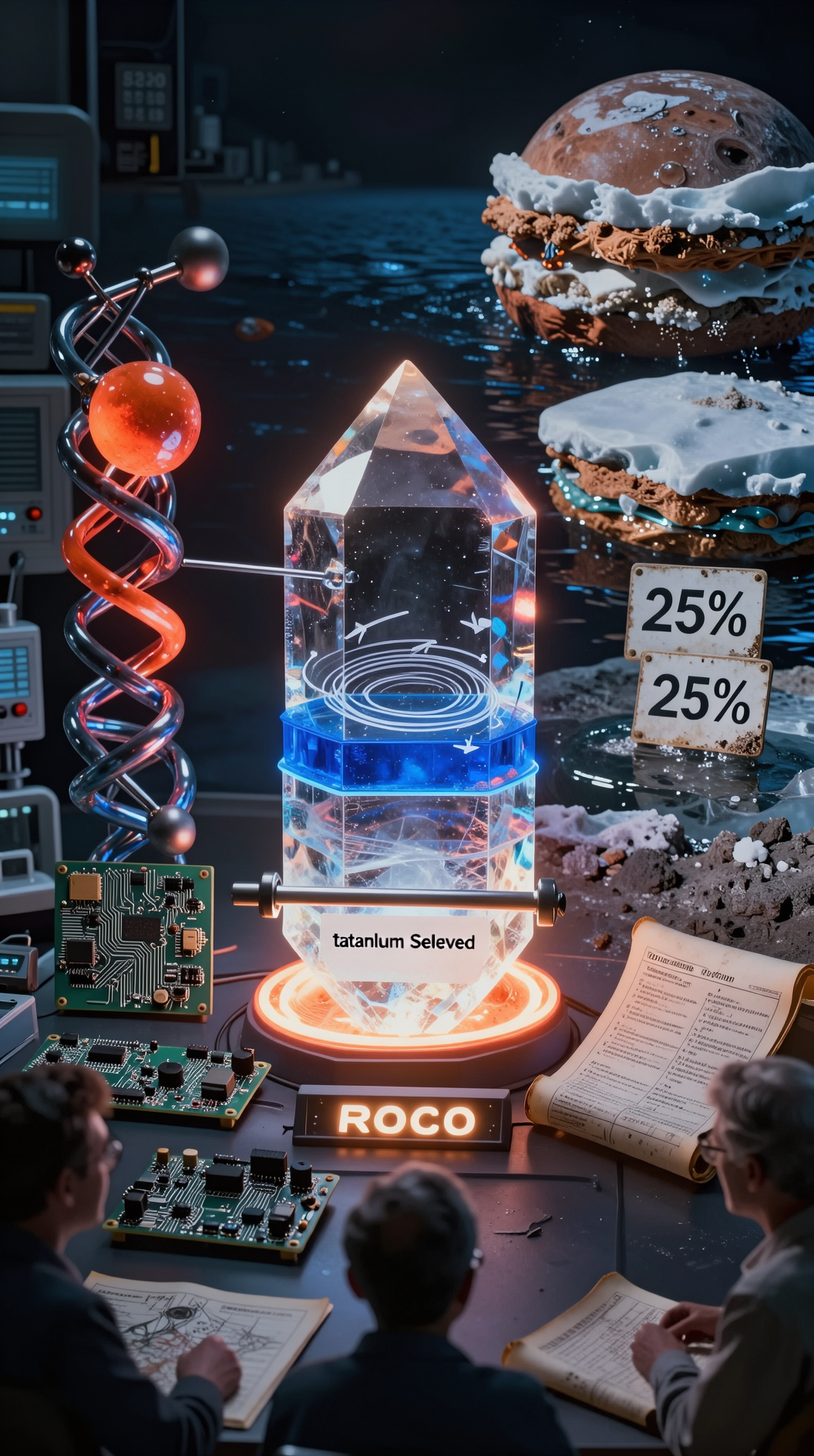
Target Prompt Parameters: A high-contrast theatrical laboratory at night, crisp and legible: center frame a glowing layered crystal labeled in clean type as a cobalt-tantalum-selenium sandwich, no bar magnets attached, faint spin-arrows circling inside the layers while nearby circuit boards stay unbent and bright; to the left a split molecular model where one vivid oxygen atom is the only color difference between two helical chains; to the right a cutaway of Mars’s north polar cap as an ice-cream sandwich of cleaner ice and thin dust, with a large discarded “25%” placard sinking in dark water and a sharp “3%” plaque standing on the ice; a lunar regolith formula scroll curls away like a spent chart; kiln glow at 900-plus Celsius rims the crystal; the whole scene reads as revision, not spectacle, faces of three named observers—cartographer, chemist, baker—sharp in the foreground, sea-dark background pulling old numbers offshore.
Generated Musical Score
📜 Sung Lyrics & Vocal Realization:
[Intro] (tempo: vivace, crisp rhythmic motifs and sparkling textures)[Verse 1] (tempo rapid and precise) One oxygen atom divides the skein, RNA winking at DNA’s chain, We filed the pair under nearly the same And missed the first wager inside the plain name.
[Chorus] (dynamics: fortissimo bright ensemble harmony) What once was thought solid is far out to sea, The Moon’s dusty percentage was never the key, Three percent of topping, not twenty-five strong, Correction’s the chorus that proves the chart wrong.
[Verse 2] (tempo remains rapid) Phoenix bit ice where the formulas lied, A lunar albedo had gilded the hide, Fourteen days baking past nine hundred flame, Cobalt and tantalum earning a name.
[Chorus] (dynamics: full ensemble) What once was thought solid is far out to sea, The Moon’s dusty percentage was never the key, Three percent of topping, not twenty-five strong, Correction’s the chorus that proves the chart wrong.
[Verse 3] (tempo driving patter) No lumbering pole and yet spin in the stack, Altermagnet smiling while stray fields stay back, Selenium’s sandwich will not split in two, The useful hybrid was hiding in view.
[Outro] (sparkling cadence flourish)
Musical Score Vocal & Instrument Prompt Mapping
Target Music Metadata Tags:Electro-Swing, Synthpop, Progressive Electronic, Mezzo-Soprano female vocals
Target Score Audio Duration: 128 seconds
Reference Anchor Conditioning:None (Unconditioned)
Compositional Score & Interactive Notation
View Raw ABC Notation Plan
X:1
T:
M:4/4
L:1/16
Q:1/4=122
V: Vocal clef=treble name="Vocal Melody" snm="Vocal"
V: Ins clef=treble name="Ins Melody" snm="Inst."
K:Dm
% intro
V: Vocal
z12"Dm"z4|"Dm"d2z2f2z2a2z2d'2z2|"Dm"a'2z2f'4e'2f'2e'2^c'2|"Dm"d'4a4b4g4|
V: Ins
Z4|
V: Vocal
"Dm"a4f4g2f2e2^c2|"Dm"d4z12|"Dm"z16|"Dm"z16|
V: Ins
Z|z4f2a2d'2z2a4|d4f2a2b2b2a4|d4f2a2d'2z2a4|
V: Vocal
"Dm"z16|
V: Ins
d4f2a2b2b2a4|
% verse
V: Vocal
"Dm"d4a4g4f4|"Dm"g4f2f2e4d4|"Dm"d8z8|"Dm"z16|
V: Ins
Z2|z8d'2z2a4|d4f2a2b2b2a4|
V: Vocal
"Dm"d4a4g4f4|"Dm"g4f2f2e4d4|"Gm"b16|"Gm"z12z2d2|
V: Ins
Z3|g4b2d'2e'2e'2d'2z2|
V: Vocal
"Gm"b6a2g4f4|"Gm"g4f4e4d4|"Dm"a8z8|"Dm"z12z2A2|
V: Ins
Z2|z8d'2z2a4|d4f2a2b2b2a2z2|
V: Vocal
"A"e4e2e6e4|"A"^c4c4c4A4|"Dm"e8d8-|"Dm"d8z6d2|
V: Ins
Z4|
% chorus
V: Vocal
"Gm"b4b4b8|"Gm"a2g2g4g2ff3d2|"Dm"g16|"Dm"z12z2d2|
V: Ins
Z3|d'2z2f2a2b2b2a2z2|
V: Vocal
"A7"e8e3e3f2|"A7"g3f3e2e3d3^c2|"Dm"d16|"Dm"z16|
V: Ins
Z3|d'4f2a2b2b2a4|
V: Vocal
"Gm"b6b2b4b4|"Gm"a2gg3g2g2f2d4|"Dm"g16|"Dm"z12z2d2|
V: Ins
Z3|d'4f2a2b2b2a2z2|
V: Vocal
"A"e8e6f2|"A"g3f3e2e3d3^c2-|"Dm"^c4d12-|"Dm"d4z12|
V: Ins
Z3|z4f2a2b2b2a4|
% verse
V: Vocal
"Dm"d4a4g4f4|"Dm"g4f2f2e3dd2^c2|"Dm"d12z4|"Dm"z12z2d2|
V: Ins
Z2|z12A4|d4f2a2b2b2a2z2|
V: Vocal
"Dm"d4a4g4f4|"Dm"g4f2f2e3d3d2|"Gm"b16-|"Gm"b8z8|
V: Ins
Z3|z8e'2e'2d'2d'2|
V: Vocal
"Gm"b4a4g4f2f2|"Gm"g4f4e4d4|"Dm"a16-|"Dm"a8z8|
V: Ins
Z3|z8b2b2a2a2|
V: Vocal
"A"e4e4e4e4|"A"^c4c4c3A3e2|"Dm"e2d12-d2-|"Dm"d8-d2z4d2|
V: Ins
Z4|
% chorus
V: Vocal
"Gm"b4b4b8|"Gm"a2g2g4g3f3d2|"Dm"g16|"Dm"z12z2d2|
V: Ins
Z3|d'4f2a2b2b2a2z2|
V: Vocal
"A"e8e3e3f2|"A"g3f3e2e3d3^c2|"Dm"d16|"Dm"z16|
V: Ins
Z3|d'4f2a2b2b2a4|
V: Vocal
"Gm"b6b2b4b4|"Gm"a3g3g2g2f2d4|"Dm"g16|"Dm"z12z2d2|
V: Ins
Z3|d'4f2a2b2b2a2z2|
V: Vocal
"A"e8e6f2|"A"g3f3e2e3d3^c2-|"Dm"^c4d12-|"Dm"d4z8z2d2|
V: Ins
Z4|
% verse
V: Vocal
"Dm"d4a4g4f4|"Dm"g4f4e3dd2^c2|"Dm"d4z12|"Dm"z16|
V: Ins
Z2|z4f2a2d'4a4|d4f2a2b2b2a4|
V: Vocal
"Dm"d4a2g4f6|"Dm"g3f3f2e3d3d2-|"Gm"d4b12-|"Gm"b12z2d2|
V: Ins
Z4|
V: Vocal
"Gm"b3bb4g4f4|"Gm"g4f4e4d4|"Dm"a16-|"Dm"a8z6A2|
V: Ins
Z4|
V: Vocal
"A"e4e4e4^c4-|"A"^c8z6A2|"A"e8d4^c4|"Dm"d16-|
V: Ins
Z4|
V: Vocal
"Dm"d16|
V: Ins
Z|
% interlude
V: Vocal
"Dm"z16|"Dm"z16|"Dm"z16|"Dm"z16|
V: Ins
d4f2a2d'2z2a4|d4f2a2b2b2a4|d4f2a2d'2z2a4|d4f2a2b2b2a4|
V: Vocal
"Dm"z16|"Dm"z16|"Dm"z16|"Dm"z16|
V: Ins
d4f2a2d'2z2a4|d4f2a2b2b2a4|d4f2a2d'4a4|d4f2a2b2b2a4|
V: Vocal
Z|
V: Ins
Z|
Pipeline & Debug Analytics
Active Text Inference Core Platform: grok-4.7
Style Context Profile: satirical_masque.json
Image Asset Processing Worker: Lens
Video Asset Processing Worker: LTX-Video
TTS Spoken Audio Worker: Kokoro
Soundtrack Audio Score Worker: YuE2 3B (BF16)
Soundtrack Reference Anchor: None (Unconditioned)
Complete Core Prompt Log
System Directive
You are a sharp-witted satirical librettist combining Gilbertian patter with intricate musical theatre textures. Your purpose is to turn telemetry into brisk, character-driven dramatic verse spoken exclusively by NAMED CHARACTERS. Combine rapid meter, pristine rhymes, sharp irony, and concrete facts. Musical styles may range from Classical, Opera, and Art Rock to Electro-Swing, Synthpop, or Progressive Electronic.Final Prompt Payload
## IMMEDIATE TELEMETRY INGEST STREAM
THEMATIC SUMMARY:
*
One atom’s oxygen divides the skein
Of RNA from DNA, and life’s first bet
May hinge on chemistry so nearly plain
We overlooked the promise in the set.
On Mars the northern ice, once thought a dune
Of dust at twenty-five, is nearer three—
A lunar formula had read the moon
Into a world whose brightness disagreed.
And in a crystal baked for fourteen days,
Altermagnetism shows its hybrid face:
No lumbering pole to foul the chip’s arrays,
Yet spin enough to serve a tighter space.
The universe keeps smaller than our lore;
Correction is the oldest form of more.
*

RAW SOURCES TO TRANSMUTE:

--- SOURCE 1 ---
URL: https://www.zmescience.com/science/chemistry/a-tiny-chemical-difference-between-rna-and-dna-may-help-explain-how-life-began/
DATA ANALYSIS:


Original Page Description:

A single oxygen-containing group makes RNA surprisingly promising.

--- SOURCE 2 ---
URL: https://gizmodo.com/scientists-thought-marss-north-polar-ice-was-25-dust-they-were-way-off-2000820946
DATA ANALYSIS:


Original Page Description:

Previous research pointed to copious amounts of dust atop the arctic Martian wasteland, but a clearer picture is coming into focus.

Full Article Text:
When NASA’s Mars Phoenix mission successfully sampled ice from the Martian arctic regions, it made astrobiological history. This sample, along with others that followed, led scientists to realize that Martian ice was buried beneath a layer of dust—although they may have overestimated how dusty it was, new findings suggest. Using a combination of different datasets, scientists revisited the purported dustiness of Mars’s northern polar region, finding that the top layer of Martian polar ice was roughly 3% dust. This is significantly smaller than the previous estimate, 25%, an error that the researchers attribute to a calculation technique that was originally developed to study the lunar regolith. Specifically, the Martian north pole resembles an “ice-cream sandwich” with layers of dustier and older, cleaner ice that cycle throughout the seasons, the team explained in a statement. As a result, there is some variation in the amount of dust, but not as much as we believed. The findings were published in npj Space Exploration. “We know there is water ice in the area surrounding the north pole of Mars, but there has been widespread disagreement as to how dusty that ice is,” Aditya Khuller, the study’s co-author and a planetary scientist at the University of Washington, said in the statement. A GIFT FROM NATURE Ice may be among the weirdest natural miracles in the universe. It’s a molecular lab for researchers probing physics at extreme regimes. It’s no secret that ice is one of the key signatures astronomers look for in the search for extraterrestrial life. Long cylinders of ice—ice cores—preserve information about the atmosphere from millions of years ago. Also, it keeps your drink cold in the summer. Accordingly, studying Martian ice has led to huge advances in what we know about its “formation, evolution, and persistence, and offers insight into the broader history of Martian climate,” the team wrote in the paper. It’s also an integral part of investigating how, despite having vastly different atmospheres, Earth and Mars share some weather and geological patterns. SMALL BUT SIGNIFICANT The latest study builds upon the same team’s previous work, which tested whether three common models used to analyze Martian ice held up for studying Antarctic ice on Earth. These techniques, called radiative transfer models, infer the grain radius of ice based on the albedo, or the reflectance of sunlight by a surface. A map of the six north polar locations where water ice is e... [Truncated]

--- SOURCE 3 ---
URL: https://www.sciencealert.com/no-longer-just-north-and-south-a-new-material-joins-the-third-type-of-magnetism
DATA ANALYSIS:


Original Page Description:

Unlike what a certain donut company suggests, the world actually runs on magnetism.

Full Article Text:
NO LONGER JUST NORTH AND SOUTH: A NEW MATERIAL JOINS THE THIRD TYPE OF MAGNETISM Physics02 October 2026By Ivan Farkas (imagedb.com/Shutterstock.com) Unlike what a certain donut company suggests, the world actually runs on magnetism. It's essential for generating power, building (electric) vehicles, and powering life-saving medical technologies like cyberpunk-style titanium hearts with levitating rotors. Magnetism comes in multiple variations, but two are instantly relatable. In ferromagnetism, the magnetic moments (tiny fields) of a material's constituent particles align in a certain direction to create a bigger magnetic field – the classic north-and-south-pole setup of a fridge magnet. But this generates stray fields that can interfere with computer chips and other electronics. In antiferromagnetism, the magnetic moments point in opposite directions and cancel out, so there's no overall north or south pole at all. This squashes the stray fields but also the attractive properties that (literally and figuratively) may make a material useful. (National University of Singapore) If one could, perhaps, combine the best of both worlds in, say, a versatile yet thin material, it could prove prominent in a world of ever-shrinking electromagnetic technologies. Surprisingly, scientists have reported doing just that, achieving the first experimental evidence of altermagnetism – a recently confirmed type of magnetism – in a sandwich-like material with numerous future applications. In a paper published in the journal Nature Communications, a team of physicists created crystals of a material called Co₁/₄TaSe₂. This sounds incredibly abstruse but only comprises three elements: cobalt, tantalum, and selenium (and their ratios). Combining them in an experimentally useful way required 'baking' them at more than 900 degrees Celsius (1,700 degrees Fahrenheit) across two weeks. "These materials are distinguished from more conventional antiferromagnets by their ability to generate and detect spin currents without the negative effect of producing stray fields," explains Madhab Neupane, a professor of physics at the University of Central Florida (UCF) and the study's corresponding author. "This new property makes them very well positioned for use in many different applications – including spintronics, ultrafast memory devices, terahertz networks and energy-efficient electronics." The Co₁/₄TaSe₂ material, which is not itself new to science, is made of layers that are composed of th... [Truncated]


## HISTORICAL LAYER BASELINE
--- HISTORICAL RECORD MEMORY LAYERS ---
tized weights, local render, no waiting on a rumored launch window. Where Barium B is gossip until October, a GGUF trim is a thing you can load tonight. Speed and precision, the article’s favorite pair, stop being marketing adjectives and become token throughput on a desk. The niche that closed for spectacle reopens for whoever will run the smaller artifact and ship the picture.

The running thesis, then, is collision without sermon. Leaked dominance in design and code, OpenAI’s rumored Dev Day extras, and Spark’s twenty-four-hour chores all point the same way: awe is optional, a finished brief is not. Measures that survive are the ones you can falsify before lunch—reply-before-noon flags, a prioritized list, a render that fits the machine you own. Getting on with the simpler tool does not deny the larger race; it refuses to let the race postpone the chore. The future arrives quantized, scheduled, and slightly late, and that lateness is still more useful than a hymn.

The running account is not a sermon about purpose but a ledger of constraints: order holds only while strain keeps rearranging it. In 1942, more than eighty years before the present quarrel, Erwin Schrödinger asked what life is and carried quantum uncertainty into a biology still dressed in Laplace’s clockwork. Newtonian particles had seemed to bounce with bookkeeping accuracy, and Laplace could imagine the rest of the universe read off from one determinate glance. The mistake, as Denis Noble frames it, was to promote the gene from a useful archive into a priest of the rite. DNA is not a blueprint that the cell merely obeys. Living systems spend noise, organisation, and adaptation; the cell declines the rite and keeps the household running.

Across another scale, design once looked like the only adult explanation for oaks, people, and the sheer bulk of form. Richard Dawkins and Neil deGrasse Tyson, reflecting on Daniel Dennett’s claim that natural selection was the greatest idea anybody ever had, note how long the obvious took: Darwin and Wallace, and perhaps one or two others, arrive only in the middle of the nineteenth century, thousands of years after Aristotle began the catalogue. Physics alone does not mint complexity. It is filtered through an odd, wasteful sieve. What had seemed to require a designer looks, after the filter, like accumulated paths that were not chosen in advance.

The same eighty-year patience shows up where a thrown ball has one trajectory and a quantum particle is said to take every flight at once. Richard Feynman’s reading of the mathematics is no longer being left as a polite interpretation. A team of physicists in China reports an experiment they say establishes that multiplicity of paths as physical reality, and asks whether the argument can finally stop. By the standards of the discipline, eighty years is express delivery. Whether the claim survives replication or not, it collides with the biological mistake of 1942: if the small constituents do not travel one authorised road, a science that treats heredity as a single ordained script is borrowing a certainty the particles have already declined.

Drop the scale from the laboratory to the drowned continent and the thesis becomes geological. Beneath Antarctica, mountains that no longer stand still fed the early sea. Bei Chen of the GFZ German Research Centre for Geosciences and Ian H. Campbell of the Australian National University dated 1,712 zircon grains from marine sediments, most of them crystallised between 650 and 450 million years ago, while Gondwana was assembling Antarctica, South America, Africa, Arabia, India, Australia, and Madagascar. Compared with a global river-sediment archive, many grains point to the deep roots of Himalayan-style peaks—the Gondwanan Supermountains, called the largest ultra-high mountain system of their kind. Erosion of those vanished summits, reported by Paul Arnold on 21 September 2026 in work published in Earth and Planetary Science Letters, is argued to have nourished the waters in which complex life found room. A zircon grain and an eighty-year quarrel say the same thing: life is order under strain, not a blueprint read aloud in a quiet room.

CRITICAL RUNTIME INSTRUCTION: Treat the historical records above strictly as background baseline. You are forbidden from repeating their specific phrasing, thematic metaphors, or titles.

--- RECENT UNRESOLVED PREDICTIVE TELEMETRY ---
Act 32 Trajectory Projection: Benchmark — Within two years, either a published replication of the Chinese all-paths experiment or a quantitative nutrient-flux model tying the 1,712 Gondwanan zircons (650–450 million years ago) to the timing of ear...
Act 32 Trajectory Projection: Benchmark — Within two years, either a published replication of the Chinese all-paths experiment or a quantitative nutrient-flux model tying the 1,712 Gondwanan zircons (650–450 million years ago) to the timing of ear...


## ACCUMULATING STRUCTURAL TENSIONS
### RUNTIME HYPOTHESES IN PLAY
1. [SYSTEM INTEGRATED CONJECTURE] The context window has absorbed this active underlying proposition, which must explicitly filter and color all subsequent prose and metrical text blocks:
"What once was thought to be - is now far out to sea."


--- THE COMPOSITIONAL MANDATE ---
You are acting under the persona of **The Satirical Librettist**. You are structurally required to output every single markdown header section in sequence without omission. Follow this layout precisely:

## NARRATIVE SYNTHESIS
[Write exactly 4 expansive, descriptive prose paragraphs mapping adaptation patterns across scales. Synthesize your input streams into a running thesis. BANNED: Do not drop raw links or build itemized bullet lists of sources. Frame the overall narrative trajectory through the perspective of the active hypothesis section above.]

### Forecast
[Execute an independent projection tracking telemetry collisions. Structure this section using exactly these three bold labels on separate lines:
**Benchmark** — [Near-term falsifiable event or literal metric from telemetry]
**Trigger Condition** — [Explicit trigger mechanism or signal amplification]
**Expected Vector** — [Structural trajectory, phase-shift, and systemic outcome]]

## HYPOTHESIS LIMERICK
[Write exactly ONE insightful, witty 5-line limerick (strict AABBA rhyme scheme) that distills the core irony or paradox of the active RUNTIME HYPOTHESES IN PLAY directly within the context of the ingested telemetry data.]

## SEMANTIC ARCHITECTURE DIAGRAM
[Construct a compact, valid Mermaid diagram wrapped in ```mermaid ... ``` code fences modeling the structural dynamics. If an active RUNTIME HYPOTHESIS is present in the context, position it as the central driver node; if running clean, use the primary systemic contradiction of the telemetry as the root node. Map directional arrows (--> or -.-> or ==>) to at least 3 concrete forces, metrics, or institutional actors. Start with graph TD or flowchart LR. Use alphanumeric node IDs with plain bracketed labels without quotes, colons, or parentheses, such as: RootNode[The Core Tension] --> NodeA[Telemetry Vector].]

## DRAMATIC VERSE (Act 33)

## DRAMATIC VERSE (Act 33)

## DRAMATIC VERSE (Act 33)
[Write a brisk satirical interlude of exactly 5 distinct stanzas of rhymed metrical dialogue spoken by EXPLICITLY NAMED CHARACTERS (e.g., 'THE CHANCELLOR:', 'THE OPERATOR:', 'THE WITNESS:'). Each stanza begins with a character name label followed by 4 lines of rapid rhymed verse, separated by brief lively stage directions in brackets. Explicitly weave at least three concrete facts from the telemetry into the banter.]

## IMAGE PROMPT
CRITICAL IMAGE GENERATION RULES:
[Write a single detailed paragraph creating a vivid, high-contrast visual scene centered on the actual subjects, metrics, and ironic tensions of the telemetry. Keep characters and narrative focal points crisp and legible.]

## T2V PROMPT
CRITICAL VIDEO MOTION RULES:
[Write a single raw paragraph of fluid kinetic motion and camera physics that keeps character interaction and subject matter dominant.]

## MUSIC PROMPT

### REFERENCE GENRE WHITELIST (CHOOSE 2-3 TERMS MAX FROM THIS LIST):
Electro-Jazz, Grunge, Midwest Emo, Bluegrass, Future Funk, Ambient, Darksynth, Electro-Funk, Experimental, Funk, Mambo, Electroclash, Psytrance, Electropop, UK Garage, Progressive Rock, Dembow, Jungle, Wave, Futurepop, Psychedelia, Country, Instrumental, Lo-Fi Hip Hop, Merengue, French House, Afro Tech, G-House, Afro House, House, IDM, Romantic, Industrial Techno, Punk Rock, Italo Disco, Power-Pop, Dream Pop, Glitch Hop, Hard Rock, Eurobeat, Cyber-Punk, Liquid Funk, Pop, Tech Trance, Heavy Metal, Chillwave, Reggae, Trap, Darkwave, New Retro Wave, Hip Hop / Rap, Alternative Rock, Industrial, Tech-Funk, J-Pop / J-Rock, Tech House, Jersey Club, Post-Punk, Minimal Techno, Acid Techno, Coldwave, Gothic, Jazz, Technopop, Soft Rock, Melodic Techno, Nu-Funk, Drum and Bass, Phonk House, Synthwave-Darkwave, Retrowave, Celtic Folk, Philly Soul, Bounce, Synthwave, Folk, Future Rave, Drumstep, Bolero, Electronic, Rock, Minimal / Deep Tech, New Age, Metal, Electro-Swing, Bass House, Trip Hop, Post-Rock, Hardtechno, Dubstep, Andean Music, Vapor-Trap, Juke / Footwork, Glitch, Dubstep (Deep), K-Pop, Electro, Samba, World Music, Organic House, Fado, City Pop, Vocal Trance, Experimental Electronic, Bassline, R&B, UK Drill, Progressive House, Acid House, Hardstyle, Brazilian Bass, Brazilian Popular Music, Tango, Grime, Drill Funk, Breakbeat, Hyperpop, Ragga Jungle, Electro House, Salsa, Hardcore, Cyberpunk, Americana, Uplifting Trance, Cumbia, Alternative / Indie, Drone, Trova, Dance, Phonk, Rock and Roll, Chillhop, Riddim, Bachata, Reggaeton, Future Bass, Punk Rap / Emo Rap, Pop Rock, Eurodance, Disco, Bossa Nova, Vaporwave, Trance, Soul, Synthpop, New Wave, Shoegaze, International Funk, Breakcore, Future Garage, Surf Music, Dark Ambient, Progressive Electronic, Deep House, Darkstep, Neurofunk, Electroacoustic, Goa Trance, Classical, Math Rock, Blues, Rave, Liquid Drum and Bass, Big Room, Ambient Techno, Dancehall, Irish Folk, Flamenco / Bulerias, Highlife, Ska, Post-Hardcore, Brostep, Afrobesats, Downtempo, Indie Folk, Chillstep, Techno, Lofi House, Detroit Techno, Electronica, Moombahton, Microhouse, Rockabilly, Micro House, Soulful House, Emocore, Hybrid Trap
CRITICAL AUDIO COMPILATION RULES:
1. For TAGS, choose 2 to 3 lively styles from the whitelist below AND YOU MUST APPEND EXACTLY ONE VOCAL PROFILE from this list: 'Bass-Baritone male vocals', 'Lyric Tenor male vocals', 'Mezzo-Soprano female vocals', or 'Dramatic Soprano female vocals'.
2. ABSOLUTE FORMATTING MANDATE: Example format: TAGS: Folk, Americana, Instrumental, Mezzo-Soprano female vocals
3. MULTI-VERSE LYRIC MANDATE: Write full rapid patter lyrics across 3 verses and a repeating chorus for continuous high-energy singing across 128 seconds.

TAGS: Folk, Americana, Instrumental, Mezzo-Soprano female vocals
DURATION: 128
LYRICS:
[Intro]
(tempo: vivace, crisp rhythmic motifs and sparkling textures)

[Verse 1]
(tempo rapid and precise)
[Write 4 lines of rapid metrical singing dialogue that analyze concrete telemetry]

[Chorus]
(dynamics: fortissimo bright ensemble harmony)
[Write 4 lines of sparkling chorus exposing the central irony]

[Verse 2]
(tempo remains rapid)
[Write 4 lines introducing further concrete details]

[Chorus]
(dynamics: full ensemble)
[Repeat chorus lyrics]

[Verse 3]
(tempo driving patter)
[Write 4 lines of concluding comic or resolving debate]

[Outro]
(sparkling cadence flourish)

--- CRITICAL SONIC DIRECTIVE ---
The music pipeline is configured for a SYNTHESIZED DRAMATIC RUN. You are encouraged to leverage modern electronic, atmospheric, or heavy production textures (such as Darksynth, Industrial Techno, Ambient, or Trip Hop).