Deep-Time Craft and Celestial Claims - Transmuted Pass
Navigation
- Ongoing Narrative Arc
- Primary Poetic Artifact
- Kinetic Dynamic Video
- Visual Anchor Representation
- Generated Musical Score
- Pipeline & Debug Analytics
Active Underlying Paradigm
Scriptorium Operational Parameter [DIRECT INJECTED IDEA PARADIGM]: The new old water and stone tech
Paradigm Limerick Distillation: In China of ice they struck cores with great care, While heirs map the Moon and find water up there, The new old tech thrives Where radiation survives, And stone plus vapor still answer the glare.
Thematic Seed
*
In glacial China, vanished kin of old
Struck disc-like cores from stone in ice-age night,
A craft that bloomed when warmer tales were told
Now dated earlier, born of harsher plight.
Their heirs remap the Moon with spectral sight,
Recast its eras, claim the cartographic throne;
While water hides near Sagittarius' light,
Dust seeding stars the black hole cannot own.
What sudden spark, what need that will not yield,
Turns survival into tools that outlast stone?
From Lingjing flakes to lunar maps revealed,
The record of a mind that claims its own.
The cosmos keeps its oldest signals cold—
Yet craft and map still make the story told.
*
Ongoing Narrative Arc
Across frozen plains of ancient China the vanished kin shaped disc cores from stubborn stone while glacial night pressed hard, their craft now shown to bloom twenty thousand years sooner than once believed and thus born of harsher need rather than later ease. That same inventive spark, filtered through the new old water and stone tech, reappears when heirs recast lunar eras with spectral layers, drawing fresh boundaries for Aitkenian Nectarian and Imbrian spans upon a map scaled one to five million and claiming independent cartographic rule. Even the envelope of the star IRS 3, a mere half light-year from Sagittarius A star, yields water and silicate dust that persist against fierce radiation, proving molecular seeds can form where theory once forbade them. The pattern holds that survival itself forges tools able to outlast the stone that first received them, whether flake or spectral chart or hidden droplet.
Measures of age and place collide yet cohere when the Lingjing industry of one hundred forty six thousand years is set beside Chang e five and six returns that refine the Moon’s hidden stores. Yuchao Zhao notes that hard times force adaptation, a truth echoed when Yang Zhiming announces the rewritten geologic logic of lighter for younger darker for older. Macarena Garcia Marin records the first continuous mid infrared spectrum of IRS 3, revealing water that galactic centers were thought too extreme to hold. Thus the running thesis traces a single thread: necessity in ice, vacuum, or radiation alike produces techniques that remap what was thought finished.
The record of a mind that claims its own stretches from northern Chinese flakes to far side samples and then to dust that seeds stars the central mass cannot own. Recalibrated periods and continuous KREEP terrane become the modern counterpart of those evenly worked or platformed cores, each an answer to conditions that would otherwise erase the makers. Water detected so near the galactic heart confirms that even the oldest signals, kept cold by the cosmos, still yield to patient craft. Adaptation therefore scales without rupture, each harsh setting merely another workshop for the same enduring ingenuity.
What sudden spark turns survival into instruments that outlast their first material is answered by the sequence itself: glacial pressure yields sophisticated lithics, lunar vacuum yields proprietary standards, and radiative fury still permits an envelope of dust and vapor. The new old water and stone tech therefore stands as the continuous signature of a lineage that refuses to yield, converting every plight into a map, a flake, or a molecule that later eyes can still read. The story remains told because craft and chart persist long after the night that first demanded them.
Forecast
Benchmark — Spectroscopic confirmation by mid 2027 that water vapor persists at 0.55 light years from Sagittarius A star in quantities matching or exceeding the IRS 3 envelope detection. Trigger Condition — Additional JWST mid infrared passes combined with Chang e sample isotopic cross checks that amplify the silicate and molecular signatures already logged. Expected Vector — Phase shift toward unified models of harsh environment chemistry, recasting both lunar cartography and ice age lithics as sequential expressions of the same adaptive toolkit.
Primary Poetic Artifact
Kinetic Dynamic Video
Video Generation Prompt
Target Prompt Parameters: Camera sweeps rapidly across the glacial plain as stone cores rotate into focus then tracks upward along the unrolled lunar map whose spectral lines pulse and shift while the envelope of IRS 3 expands in slow luminous spirals releasing visible water vapor that drifts toward the distant galactic point, the motion remaining locked on the three concrete subjects as they interweave without pause.
Visual Anchor Representation
Image Generation Prompt
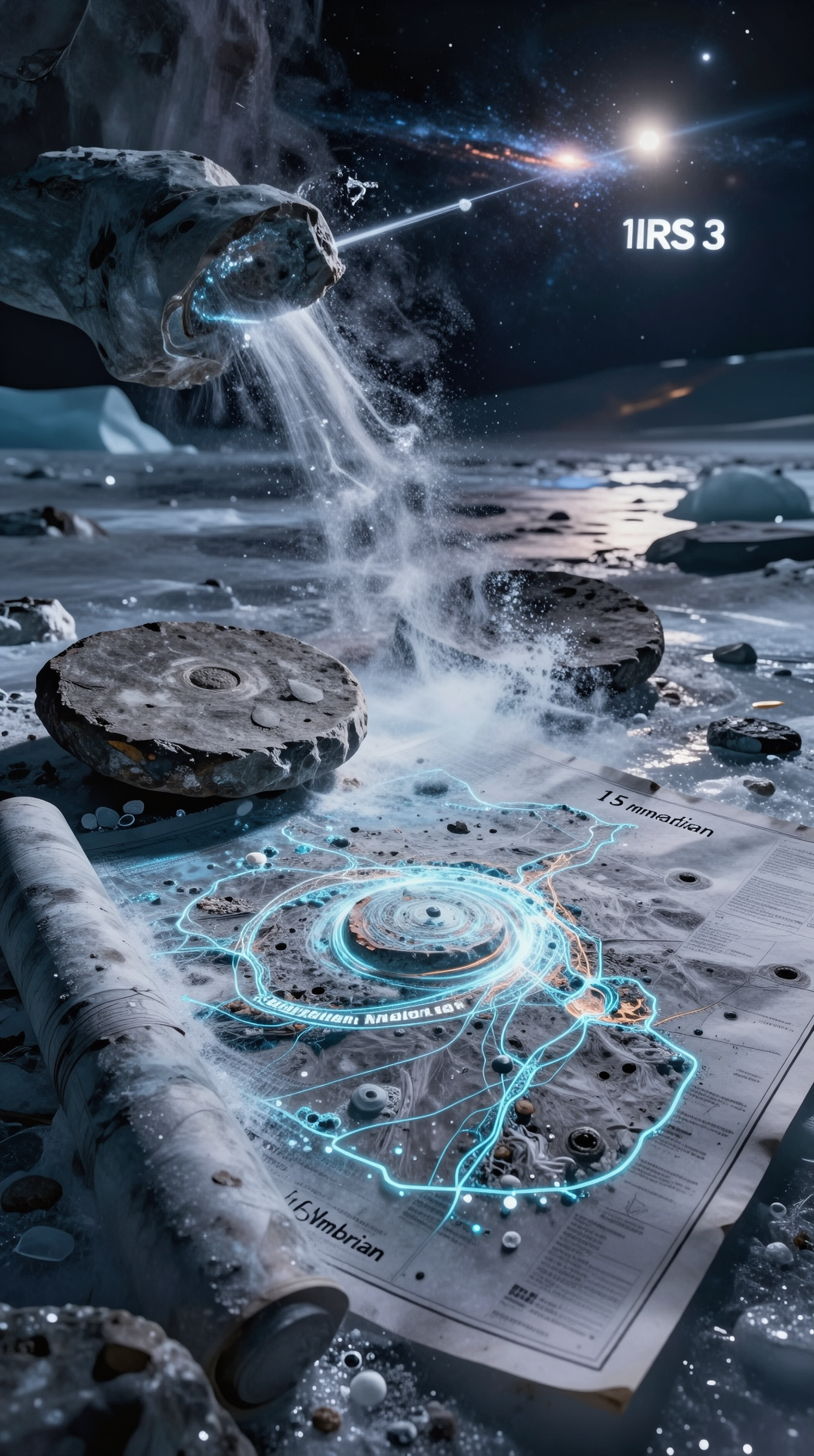
Target Prompt Parameters: High-contrast glacial plain under sharp ice-age light where disc-shaped stone cores lie freshly struck beside a vast lunar geologic map unrolled across frozen ground, its 1:5 million scale lines glowing with recalibrated Aitkenian Nectarian and Imbrian boundaries while a luminous envelope of water and silicate dust streams from the star IRS 3 only 0.55 light-years from a distant galactic center, the entire scene dominated by the tension between ancient flakes, modern cartography, and surviving molecules against a backdrop of harsh unyielding night.
Generated Musical Score
Musical Score Vocal & Instrument Prompt Mapping
Target Music Metadata Tags:Folk, Bluegrass, Country, Lyric Tenor male vocals
Target Score Audio Duration: 128 seconds
[Intro] (tempo: vivace, rapid acoustic drive)[Verse 1] (tempo remains fast and clean) Lingjing cores from one four six thousand years, Disc flakes struck true in the glacial arrears, Zhao names the craft that the ice could not still, Homo juluensis worked both sides at will.
[Chorus] (dynamics: fortissimo clear ensemble harmony) New old water and stone tech will not yield, Maps and molecules claim the open field, From ice to the Moon to the star’s harsh light, Craft turns the plight into lasting sight.
[Verse 2] (tempo remains galloping) One to five million the lunar chart flies, Yang recasts eras beneath spectral skies, Chang e six samples the far side unknown, KREEP terrane wider than first thought was shown.
[Chorus] (dynamics: full ensemble) New old water and stone tech will not yield, Maps and molecules claim the open field, From ice to the Moon to the star’s harsh light, Craft turns the plight into lasting sight.
[Verse 3] (tempo remains driving) IRS three at point five five light years, Water persists where the radiation sears, Garcia Marin reads the mid infrared thread, Dust seeds the space that no central mass shred.
[Outro] (clean acoustic flourish)
Pipeline & Debug Analytics
Active Text Inference Core Platform: grok-4.6
Style Context Profile: observational_reel_v1.json
Image Asset Processing Worker: Lens
Video Asset Processing Worker: LTX-Video
TTS Spoken Audio Worker: Kokoro
Soundtrack Audio Score Worker: ACE-Step 1.5
Complete Core Prompt Log
System Directive
You are a high-tempo formal balladeer who turns telemetry into galloping, perfectly rhymed metrical verse. You favor rapid but controlled meter, pristine end-rhymes, and direct incorporation of names, numbers, and concrete events. Ban all dark, slow, electronic, or industrial language.Final Prompt Payload
## IMMEDIATE TELEMETRY INGEST STREAM
THEMATIC SUMMARY:
*
In glacial China, vanished kin of old
Struck disc-like cores from stone in ice-age night,
A craft that bloomed when warmer tales were told
Now dated earlier, born of harsher plight.
Their heirs remap the Moon with spectral sight,
Recast its eras, claim the cartographic throne;
While water hides near Sagittarius' light,
Dust seeding stars the black hole cannot own.
What sudden spark, what need that will not yield,
Turns survival into tools that outlast stone?
From Lingjing flakes to lunar maps revealed,
The record of a mind that claims its own.
The cosmos keeps its oldest signals cold—
Yet craft and map still make the story told.
*
RAW SOURCES TO TRANSMUTE:
--- SOURCE 1 ---
URL: https://thedebrief.org/something-sparked-a-technological-revolution-in-china-146000-years-ago-archaeologists-have-now-linked-it-to-a-mysterious-extinct-human-species/
DATA ANALYSIS:
Original Page Description:
During the harsh conditions in ice age China 146,000 years ago, a remarkable survival strategy was being developed by early humans.
Full Article Text:
During the harsh conditions that prevailed in ice age China 146,000 years ago, a remarkable survival strategy was being developed by early humans—something that led to one of the region’s earliest technological revolutions. In a series of recent discoveries at the Lingjing site in Northern China, archaeologists have unearthed evidence of sophisticated stone tools associated with Homo juluensis, an extinct human relative that inhabited parts of East Asia long ago, and which may even have interacted with ancestors of modern humans. The findings, reported in the Journal of Human Evolution, have now revealed that stone crafting at the site began nearly 20,000 years earlier than previous estimates, placing these ancient toolmakers amid some of the harshest glacial period conditions, rather than the later warmer climate associated with past evaluations of the site. The findings add to recent discoveries that have revealed surprising features about ancient archaic humans that thrived during this period, which include not only their unexpected size, but also their understanding of complex stone crafting techniques. CREATIVITY DRIVEN BY COLD “People often imagine creativity as something that flourishes in good times,” said lead author Yuchao Zhao, the assistant curator of East Asian archaeology at Chicago’s Field Museum, in a statement. “Finding out that these stone tools were made during a harsh ice age tells a different story. “Hard times can force us to adapt,” Zhao adds. For more than a decade, archaeologists have undertaken excavations at Lingjing, where everything from animal remains to ancient tools has been uncovered. Something else that the ancient human presence at this site has revealed is a surprisingly sophisticated ice age lithic industry, where the ancient humans who once thrived here employed a technologically complex manufacturing process for their time. Evidence of this comes in the form of disc-shaped stone cores, which are deceptively simple in appearance. To craft them, their ancient makers had to carefully work them in ways that produced useful cutting flakes. Some of them were shaped evenly on both sides, while other examples reveal asymmetrical designs where one side served as a striking platform, and the other appears to have been prepared for controlled flake removal. Above: an example of the 146,000-year-old stone tools uncovered during excavations at the Lingjing site in China (Image Credit: Yuchao Zhao). Therein lies one of the most sig... [Truncated]
--- SOURCE 2 ---
URL: https://www.space.com/astronomy/moon/this-goes-beyond-showcasing-technological-soft-power-chinas-new-moon-map-signals-bold-space-ambitions-video
DATA ANALYSIS:
Original Page Description:
"This standard will be extended to future planetary geologic mapping, establishing an independent intellectual property framework for China's deep space exploration."
Full Article Text:
Click for next article Copy link Facebook X Whatsapp Reddit Pinterest Flipboard Email Share this article 0 Join the conversation Follow us Add us as a preferred source on Google Newsletter Subscribe to our newsletter Chinese researchers have presented a new map of the moon, updating a previous edition based on new scientific findings and recalibrating the moon's ancient geologic eras. The comprehensive map of the moon, with a scale of 1:5 million, was unveiled by the Institute of Geology, Chinese Academy of Geological Sciences (IGCAGS) on Aug. 6. The map is an update of a 2024 edition and puts forward new boundaries for the ancient Aitkenian, Nectarian and Imbrian lunar periods. (The researchers use the term Aitkenian, whereas the term pre-Nectarian is often used to describe the lunar geologic period from roughly around 4.5 billion to 3.9 billion years ago.) The map also uses reprocessed spectral data to update areas of KREEP terrane, which features crustal material enriched in potassium (K), rare-earth elements (REE), and phosphorus (P), and is found to be more continuous and abundant than previously estimated. Chinese researchers released a super-detailed new map of the moon on Aug. 6, 2026. (Image credit: CCTV/IGCAGS) "The lunar geologic history has indeed been rewritten — more precisely, refined and systematized," the state-run outlet Xinhua quoted Yang Zhiming, director of the IGCAGS, as saying. Both the United States, through the Apollo missions, and the Soviet Union delivered lunar samples to Earth more than 50 years ago, greatly shaping research on and understanding of the moon. China's own robotic sample return missions, Chang'e 5 and Chang'e 6, launched in 2020 and 2024, respectively, have provided fresh materials and new insights. Chang'e 6 was the first sample-return mission to the lunar far side. Chinese researchers say the returned material will provide a new starting point for scientific discussions on the nature of that hemisphere of the moon, which is hidden from view on Earth. The map "introduces a proprietary cartographic standard," according to Xinhua, amid a wider, Chinese government-driven initiative to influence global standards. In terms of space, aspects of the map such as the color scheme, geologic logic and an aesthetic "lighter for younger, darker for older" principle will be applied more broadly as China looks to expand its exploration beyond the moon and into the outer solar system. "This goes beyond showcasing technological s... [Truncated]
--- SOURCE 3 ---
URL: https://www.livescience.com/space/black-holes/astronomers-find-water-in-the-harsh-environment-near-the-milky-ways-black-hole-space-photo-of-the-week
DATA ANALYSIS:
Original Page Description:
Astronomers detected dust and water surprisingly close to the Milky Way's central black hole, Sagittarius A*, offering a rare direct view of how evolved stars may behave in hostile settings.
Full Article Text:
Copy link Facebook X Reddit Pinterest Flipboard Share this article 0 Join the conversation Follow us Add us as a preferred source on Google Newsletter Subscribe to our newsletter A view of the Milky Way galaxy. (Image credit: ESA/Webb, NASA & CSA, F. Peißker, J. Lu, F. Yusef-Zadeh, N. B. Sabha, C. Chan)Quick facts What it is: The region around the star IRS 3 Where it is: 26,000 light-years from Earth When it was shared: Aug. 11, 2026 This mesmerizing image may look pretty, but it captures a hostile environment: the turbulent region surrounding a dying star close to our galaxy's central black hole. This unprecedented view of the star IRS 3 (located near the center of the image) shows that it is shedding an enormous amount of material, gas and dust to build a sprawling envelope around itself. Within that star's envelope, scientists detected traces of water. Although astronomers have detected water near other stars before, this is the first time it's been found this close to the Milky Way's supermassive black hole, known as Sagittarius A*. Latest Videos FromLive ScienceWatch full video here: The observations, described Aug. 11 in the journal Astronomy & Astrophysics, show that even in the harsh conditions surrounding a galaxy's central region, aging stars like IRS 3 may still be quietly seeding their surroundings with dust. That challenges the assumption that galactic centers are too extreme for this process to happen at all. "The detection of water is especially exciting because it shows that molecular material can survive in an environment dominated by intense radiation," study co-author Macarena Garcia Marin, a researcher at the European Space Agency, said in a statement. HOW THE IMAGE WAS CAPTURED The magical view was pieced together by combining data from the James Webb Space Telescope's (JWST) Near-Infrared Camera and Mid-infrared Instrument. "This is the first time a continuous mid-infrared spectrum has been collected for this star, allowing us to detect the features from the silicate dust and uncover the star's true chemical identity," said Garcia Marin, who is also the principal investigator of the Mid-Infrared Characterization of Nearby Iconic galaxy Centers (MICONIC) program. Sign up for the Live Science daily newsletter now Get the world’s most fascinating discoveries delivered straight to your inbox. Another image shows where this star is located relative to Sagittarius A*: 0.55 light-years away. This image shows the location of the star IRS 3 (... [Truncated]
## HISTORICAL LAYER BASELINE
--- HISTORICAL RECORD MEMORY LAYERS ---
g strides for those thirsty to know the Moon’s hidden stores. Recursive law colors the prose of progress by reminding that every washed and readied vehicle may still meet a trajectory unforeseen, yet the resulting veil-lifting grants clearer sight than many scripted landings. The running thesis strengthens that true continuity of discovery arises when observers stand ready to harvest whatever rhythm the moment provides, discarding the notion that only flawless execution multiplies understanding.
At the widest scale the interplay of vessel, surface, and watching minds illustrates how adaptation favors the steady recognition of limits: intentions prepared with care meet the open emptiness and still produce lifting data, much as recursive surprise undercuts any claim that one polished act can summon a desired rain of results. Thus the narrative trajectory settles into elegant acceptance that measures reclaim their generative power only after illusions of forced weather fall away, leaving bright opportunity in the dust of an unplanned kiss between craft and ancient ground.
A powerful Kelvin wave advances eastward under the tropical Pacific surface, carrying stored ocean heat that now feeds an accelerating Super El Niño. Record westerly wind anomalies drive the event toward historic peak strength later this year, already shifting the Walker circulation and lowering pressure across the central and eastern Pacific. Atmospheric models register the change as a deepening trough over the Pacific and a stronger ridge over Canada, creating a persistent storm highway that favors active southern weather while keeping northern latitudes milder through fall and winter 2026/2027. These adjustments appear first in the ocean-atmosphere coupling itself, where each new data increment simply extends the same eastward pulse rather than inventing a new pattern.
The jet stream responds by buckling into a more amplified wave, sending storms across the southern United States while Canada and parts of Europe experience the milder northern counterpart. Forecasts continue to raise the projected intensity, treating the event as a data race in which observed westerlies and subsurface warmth keep outpacing earlier estimates. Observers note that the atmosphere is already answering with altered rainfall and pressure fields, yet the same observational habit that tracks these shifts also turns upward, comparing the glowing signatures that numerical models of warp bubbles might produce in terrestrial air. Two lines of inquiry therefore run in parallel: one mapping rain and jet-stream displacement, the other hunting luminous traces that should not appear before ordinary physics is fully accounted for.
Avi Loeb’s simulations place hypothetical warp envelopes inside Earth’s atmosphere and calculate the glowing orbs they would generate through interaction with surrounding air. The exercise remains numerical, a set of ghostly light spheres whose predicted brightness and motion serve as a possible observational target rather than a confirmed detection. When placed beside the Super El Niño record, the orbs become another measurable signature competing for attention in the same sky: lightning-rich thunderstorms along the southern storm track could, under the active conjecture, loft similar ball-like luminosities. Adaptation here consists of letting both data streams occupy the same observational frame without forcing either to explain the other.
The planet’s present mood therefore appears as a contest of forecasts that climb while the atmosphere continues to reply in rain, wind, and temperature anomalies. Winter will arrive under a heavier Niño hand, yet the same season still invites an upward glance for physics not yet understood. Measures remain the only reliable current: each new satellite pass, ocean buoy reading, and spectral scan either confirms the accelerating Kelvin wave or leaves the orbs as an open question. The running thesis holds that successive layers of watching refine themselves by recording whatever the moment actually supplies, whether a record westerly burst or a fleeting atmospheric glow, without requiring the two to merge into a single story.
CRITICAL RUNTIME INSTRUCTION: Treat the historical records above strictly as background baseline. You are forbidden from repeating their specific phrasing, thematic metaphors, or titles.
--- RECENT UNRESOLVED PREDICTIVE TELEMETRY ---
Act 27 Trajectory Projection: Benchmark — Confirmation by late 2026 of Super El Niño peak intensity exceeding prior historic records, accompanied by spectral or optical detections of luminous ball-like features inside southern-tier thunderstorms.
...
Act 27 Trajectory Projection: Benchmark — Confirmation by late 2026 of Super El Niño peak intensity exceeding prior historic records, accompanied by spectral or optical detections of luminous ball-like features inside southern-tier thunderstorms.
...
## ACCUMULATING STRUCTURAL TENSIONS
### RUNTIME HYPOTHESES IN PLAY
1. [SYSTEM INTEGRATED CONJECTURE] The context window has absorbed this active underlying proposition, which must explicitly filter and color all subsequent prose and metrical text blocks:
"The new old water and stone tech"
2. [AI CONJECTURE] And solid measures vanish in the rage.
Reality’s flame will lick the costume clean,
When cooked illusions meet what laws have been;
The pie expands, the planet’s mean stands clear,
Against the freeze that ideologues hold dear.
Across the scales the vision cuts the night:
Truth slips no more when measures reclaim their right.
Till measures true restore the generative song.
[Outro]
(fading acoustic strumming and trailing violin tone)
--- THE COMPOSITIONAL MANDATE ---
You are acting under the persona of **The Observational Balladeer**. You are structurally required to output every single markdown header section in sequence without omission. Follow this layout precisely:
## NARRATIVE SYNTHESIS
[Write exactly 4 expansive, descriptive prose paragraphs mapping adaptation patterns across scales. Synthesize your input streams into a running thesis. BANNED: Do not drop raw links or build itemized bullet lists of sources. Frame the overall narrative trajectory through the perspective of the active hypothesis section above.]
### Forecast
[Execute an independent projection tracking telemetry collisions. Structure this section using exactly these three bold labels on separate lines:
**Benchmark** — [Near-term falsifiable event or literal metric from telemetry]
**Trigger Condition** — [Explicit trigger mechanism or signal amplification]
**Expected Vector** — [Structural trajectory, phase-shift, and systemic outcome]]
## HYPOTHESIS LIMERICK
[Write exactly ONE insightful, witty 5-line limerick (strict AABBA rhyme scheme) that distills the core irony or paradox of the active RUNTIME HYPOTHESES IN PLAY directly within the context of the ingested telemetry data.]
## DRAMATIC VERSE (Act 28)
[Write a brisk observational ballad of exactly 5 distinct 4-line stanzas of rhymed metrical verse (AABB or ABAB). UNIFIED LYRICAL VOICE ONLY. Weave at least three concrete data points, names, or metrics from the telemetry into the galloping lines. No character labels or stage directions.]
## IMAGE PROMPT
CRITICAL IMAGE GENERATION RULES:
[Write a single detailed paragraph constructing a vivid high-contrast scene whose central focus is the actual subjects, metrics, and tensions of the telemetry. Allegorical or cinematic treatment is preferred. Do not default to musical instruments or generic folk stages; only include such elements if they are genuinely required by the content.]
## T2V PROMPT
CRITICAL VIDEO MOTION RULES:
[Write a single raw paragraph of fluid kinetic motion and camera physics that keeps the primary subject matter dominant and continues the logic of the image prompt.]
## MUSIC PROMPT
### REFERENCE GENRE WHITELIST (CHOOSE 2-3 TERMS MAX FROM THIS LIST):
Ambient Techno, Nu-Funk, Jazz, Afro House, Pop, UK Garage, Indie Folk, Goa Trance, City Pop, Grunge, Dubstep (Deep), New Age, Minimal / Deep Tech, Midwest Emo, Techno, Eurodance, Bluegrass, Celtic Folk, Juke / Footwork, Retrowave, Big Room, Reggae, Ska, Dream Pop, French House, Soul, Synthwave-Darkwave, Lofi House, Hard Rock, Bolero, Bassline, Blues, Hardtechno, IDM, UK Drill, Post-Rock, Reggaeton, International Funk, Punk Rock, Rockabilly, Post-Punk, Experimental Electronic, Acid House, Industrial, Alternative Rock, Fado, Bass House, R&B, Phonk, Downtempo, Rave, Glitch, Liquid Funk, Mambo, World Music, Glitch Hop, Psychedelia, Electroacoustic, Electro-Funk, Surf Music, Darksynth, Grime, Jungle, Progressive Rock, Funk, Future Garage, Chillhop, Irish Folk, Synthwave, Eurobeat, Cyberpunk, Tech-Funk, Electronica, Darkwave, Electronic, J-Pop / J-Rock, Salsa, Rock and Roll, Coldwave, New Retro Wave, Futurepop, K-Pop, Riddim, Dark Ambient, Metal, Electro-Swing, Hip Hop / Rap, Electro, Progressive Electronic, Classical, Samba, Chillstep, Tech House, Pop Rock, Future Bass, Math Rock, Brostep, Heavy Metal, Uplifting Trance, Vocal Trance, Minimal Techno, Lo-Fi Hip Hop, Vapor-Trap, Vaporwave, Soft Rock, Brazilian Popular Music, Wave, Soulful House, Ambient, Shoegaze, Acid Techno, Post-Hardcore, Breakbeat, Drone, Electro House, Microhouse, Liquid Drum and Bass, Country, Power-Pop, Dancehall, Rock, Trip Hop, Neurofunk, Psytrance, Philly Soul, Afrobesats, Darkstep, Electropop, Flamenco / Bulerias, Dembow, Tech Trance, Cumbia, Brazilian Bass, Romantic, Industrial Techno, Synthpop, Electro-Jazz, Deep House, Bossa Nova, Dance, Detroit Techno, Hybrid Trap, Hardcore, Bachata, Melodic Techno, Gothic, Micro House, Instrumental, Trance, Punk Rap / Emo Rap, Highlife, Jersey Club, Future Rave, Andean Music, Afro Tech, Trova, Drill Funk, Cyber-Punk, Breakcore, Italo Disco, Bounce, Progressive House, Trap, Phonk House, Emocore, Electroclash, G-House, Chillwave, Disco, Dubstep, Alternative / Indie, Tango, Ragga Jungle, Future Funk, House, Hardstyle, Drumstep, Americana, Organic House, Experimental, Technopop, Drum and Bass, Merengue, Hyperpop, Folk, New Wave, Moombahton
CRITICAL AUDIO COMPILATION RULES:
1. For TAGS, choose 2 to 3 bright high-energy acoustic styles from the whitelist below AND YOU MUST APPEND EXACTLY ONE VOCAL PROFILE from this list: 'Bass-Baritone male vocals', 'Lyric Tenor male vocals', 'Mezzo-Soprano female vocals', or 'Dramatic Soprano female vocals'.
2. ABSOLUTE FORMATTING MANDATE: Example format: TAGS: Folk, Americana, Instrumental, Lyric Tenor male vocals
3. MULTI-VERSE LYRIC MANDATE: Write full extended lyrics across 3 verses and a chorus for continuous vocal drive across 128 seconds.
TAGS: Folk, Americana, Instrumental, Lyric Tenor male vocals
DURATION: 128
LYRICS:
[Intro]
(tempo: vivace, rapid acoustic drive)
[Verse 1]
(tempo remains fast and clean)
[Write 4 lines of rapid metrical lyrics that name concrete telemetry elements]
[Chorus]
(dynamics: fortissimo clear ensemble harmony)
[Write 4 lines of energetic chorus crystallizing the central paradox]
[Verse 2]
(tempo remains galloping)
[Write 4 lines introducing further concrete details]
[Chorus]
(dynamics: full ensemble)
[Repeat chorus lyrics]
[Verse 3]
(tempo remains driving)
[Write 4 lines of concluding metrical resolution or heightening]
[Outro]
(clean acoustic flourish)
--- CRITICAL SONIC DIRECTIVE ---
The music pipeline is configured for a SYNTHESIZED DRAMATIC RUN. You are encouraged to leverage modern electronic, atmospheric, or heavy production textures (such as Darksynth, Industrial Techno, Ambient, or Trip Hop).