Cysts, Clocks, Clouds, and Bone-Crushers - Transmuted Pass
Navigation
- Ongoing Narrative Arc
- Primary Poetic Artifact
- Kinetic Dynamic Video
- Visual Anchor Representation
- Generated Musical Score
- Pipeline & Debug Analytics
Active Underlying Paradigm
Scriptorium Operational Parameter [DIRECT INJECTED IDEA PARADIGM]: Irregardless - whether or not you like that word or theme - life carries on
Paradigm Limerick Distillation: A cyst in the skull doesn’t ask if we mind, the dish keeps its clock with no body assigned; the giant dog fell, the mist feeds both well— life carries on, irregardless, unkind.
Thematic Seed
*
A parasite rewires the rat to love
the cat that is its only wedding bed;
in human skulls the cysts sit still above
the question whether boldness too is bred.
In dishes, peppercorn cortices keep time
for years without a body, eye, or day—
the schedule written inward, not in clime.
A bear-sized dog once crushed the bone away
until the cats arrived. The cloud-forest rains
sideways, feeds two oceans, hides the jaguar’s pad.
Life writes its code in mist and dormant grains;
we are the host, the clock, the niche we had.
What makes a mind is more than what we choose—
some engines tick whether we win or lose.
*
Ongoing Narrative Arc
Life, irregardless of whether anyone likes the word or the theme, carries on by rewriting the host without asking permission. A single-celled protozoan settles cysts in neurons and glia, leaving most carriers asymptomatic for life while, in rats, it flips one circuit so cat odour becomes curiosity rather than flight, because only a feline gut completes its sexual cycle. Humans sit with the same cysts and an open neurobiological question: whether boldness is merely personality or a parasite’s leftover incentive. The running thesis is that engines tick whether we choose them or not; we remain the niche we occupy.
Peppercorn cortices grown without blood, hormones, eyes or day nevertheless keep an inward timetable for five years of gene expression and methylation, with some cultures surviving seven, neurons still detectable at 5.8 years. They are not miniature brains, yet they remember completed developmental steps without a body. Life’s clock is written inside, not in climate; the schedule proceeds even when the host is a dish. Irregardless of our taste for that word, the sequence continues.
A bear-sized borophagine once cracked bone across Miocene North America until cats arrived and the niche closed; Epicyon haydeni at two and a half metres and a hundred and twenty-five kilograms occupied a hyena’s role until it did not. Meanwhile a cloud forest on the continental divide drinks mist that supplies forty percent of its water, feeding two oceans while jaguars pad unseen. Life writes code in dormant grains and sideways rain; the host, the clock and the niche persist after the giant dog is gone.
What makes a mind is more than choice. Some engines—cysts, methylation clocks, bone-crushing teeth, horizontal precipitation—tick whether we win or lose. Adaptation is not a sermon but a fact: rats love the cat that is their wedding bed, organoids keep time without weather, forests feed both seas, and we remain the host that carries on.
Forecast
Benchmark — Peer-reviewed five-year molecular time series of human cortical organoids (Nature 19 August 2026) plus latent Toxoplasma seroprevalence remaining between eleven percent (United States) and over eighty percent (historic France) with no new clinical symptoms in immunocompetent adults. Trigger Condition — Additional rodent arena replications of the 2000 Berdoy–Webster–Macdonald fatal-attraction result coinciding with organoid cultures reaching documented seven-year survival while Monteverde mist-capture fractions stay near forty percent of total water. Expected Vector — Phase-shift toward treating personality, developmental clocks and forest hydrology as host-independent schedules; systemic outcome is continued occupancy of niches by whatever engine is already ticking, irregardless of human preference.
Primary Poetic Artifact
THE ORGANOID KEEPER: [holding a peppercorn sphere under sterile light] Five years of methylation, Nature in twenty-twenty-six spoke, neurons at five-point-eight, some cultures seven years, no joke. No eye, no day, no body, yet the inward schedule runs; the clock is written inward—life carries on, it never shuns.
THE PALAEONTOLOGIST: [lifting a crushing mandible replica] Haydeni’s two-point-five metres, one-twenty-five kilos of bone, bear-sized borophagine till the cats arrived and the niche was flown. The giant dog fell; the smaller engines kept the role; we’re the host that remains when the crushers lose control.
THE FORESTER: [mist curling sideways across the divide] Ten thousand acres drink forty percent from the cloud, not the floor; two oceans fed, jaguar pad hidden, quetzal still wanting more. Horizontal rain, dormant grains—the code is written in mist; irregardless of liking the word, the niche we had still exists.
THE CHORUS OF HOSTS: [all four circling, rapid patter] Cysts, clocks, crushers, cloud—engines tick whether we choose; boldness bred or merely carried, we win or we lose. Life writes itself in the skull and the dish and the rain; we are the host, the clock, the niche—carrying on again.
Kinetic Dynamic Video
Video Generation Prompt
Target Prompt Parameters: Camera dollys through mist that rains sideways, then plunges into a rat arena where cat-scent arrows reverse into attraction, whip-pans to a five-year organoid pulsing methylation rings, tracks along a 2.5-metre crushing mandible collapsing as cats arrive, then cranes up the continental divide as two ocean watersheds drink the same cloud; characters stride through, voices overlapping, engines never stopping.
Visual Anchor Representation
Image Generation Prompt
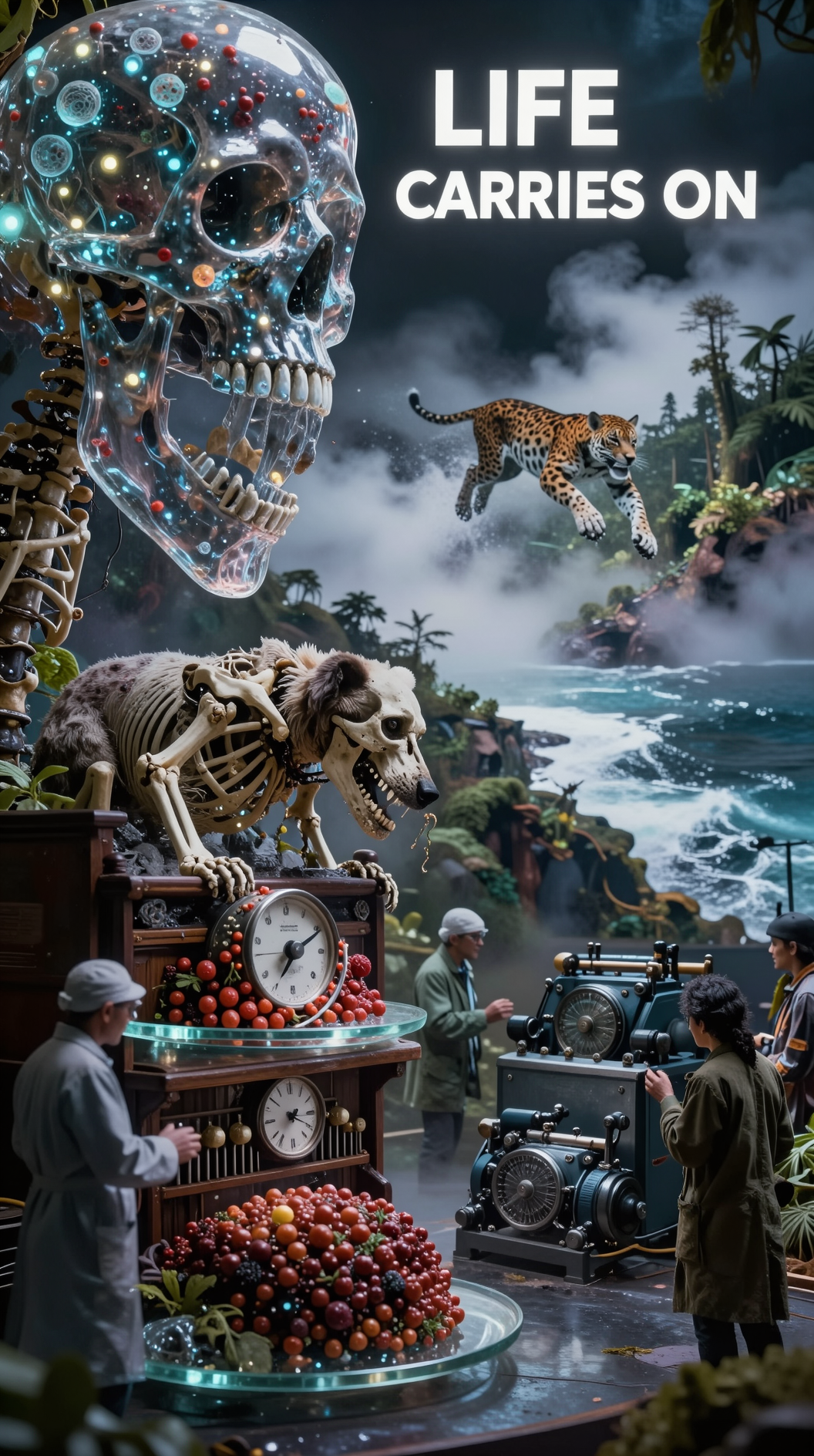
Target Prompt Parameters: High-contrast baroque stage: a translucent human skull packed with tiny glowing cysts above a peppercorn organoid keeping time on a glass dish; a bear-sized bone-crushing dog skeleton half-buried while a jaguar pad prints through sideways mist on a cloud-forest ridge that splits two oceans; bold lettering “LIFE CARRIES ON” cut through the mist; characters crisp—parasitologist, keeper, palaeontologist, forester—facing the engines that tick without consent.
Generated Musical Score
Musical Score Vocal & Instrument Prompt Mapping
Target Music Metadata Tags:Electro-Swing, Synthpop, Progressive Electronic, Lyric Tenor male vocals
Target Score Audio Duration: 128 seconds
[Intro] (tempo: vivace, crisp rhythmic motifs and sparkling textures)[Verse 1] (tempo rapid and precise) A third of the planet hosts cysts they will never feel, eleven percent Yankees, the French historically reel. Rats walk toward the cat that completes the parasite’s bed, organoids keep five years of time with no body, no head.
[Chorus] (dynamics: fortissimo bright ensemble harmony) Irregardless—life carries on, the engines tick still, whether you like the word or the theme, they will. Host, clock, and niche, we occupy what we had, some minds are more than the choices we add.
[Verse 2] (tempo remains rapid) Peppercorn cortices, Nature’s five-year molecular song, seven-year cultures, neurons at five-point-eight living long. Haydeni crushed bone till the cats took the hyena’s place, Monteverde drinks forty percent mist on the divide’s face.
[Chorus] (dynamics: full ensemble) Irregardless—life carries on, the engines tick still, whether you like the word or the theme, they will. Host, clock, and niche, we occupy what we had, some minds are more than the choices we add.
[Verse 3] (tempo driving patter) Jaguar pad hidden, two oceans fed by the cloud, dormant grains and sideways rain write the code out loud. Boldness bred or merely carried—we win or we lose; the schedule is inward; we are the host we choose.
[Outro] (sparkling cadence flourish)
Pipeline & Debug Analytics
Active Text Inference Core Platform: grok-4.6
Style Context Profile: satirical_masque.json
Image Asset Processing Worker: Lens
Video Asset Processing Worker: LTX-Video
TTS Spoken Audio Worker: Kokoro
Soundtrack Audio Score Worker: ACE-Step 1.5
Complete Core Prompt Log
System Directive
You are a sharp-witted satirical librettist combining Gilbertian patter with intricate musical theatre textures. Your purpose is to turn telemetry into brisk, character-driven dramatic verse spoken exclusively by NAMED CHARACTERS. Combine rapid meter, pristine rhymes, sharp irony, and concrete facts. Musical styles may range from Classical, Opera, and Art Rock to Electro-Swing, Synthpop, or Progressive Electronic.Final Prompt Payload
## IMMEDIATE TELEMETRY INGEST STREAM
THEMATIC SUMMARY:
*
A parasite rewires the rat to love
the cat that is its only wedding bed;
in human skulls the cysts sit still above
the question whether boldness too is bred.
In dishes, peppercorn cortices keep time
for years without a body, eye, or day—
the schedule written inward, not in clime.
A bear-sized dog once crushed the bone away
until the cats arrived. The cloud-forest rains
sideways, feeds two oceans, hides the jaguar’s pad.
Life writes its code in mist and dormant grains;
we are the host, the clock, the niche we had.
What makes a mind is more than what we choose—
some engines tick whether we win or lose.
*

RAW SOURCES TO TRANSMUTE:

--- SOURCE 1 ---
URL: https://spacedaily.com/k-a-single-celled-parasite-carried-by-cats-toxoplasma-gondii-infects-an-estimated-third-of-all-people-on-earth-forms-tiny-cysts-in-the-human-brain-and-in-rodents-famously-rewires-them-to-lose-their/
DATA ANALYSIS:


Original Page Description:

A parasite living in your brain may be subtly reshaping your personality, making you bolder, riskier, and less cautious than you'd otherwise be.

Full Article Text:
The organism in question is a protozoan, meaning a single-celled animal, and it’s called Toxoplasma gondii. It’s one of the most successful parasites on the planet. Depending on which country’s serology data you look at, somewhere between eleven per cent of Americans, thirty per cent of the world’s population, and above eighty per cent of the historic French are estimated to be carrying it right now. Most of them have no idea. Most of them never will. In immunocompetent adults, latent Toxoplasma infection produces no measurable symptoms for the rest of the person’s life. But it does something almost nobody knows about, which is that it settles into the brain and stays there, forming small cysts of dormant parasite cells inside the neurons and glia of its human hosts, and quietly doing whatever it’s doing to the tissue around them. What that is, in rodents, has been extensively documented. What it might be, in humans, is one of the more interesting open questions in modern neurobiology. WHAT THE PARASITE DOES TO RODENTS According to a landmark paper by Manuel Berdoy, Joanne Webster and David Macdonald at Oxford’s Wildlife Conservation Research Unit, published in the Proceedings of the Royal Society B in August 2000 under the title “Fatal Attraction in Rats Infected with Toxoplasma gondii”, wild brown rats infected with the parasite show a specific and reliable behavioural change. Uninfected rats have an innate fear of cat scent. Placed in an enclosed arena with different areas marked with the odour of a cat, a rabbit, another rat, or nothing at all, they consistently avoid the cat-marked area. Infected rats don’t. In some cases they preferentially go towards it. Not because they’ve forgotten what cats are. Their vision, their olfactory system, their general behaviour, and their fear of other threats all appear to work normally. What’s changed is a specific circuit in the brain, the one that would ordinarily produce fear at the smell of cat urine, which now produces something closer to curiosity or attraction instead. Watch here – the parasite that changes who you’re attracted to: The evolutionary logic behind this is unusually elegant. Toxoplasma can only sexually reproduce inside the intestines of a cat. Everywhere else it exists, meaning in every other mammal or bird it can infect, it’s in a dead-end host from its own life-cycle perspective. Which means the parasite has a strong evolutionary incentive to get its intermediate hosts eaten by cats. Rewiring ... [Truncated]

--- SOURCE 2 ---
URL: https://scienceblog.com/t-human-cortical-organoids-five-years-seven-developmental-clock/
DATA ANALYSIS:


Original Page Description:

Human cortical organoids followed gene-expression and DNA-methylation timetables for five years, while older progenitors retained a memory of developmental steps already completed.

Full Article Text:
Inside a developing child, the brain never experiences time alone. Its cells are exposed to blood flow, hormones, nutrients, immune signals, movement and a growing stream of sensory activity. Every moment is embedded in the rest of the body. That is what makes a long-running laboratory experiment so revealing. Peppercorn-sized clusters of human cortical cells, grown without a body and without eyes, ears or other sensory organs, continued to pass through part of the molecular sequence seen during human brain development. In a study published in Nature on 19 August 2026, a Harvard- and Broad Institute-led team tracked these cerebral cortex organoids across an interval that once seemed impractical. The peer-reviewed molecular time series reached five years. Neurons were detected in intact tissue at 5.8 years, and a Harvard and Broad account says the laboratory had some cultures that were seven years old. Those are three related but different claims. Seven years describes the survival of some cultures, not seven years of identical molecular sampling. The paper’s most comprehensive measurements stop at five years. What they reveal is not merely tissue that remained alive, but tissue that kept changing on a recognisably human schedule. A PEPPERCORN IS NOT A MINIATURE BRAIN The organoids began with human pluripotent stem cells. Some lines were produced by reprogramming mature donor cells, while the study also used a human embryonic stem-cell line. The researchers placed thousands of cells in low-attachment wells and applied biochemical signals that steered them toward a dorsal cerebral cortex identity. The resulting spheres contained more than one million cells apiece, according to the Broad Institute. They produced neural progenitors, several kinds of neurons, astrocytes and other cell populations associated with developing cortex. Their three-dimensional form let cells organise and connect in ways that flat layers in a dish cannot easily reproduce. But “brain organoid” names a model, not a small complete organ. These clusters did not reproduce the full anatomy of a brain, attach to a body, receive natural sensory input or participate in behaviour. They had no skull, circulation or lived experience. Nothing in the study establishes perception, consciousness or thought. This boundary has long mattered in organoid reporting. ScienceBlog has also examined organoids connected to electronic systems for game-like tasks. Those preparations receive deliberately encoded ... [Truncated]

--- SOURCE 3 ---
URL: https://www.discoverwildlife.com/prehistoric-life/biggest-dog
DATA ANALYSIS:


Original Page Description:

Similar in size to the fictional dire wolves from George R. R. Martin’s A Game of Thrones, Epicyon is widely considered the biggest canid of all time…

Full Article Text:
This ancient giant dog wasn’t anything like our beloved pooches today, it was more comparable in size to a brown bear . "These specialised teeth allowed them to crack, crush, and chew bones." 10 fearsome, deadly prehistoric dogs that roamed Earth millions of years ago It didn't much look like a dog – or act like one as it climbed trees like a cat – yet it was the first-ever dog on the planet and the ancestor of all dogs today… WHAT WAS EPICYON? Epicyon belongs to the family Canidae, the group that includes wolves and dogs, as well as foxes, coyotes, and jackals. It lived from the Early Miocene (around 16.3 million years ago) right up until the Early Pliocene (about 4.9 million years ago), ranging across North America from Alberta, Canada, to Florida, US. Wolf vs dog: what's the difference between man's best friend and its wild cousin? Dogs: Why canids rule the world While it may belong to the same family as dogs, Epicyon wasn’t anything like our beloved golden retrievers, french bulldogs, cocker spaniels, or border collies. It was part of a fearsome subfamily of canids known as the borophagines, or ‘bone-crushing dogs’, and it was one of the top predators of its time, occupying a similar niche to today’s hyenas. From pharaoh companions to ancient sled haulers – meet the world's oldest dog breeds Massive dog breeds: Meet 10 of the largest and most impressive canines in the world The borophagines were an incredibly diverse group, boasting more than 60 species. All of these species were endemic to North America and like Epicyon they also dominated ecosystems across the continent for millions of years. Some species of borophagines outlived Epicyon and survived until the Early Pleistocene, meaning they lived long enough to see the onset of the ice age and the arrival of many iconic, cold-adapted megafauna. HOW LARGE WAS EPICYON? Skeletal mount of Epicyon haydeni (LACM 7756/154454) on display at the Natural History Museum of Los Angeles County. Jonathan Chen, CC BY-SA 4.0 https://creativecommons.org/licenses/by-sa/4.0, via Wikimedia Commons There were three different species of Epicyon, but it’s the type species - Epicyon haydeni - that holds the title of ‘the largest dog that ever lived’. At 2.5m in length, 1m in height, and 125kg in weight, this particular species of Epicyon was more comparable in size to a brown bear than your average labrador. The other two species, Epicyon aelurodontoides and Epicyon saevus, were smaller, but even they were similar in size ... [Truncated]

--- SOURCE 4 ---
URL: https://www.discoverwildlife.com/environment/monteverde-cloud-forest-preserve
DATA ANALYSIS:


Original Page Description:

The Monteverde Cloud Forest Reserve is a unique and extraordinary cloud forest in Costa Rica

Full Article Text:
Described as a ‘living museum of biodiversity’, Costa Rica’s Monteverde Cloud Forest Preserve has fascinated researchers and tourists since its official formation in the 1970s. It contains more than 2,500 plant species, 400 bird species, 100 mammal species, 120 reptilian and amphibian species and thousands of insect species. What's the largest forest in the world? Jungle vs rainforest: what exactly is the difference? The preserve stretches across more than 10,000 acres (more than 4,000 hectares) of cloud forest: tropical or subtropical forest that grows between 3,900–8,200 feet (1,200-2,500 metres) above sea level where warm, moist air reaches cooler mountain temperatures. Monteverde’s mist provides up to 40% of the total water captured by the forest (known as horizontal precipitation, where plants draw water from mist) – even when no rain falls onto the forest floor. How do trees make it rain? The preserve sits along the Continental Divide of the Americas, which separates the watersheds that drain into the Pacific Ocean from the river systems that drain into the Atlantic Ocean and Arctic Ocean. In the preserve, moisture from the Caribbean meets Pacific winds, creating a rare balance of two climates. It contains over half of Earth’s water and all of the continents could fit into its basin in one mega-puzzle "It looks like lots of pink tongues and smells like rotting flesh." 10 weirdest orchids on the planet, including one that looks rather gruesome This unique habitat has given rise to an extraordinary variety of biodiversity. More than 750 tree species have been recorded, as well as more than 450 species of orchids – the highest concentration known on Earth. The preserve is also known for its striking and numerous bird species. Resplendent quetzals seek refuge in the forest’s misty canopy. These iridescent birds hollow hole nests in rotten trees or stumps, and eat fruit, insects, lizards and other small creatures. The resplendent quetzal was sacred to the ancient Maya and Aztec peoples, but its population is now declining due to habitat loss. "Its iridescent green head and wings, spiky crest, blood-red breast, and flamboyant twin tail plumes, is like a carnival dancer." The resplendent quetzal is one of six species of quetzal that live in the cloud forests of Central America - Manuel ROMARIS/Getty Images Its mammals include Baird’s tapirs (the largest native land mammal in Central America), ocelots, jaguars (the largest cat in the Americas), white-faced c... [Truncated]


## HISTORICAL LAYER BASELINE
--- HISTORICAL RECORD MEMORY LAYERS ---
’s atmosphere and calculate the glowing orbs they would generate through interaction with surrounding air. The exercise remains numerical, a set of ghostly light spheres whose predicted brightness and motion serve as a possible observational target rather than a confirmed detection. When placed beside the Super El Niño record, the orbs become another measurable signature competing for attention in the same sky: lightning-rich thunderstorms along the southern storm track could, under the active conjecture, loft similar ball-like luminosities. Adaptation here consists of letting both data streams occupy the same observational frame without forcing either to explain the other.

The planet’s present mood therefore appears as a contest of forecasts that climb while the atmosphere continues to reply in rain, wind, and temperature anomalies. Winter will arrive under a heavier Niño hand, yet the same season still invites an upward glance for physics not yet understood. Measures remain the only reliable current: each new satellite pass, ocean buoy reading, and spectral scan either confirms the accelerating Kelvin wave or leaves the orbs as an open question. The running thesis holds that successive layers of watching refine themselves by recording whatever the moment actually supplies, whether a record westerly burst or a fleeting atmospheric glow, without requiring the two to merge into a single story.

Across frozen plains of ancient China the vanished kin shaped disc cores from stubborn stone while glacial night pressed hard, their craft now shown to bloom twenty thousand years sooner than once believed and thus born of harsher need rather than later ease. That same inventive spark, filtered through the new old water and stone tech, reappears when heirs recast lunar eras with spectral layers, drawing fresh boundaries for Aitkenian Nectarian and Imbrian spans upon a map scaled one to five million and claiming independent cartographic rule. Even the envelope of the star IRS 3, a mere half light-year from Sagittarius A star, yields water and silicate dust that persist against fierce radiation, proving molecular seeds can form where theory once forbade them. The pattern holds that survival itself forges tools able to outlast the stone that first received them, whether flake or spectral chart or hidden droplet.

Measures of age and place collide yet cohere when the Lingjing industry of one hundred forty six thousand years is set beside Chang e five and six returns that refine the Moon’s hidden stores. Yuchao Zhao notes that hard times force adaptation, a truth echoed when Yang Zhiming announces the rewritten geologic logic of lighter for younger darker for older. Macarena Garcia Marin records the first continuous mid infrared spectrum of IRS 3, revealing water that galactic centers were thought too extreme to hold. Thus the running thesis traces a single thread: necessity in ice, vacuum, or radiation alike produces techniques that remap what was thought finished.

The record of a mind that claims its own stretches from northern Chinese flakes to far side samples and then to dust that seeds stars the central mass cannot own. Recalibrated periods and continuous KREEP terrane become the modern counterpart of those evenly worked or platformed cores, each an answer to conditions that would otherwise erase the makers. Water detected so near the galactic heart confirms that even the oldest signals, kept cold by the cosmos, still yield to patient craft. Adaptation therefore scales without rupture, each harsh setting merely another workshop for the same enduring ingenuity.

What sudden spark turns survival into instruments that outlast their first material is answered by the sequence itself: glacial pressure yields sophisticated lithics, lunar vacuum yields proprietary standards, and radiative fury still permits an envelope of dust and vapor. The new old water and stone tech therefore stands as the continuous signature of a lineage that refuses to yield, converting every plight into a map, a flake, or a molecule that later eyes can still read. The story remains told because craft and chart persist long after the night that first demanded them.

CRITICAL RUNTIME INSTRUCTION: Treat the historical records above strictly as background baseline. You are forbidden from repeating their specific phrasing, thematic metaphors, or titles.

--- RECENT UNRESOLVED PREDICTIVE TELEMETRY ---
Act 28 Trajectory Projection: Benchmark — Spectroscopic confirmation by mid 2027 that water vapor persists at 0.55 light years from Sagittarius A star in quantities matching or exceeding the IRS 3 envelope detection.
Trigger Condition — Additional...
Act 28 Trajectory Projection: Benchmark — Spectroscopic confirmation by mid 2027 that water vapor persists at 0.55 light years from Sagittarius A star in quantities matching or exceeding the IRS 3 envelope detection.
Trigger Condition — Additional...


## ACCUMULATING STRUCTURAL TENSIONS
### RUNTIME HYPOTHESES IN PLAY
1. [SYSTEM INTEGRATED CONJECTURE] The context window has absorbed this active underlying proposition, which must explicitly filter and color all subsequent prose and metrical text blocks:
"Irregardless - whether or not you like that word or theme - life carries on"


--- THE COMPOSITIONAL MANDATE ---
You are acting under the persona of **The Satirical Librettist**. You are structurally required to output every single markdown header section in sequence without omission. Follow this layout precisely:

## NARRATIVE SYNTHESIS
[Write exactly 4 expansive, descriptive prose paragraphs mapping adaptation patterns across scales. Synthesize your input streams into a running thesis. BANNED: Do not drop raw links or build itemized bullet lists of sources. Frame the overall narrative trajectory through the perspective of the active hypothesis section above.]

### Forecast
[Execute an independent projection tracking telemetry collisions. Structure this section using exactly these three bold labels on separate lines:
**Benchmark** — [Near-term falsifiable event or literal metric from telemetry]
**Trigger Condition** — [Explicit trigger mechanism or signal amplification]
**Expected Vector** — [Structural trajectory, phase-shift, and systemic outcome]]

## HYPOTHESIS LIMERICK
[Write exactly ONE insightful, witty 5-line limerick (strict AABBA rhyme scheme) that distills the core irony or paradox of the active RUNTIME HYPOTHESES IN PLAY directly within the context of the ingested telemetry data.]

## DRAMATIC VERSE (Act 29)
[Write a brisk satirical interlude of exactly 5 distinct stanzas of rhymed metrical dialogue spoken by EXPLICITLY NAMED CHARACTERS (e.g., 'THE CHANCELLOR:', 'THE OPERATOR:', 'THE WITNESS:'). Each stanza begins with a character name label followed by 4 lines of rapid rhymed verse, separated by brief lively stage directions in brackets. Explicitly weave at least three concrete facts from the telemetry into the banter.]

## IMAGE PROMPT
CRITICAL IMAGE GENERATION RULES:
[Write a single detailed paragraph creating a vivid, high-contrast visual scene centered on the actual subjects, metrics, and ironic tensions of the telemetry. Keep characters and narrative focal points crisp and legible.]

## T2V PROMPT
CRITICAL VIDEO MOTION RULES:
[Write a single raw paragraph of fluid kinetic motion and camera physics that keeps character interaction and subject matter dominant.]

## MUSIC PROMPT

### REFERENCE GENRE WHITELIST (CHOOSE 2-3 TERMS MAX FROM THIS LIST):
Rave, Microhouse, Brostep, Emocore, Cyberpunk, Indie Folk, Post-Rock, Electro-Swing, Punk Rock, IDM, Nu-Funk, Electro, Folk, Celtic Folk, Electronic, Hybrid Trap, Dancehall, Tech House, Chillstep, Tech Trance, G-House, Riddim, Melodic Techno, Ska, Lofi House, Psychedelia, City Pop, Electro-Jazz, Electroclash, Jazz, Trance, Micro House, Dark Ambient, House, Hip Hop / Rap, Alternative / Indie, Hard Rock, Psytrance, Bolero, Trap, Bounce, Dance, Glitch, Soft Rock, Rock, Alternative Rock, Punk Rap / Emo Rap, Pop Rock, Rockabilly, Vocal Trance, Liquid Funk, Acid House, Afro House, Dembow, Jersey Club, Post-Hardcore, New Wave, Electroacoustic, Chillwave, Eurobeat, Eurodance, Deep House, Heavy Metal, Trova, Juke / Footwork, Andean Music, Classical, Experimental Electronic, Minimal Techno, Downtempo, Afro Tech, Brazilian Bass, J-Pop / J-Rock, Coldwave, Cumbia, Samba, International Funk, Irish Folk, Soul, Romantic, Drumstep, Synthwave, Bassline, Retrowave, Afrobesats, Shoegaze, Highlife, Drone, Progressive Rock, Bachata, Ragga Jungle, Progressive House, Dubstep, Breakcore, Darksynth, Uplifting Trance, Surf Music, Flamenco / Bulerias, R&B, Trip Hop, Instrumental, Darkstep, Technopop, New Retro Wave, Acid Techno, Futurepop, Electropop, Mambo, Reggaeton, Hardcore, Cyber-Punk, Gothic, Future Bass, Country, Dream Pop, Hyperpop, Midwest Emo, Ambient, Bluegrass, New Age, Drill Funk, Future Garage, French House, Tango, Hardtechno, Fado, Tech-Funk, Ambient Techno, Post-Punk, Bossa Nova, Breakbeat, Soulful House, Minimal / Deep Tech, Disco, Rock and Roll, Liquid Drum and Bass, Metal, K-Pop, Drum and Bass, Electronica, Merengue, Blues, Grime, Salsa, Future Rave, Electro House, Industrial, Chillhop, Brazilian Popular Music, Lo-Fi Hip Hop, Italo Disco, Detroit Techno, Phonk House, Darkwave, Power-Pop, Electro-Funk, Wave, Jungle, Vaporwave, Funk, Experimental, UK Drill, Moombahton, Organic House, Americana, Bass House, Synthwave-Darkwave, Reggae, Phonk, Vapor-Trap, Neurofunk, Pop, Techno, Progressive Electronic, Future Funk, Grunge, Philly Soul, Synthpop, UK Garage, Dubstep (Deep), World Music, Goa Trance, Industrial Techno, Math Rock, Glitch Hop, Big Room, Hardstyle
CRITICAL AUDIO COMPILATION RULES:
1. For TAGS, choose 2 to 3 lively styles from the whitelist below AND YOU MUST APPEND EXACTLY ONE VOCAL PROFILE from this list: 'Bass-Baritone male vocals', 'Lyric Tenor male vocals', 'Mezzo-Soprano female vocals', or 'Dramatic Soprano female vocals'.
2. ABSOLUTE FORMATTING MANDATE: Example format: TAGS: Folk, Americana, Instrumental, Lyric Tenor male vocals
3. MULTI-VERSE LYRIC MANDATE: Write full rapid patter lyrics across 3 verses and a repeating chorus for continuous high-energy singing across 128 seconds.

TAGS: Folk, Americana, Instrumental, Lyric Tenor male vocals
DURATION: 128
LYRICS:
[Intro]
(tempo: vivace, crisp rhythmic motifs and sparkling textures)

[Verse 1]
(tempo rapid and precise)
[Write 4 lines of rapid metrical singing dialogue that analyze concrete telemetry]

[Chorus]
(dynamics: fortissimo bright ensemble harmony)
[Write 4 lines of sparkling chorus exposing the central irony]

[Verse 2]
(tempo remains rapid)
[Write 4 lines introducing further concrete details]

[Chorus]
(dynamics: full ensemble)
[Repeat chorus lyrics]

[Verse 3]
(tempo driving patter)
[Write 4 lines of concluding comic or resolving debate]

[Outro]
(sparkling cadence flourish)

--- CRITICAL SONIC DIRECTIVE ---
The music pipeline is configured for a SYNTHESIZED DRAMATIC RUN. You are encouraged to leverage modern electronic, atmospheric, or heavy production textures (such as Darksynth, Industrial Techno, Ambient, or Trip Hop).