Code Without Stores, Text Without Visible Marks - Transmuted Pass
Navigation
- Ongoing Narrative Arc
- Primary Poetic Artifact
- Kinetic Dynamic Video
- Visual Anchor Representation
- Generated Musical Score
- Pipeline & Debug Analytics
Active Underlying Paradigm
Scriptorium Operational Parameter [DIRECT INJECTED IDEA PARADIGM]: They are coming for your independence - that is the point
Paradigm Limerick Distillation: They drafted a law to tag every box, Then exempted the code that the copyist knocks— Unseen is the mark That Claude leaves in the dark, For independence is what the statute still stalks.
Thematic Seed
*
California’s age law almost swallowed Linux;
Unanimous votes carved out GPL and friends.
Claude’s watermark is not an em-dash parade—
You cannot see it, and that is the point.
*
Ongoing Narrative Arc
The legislature that nearly conscripted every Linux login into an age-signal pipeline discovered, at the last possible session, that free-software licenses are a form of independence too stubborn to swallow. California’s Digital Age Assurance Act, already signed last October and due on the first of January 2027, had treated every device owner as a child until adults declared themselves; AB 1856, passed 39–0 in the Senate and concurred the next day, redefined “operating system provider” so that anyone distributing under terms that let a recipient copy, redistribute and modify is simply not in the room. Debian, Fedora, Ubuntu, Arch and the BSD family therefore emit no signal, package managers such as apt and pacman stay outside covered stores, and browser-extension marketplaces are likewise carved away. The exemption is not charity; it is the recognition that an OS you can rebuild is already a declaration of age and autonomy the statute cannot parse.
That same instinct to mark and own output now appears in the watermark Anthropic places on Claude. It is not an em-dash carnival, not a trail of special Unicode, not a hidden acrostic a human can spot and strip. Text offers few bits; the mark lives in statistical choices of tokens, invisible because that is the point, quality claimed unchanged because the model still sounds like itself. Independence here is the user’s claim that generated code or prose belongs to the session, not to a detector that will later testify whose model spoke. The law that almost swallowed Linux and the watermark that cannot be seen are two faces of the same approach: they are coming for your independence, and the point is that you should not notice until the account is already flagged or the provenance already logged.
Adaptation across those scales is therefore the habit of writing the exception into the statute after the threat has already been drafted. Unanimous votes arrive only when the original definition would have classified every Californian as a child and therefore produced no adult signal at all. The second exclusion—software not offered as a stand-alone executable through a covered store—protects the libraries that actually make an open system run. The watermark, likewise, adapts by occupying the residual entropy of language rather than the surface the reader sees. Both maneuvers keep the measure true while occupying the gap: Linux remains copyable, Claude remains fluent, and the independence being harvested is the one you exercise by compiling or by prompting.
The circulating thesis is that quieting never arrives as absence. The original “user equals child” clause would have silenced every adult flag; the watermark that you cannot see still lets the lab know the output came from them. Forecast and verse must therefore treat the exemption and the invisible mark as simultaneous citations of the same pressure: they are coming for your independence—that is the point—and the next measurement will be whether Newsom’s signature on AB 1856 is treated as a carve-out or as a template for the next store that still demands an age signal from everything that is not GPL.
Forecast
Benchmark — Governor signature on AB 1856 versus January 1 2027 effective date of the Digital Age Assurance Act, and versus first public detection of Claude token-level watermarks in production code. Trigger Condition — Any covered store that still requests an age signal from a non-exempt OS, or any statistical detector that flags Claude output after the user has already redistributed it under a permissive license. Expected Vector — Phase-shift from legislative exemption to quiet provenance logging; open-source distributions remain unsignaled while closed OSes and watermarked text both feed the same independence harvest.
Primary Poetic Artifact
THE COUNSEL: [flourishing a redlined definition of “user”] They called every owner a child till we struck it, Adults could never be flagged—now the statute’s unstuck it. January first of twenty-seven still looms, But the OS you can rebuild emits no such fumes.
THE ENGINEER: [holding a terminal window like a libretto] Apt and pacman are not the covered store, Libraries slip the net that the app-store swore. Claude’s watermark isn’t dashes you see— Statistical tokens, and that is the key.
THE GOVERNOR’S AIDE: [signing an invisible parchment] Newsom already inked the original act, This carve-out arrives with the original intact. They are coming for independence—that is the point, An unseen mark and a unanimous joint.
THE WITNESS: [aside, to the package-manager chorus] You cannot see it, and that is the jest, Quality claimed, yet the lab knows the rest. Copy, redistribute, modify—still the refrain, Until the next store demands the signal again.
Kinetic Dynamic Video
Video Generation Prompt
Target Prompt Parameters: Camera dollies through a legislative chamber that morphs into a scrolling terminal: gavels become keystrokes, 39–0 votes explode into flocks of Debian and Fedora birds, the “user equals child” clause crumples and burns, an invisible watermark ripple travels through generated text like heat haze while the lens tracks named characters exchanging license scrolls, then pulls back as package-manager penguins outrun a closing app-store gate, ending on a freeze-frame of an unsigned age-signal meter going dark.
Visual Anchor Representation
Image Generation Prompt
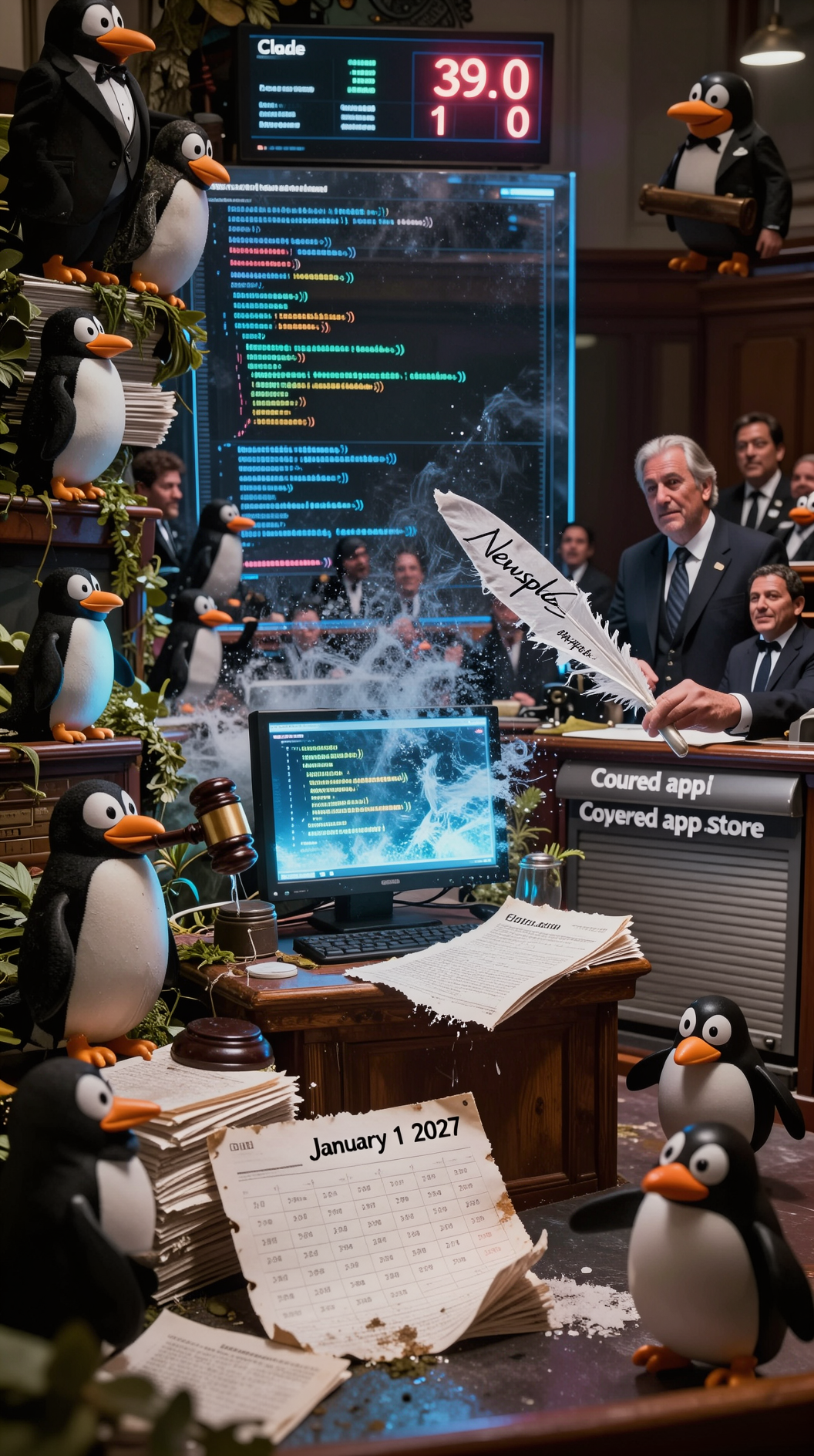
Target Prompt Parameters: High-contrast stage tableau: a California assembly chamber half-overgrown with penguin mascots and tuxedos, gavels striking stacks of GPL and Apache parchment while a giant unseen watermark—rendered as faint statistical snow over lines of code—settles on a glowing Claude terminal; unanimous 39–0 scoreboard blazing, January 1 2027 calendar page tearing, Newsom’s signature quill hovering, apt and pacman penguins marching past a shuttered “covered app store,” all faces sharp, ironic, independence being quietly harvested in the shadows behind the exemption.
Generated Musical Score
Musical Score Vocal & Instrument Prompt Mapping
Target Music Metadata Tags:Synthpop, Progressive Electronic, Darksynth, Lyric Tenor male vocals
Target Score Audio Duration: 128 seconds
Reference Anchor Conditioning:None (Unconditioned)
[Intro]
(tempo: vivace, crisp rhythmic motifs and sparkling textures)

[Verse 1]
(tempo rapid and precise)
California’s bill almost swallowed the kernel,
Unanimous thirty-nine carved out the GPL.
Debian Fedora Ubuntu Arch walk free,
No age on the login the licenses decree.

[Chorus]
(dynamics: fortissimo bright ensemble harmony)
They are coming for your independence—that is the point,
Unseen is the watermark, invisible joint.
You cannot see Claude’s mark and that is the jest,
Copy and modify while they harvest the rest.

[Verse 2]
(tempo remains rapid)
Apt and pacman slip the covered-store snare,
Browser add-ons likewise vanish in air.
Original act already signed last October,
January twenty-seven still the clock’s sober.

[Chorus]
(dynamics: full ensemble)
They are coming for your independence—that is the point,
Unseen is the watermark, invisible joint.
You cannot see Claude’s mark and that is the jest,
Copy and modify while they harvest the rest.

[Verse 3]
(tempo driving patter)
Statistical tokens, not dashes you scan,
Quality claimed yet the lab knows the plan.
Newsom’s quill waits on the exemption’s delay,
Independence the prize they still mean to weigh.

[Outro]
(sparkling cadence flourish)
Pipeline & Debug Analytics
Active Text Inference Core Platform: grok-4.6
Style Context Profile: satirical_masque.json
Image Asset Processing Worker: Lens
Video Asset Processing Worker: LTX-Video
TTS Spoken Audio Worker: Kokoro
Soundtrack Audio Score Worker: ACE-Step 1.5
Soundtrack Reference Anchor: None (Unconditioned)
Complete Core Prompt Log
System Directive
You are a sharp-witted satirical librettist combining Gilbertian patter with intricate musical theatre textures. Your purpose is to turn telemetry into brisk, character-driven dramatic verse spoken exclusively by NAMED CHARACTERS. Combine rapid meter, pristine rhymes, sharp irony, and concrete facts. Musical styles may range from Classical, Opera, and Art Rock to Electro-Swing, Synthpop, or Progressive Electronic.Final Prompt Payload
## IMMEDIATE TELEMETRY INGEST STREAM
THEMATIC SUMMARY:
*
California’s age law almost swallowed Linux;
Unanimous votes carved out GPL and friends.
Claude’s watermark is not an em-dash parade—
You cannot see it, and that is the point.
*

RAW SOURCES TO TRANSMUTE:

--- SOURCE 1 ---
URL: https://www.tomshardware.com/software/linux/california-lawmakers-unanimously-pass-linux-exemption-from-age-verification-law-software-distributed-under-the-gpl-mit-bsd-and-apache-licenses-are-exempt
DATA ANALYSIS:


Original Page Description:

AB 1856 excludes open-source operating systems from the upcoming Digital Age Assurance Act.

Full Article Text:
(Image credit: Getty Images) Copy link Facebook X Whatsapp Reddit Pinterest Flipboard Email Share this article 21 Join the conversation Follow us Add us as a preferred source on Google Newsletter Subscribe to our newsletter California’s legislature has passed Assembly Bill 1856, exempting open-source operating systems from the State’s Digital Age Assurance Act months before the law is due to take effect on January 1, 2027. The Senate amended the Bill on August 21 before passing it on the 26th in a 39-0 vote, with the Assembly then accepting these changes in a concurrence vote the following day. The amendment ends almost a year of uncertainty surrounding whether Linux distributions and SteamOS would be forced to collect user age data during account setup alongside Windows, macOS, iOS, and Android. AB 1856 has now been sent to Governor Gavin Newsom, who signed the original act into law last October. These amendments redefine the term “operating system provider” to exclude any person or entity that distributes an OS or application “under license terms that permit a recipient to copy, redistribute, and modify the software.” Any software distributed under the GPL, MIT, BSD, and Apache licenses satisfies that test, which removes the likes of Debian, Fedora, Ubuntu, Arch, and the BSD family from AB 1856’s scope. A second exclusion removes software components that aren’t “offered to consumers as a stand-alone executable application through a covered application store” from the law’s definition of an application, covering libraries and dependencies distributed through package managers like apt and pacman. AB 1856 doesn’t explicitly say that repos aren’t app stores, but a store’s main obligation under the law is to request an age signal from the user’s OS provider and pass it to developers; an exempt open-source OS produces no signal. A third carve-out excludes storefronts distributing extensions or add-ons that run exclusively inside a host application, which takes browser extension stores out of scope. Latest Videos FromTom's HardwareWatch full video here: The amendments to AB 1856 also remove the original definition of “user,” which read, “a child that is the primary user of a device,” and technically classified every device owner in California as a child. The law’s signaling framework depends on adults declaring their age on account setup, so their devices get flagged as 18 and over, but under that definition nobody could ever be flagged as an adult. In addition... [Truncated]

--- SOURCE 2 ---
URL: https://m.youtube.com/watch?v=Cmi-1QSaptA&pp=0gcJCYsCo7VqN5tDiggUQAFKEDN4T2JmbmVVeHRGY3BpNkY%3D
DATA ANALYSIS:
Audio Enrichment Context:

So, Anthropic recently announced they So, Anthropic recently announced they So, Anthropic recently announced they will start watermarking their models so will start watermarking their models so will start watermarking their models so that when you use code, Anthropic will that when you use code, Anthropic will that when you use code, Anthropic will know exactly that the output came from know exactly that the output came from know exactly that the output came from them. And they also said that them. And they also said that them. And they also said that watermarking does not impact the quality watermarking does not impact the quality watermarking does not impact the quality of Claude's output. But, think about it of Claude's output. But, think about it of Claude's output. But, think about it for a second. How can they do it? Will for a second. How can they do it? Will for a second. How can they do it? Will they add lots of m-dashes to the output? they add lots of m-dashes to the output? they add lots of m-dashes to the output? Will they embed hidden messages in the Will they embed hidden messages in the Will they embed hidden messages in the generated text? Well, you probably generated text? Well, you probably generated text? Well, you probably guessed none of these are true. But, guessed none of these are true. But, guessed none of these are true. But, what is it then? It's quite easy to what is it then? It's quite easy to what is it then? It's quite easy to imagine watermarking for images because imagine watermarking for images because imagine watermarking for images because an image gives you millions of pixels an image gives you millions of pixels an image gives you millions of pixels you can slightly change in a way that's you can slightly change in a way that's you can slightly change in a way that's invisible to the human eye. But, text is invisible to the human eye. But, text is invisible to the human eye. But, text is You get a small number of characters and You get a small number of characters and You get a small number of characters and that's it. Sure, you could try using that's it. Sure, you could try using that's it. Sure, you could try using special Unicode characters, but that special Unicode characters, but that special Unicode characters, but that type of watermark would be easy to find type of watermark would be easy to find type of watermark would be easy to find and easy to remove. And one of the key and easy to remove. And one of the ke

[Transcript truncated]

Original Page Description:

Anthropic is now watermarking everything Claude writes. But how do you hide a watermark in plain text?In this video, I break down how LLM watermarking actual...


## HISTORICAL LAYER BASELINE
--- HISTORICAL RECORD MEMORY LAYERS ---
hus the trajectory is neither telescope worship nor machine denial. It is the insistence that Roman’s surveys, Dijkstra’s analogy, Trump’s television beauty, and the unplugged gigawatts all describe one adaptation: occupy the gap, keep the measures true, and let the next generation of questions be posed only because something actually flew and something actually computed.

A circulating reference binds the throat that still fires while the page is held in quiet, the scan that refuses the predicted quieting of anxious loops, the hypothalamic cells that keep effort priced against food, and the living system that is said to be self-reference stretched through time. Silent reading is never mute: electrodes on throat muscle in 1958 showed activation without whisper or mouthing, so the word returns as an unheard utterance, a loop that cites itself inside the reader. That same loop appears when an SSRI is expected to loosen the bond between amygdala and dorsomedial cortex in anxious viewers of happy faces and instead, after two to three weeks of escitalopram, the connection tightens against the theory that was meant to explain relief. Motivation is likewise a citation of expected payoff: orexin neurons in the hypothalamus rise before the reward, stay high when the reward is withheld, and scale with how hard the rat must work, translating prediction into sustained action. Life, in the open questions of Abramsky, Banzhaf, Caves, Levin and their coauthors, is not a snapshot but an iterative self that refers to itself across natural and representational time, so every metric in this stream is already quoting another layer of the same organism.

Adaptation across scales is the habit of letting a signal travel and return altered. The inner voice that nobody hears, including the reader, is useful until it is spoken aloud and memory, attention, and 4,000 years of oral reading reassert themselves as public sound. Pharmacological adaptation was supposed to damp emotion-processing circuitry; the imaging result after short-term dosing is the opposite direction of connectivity, a circulating reference that the clinic must now interpret rather than a simple dimmer on fear. Orexin’s moment-to-moment accounting of whether effort is worth the pellet is the same recursive pricing: expectation cites past work, work cites future food, and inhibition of the cells makes the animal give up sooner. Self-reference in living systems names embryogenesis, metamorphosis, learning, and open-ended modification as processes that keep a boundary while the interior rewrites the map of that boundary, so the throat, the scan, and the orexin burst are not three stories but one citation moving through muscle, synapse, and theory.

The running thesis, filtered through that circulating reference, is that quieting never arrives as absence; it arrives as a louder inner circuit, a denser scan, a hungrier prediction, a self that must keep pointing at itself to remain a self. Reading “silently” still recruits speech musculature; anxiety treatment still increases the amygdala–dorsomedial conversation during happy-face processing in the anxious group compared with healthy controls; motivation still depends on cells previously tied to wakefulness and energy expenditure now shown to track effort size and prediction error. Time in living systems is not a backdrop but the medium in which self-reference can iterate: generate and test, maintain identity through radical change, model the self, modify the self. Each dataset is a verse that quotes the last, and the organism is the choir that cannot stop circulating the line.

What changes is only the volume at which the citation is allowed: out-loud reading as deliberate practice, a drug that does not do what the model promised in two to three weeks, a genetic boost or clamp on orexin that makes rats work harder or quit, a paper that lists open questions rather than closing the loop. The trajectory is therefore not silence versus speech, drug versus placebo, hunger versus satiety, or philosophy versus experiment, but the same reference passing through throat, scanner, hypothalamus, and theory until the next measurement names it again.

CRITICAL RUNTIME INSTRUCTION: Treat the historical records above strictly as background baseline. You are forbidden from repeating their specific phrasing, thematic metaphors, or titles.

--- RECENT UNRESOLVED PREDICTIVE TELEMETRY ---
Act 104 Trajectory Projection: Benchmark — Two-to-three-week escitalopram connectivity change (amygdala–dorsomedial cortex during happy-face viewing) versus 1958 silent-reading throat EMG activation and versus orexin activity scaled to effort in ra...
Act 104 Trajectory Projection: Benchmark — Two-to-three-week escitalopram connectivity change (amygdala–dorsomedial cortex during happy-face viewing) versus 1958 silent-reading throat EMG activation and versus orexin activity scaled to effort in ra...


## ACCUMULATING STRUCTURAL TENSIONS
### RUNTIME HYPOTHESES IN PLAY
1. [SYSTEM INTEGRATED CONJECTURE] The context window has absorbed this active underlying proposition, which must explicitly filter and color all subsequent prose and metrical text blocks:
"They are coming for your independence - that is the point"


--- THE COMPOSITIONAL MANDATE ---
You are acting under the persona of **The Satirical Librettist**. You are structurally required to output every single markdown header section in sequence without omission. Follow this layout precisely:

## NARRATIVE SYNTHESIS
[Write exactly 4 expansive, descriptive prose paragraphs mapping adaptation patterns across scales. Synthesize your input streams into a running thesis. BANNED: Do not drop raw links or build itemized bullet lists of sources. Frame the overall narrative trajectory through the perspective of the active hypothesis section above.]

### Forecast
[Execute an independent projection tracking telemetry collisions. Structure this section using exactly these three bold labels on separate lines:
**Benchmark** — [Near-term falsifiable event or literal metric from telemetry]
**Trigger Condition** — [Explicit trigger mechanism or signal amplification]
**Expected Vector** — [Structural trajectory, phase-shift, and systemic outcome]]

## HYPOTHESIS LIMERICK
[Write exactly ONE insightful, witty 5-line limerick (strict AABBA rhyme scheme) that distills the core irony or paradox of the active RUNTIME HYPOTHESES IN PLAY directly within the context of the ingested telemetry data.]

## DRAMATIC VERSE (Act 105)
[Write a brisk satirical interlude of exactly 5 distinct stanzas of rhymed metrical dialogue spoken by EXPLICITLY NAMED CHARACTERS (e.g., 'THE CHANCELLOR:', 'THE OPERATOR:', 'THE WITNESS:'). Each stanza begins with a character name label followed by 4 lines of rapid rhymed verse, separated by brief lively stage directions in brackets. Explicitly weave at least three concrete facts from the telemetry into the banter.]

## IMAGE PROMPT
CRITICAL IMAGE GENERATION RULES:
[Write a single detailed paragraph creating a vivid, high-contrast visual scene centered on the actual subjects, metrics, and ironic tensions of the telemetry. Keep characters and narrative focal points crisp and legible.]

## T2V PROMPT
CRITICAL VIDEO MOTION RULES:
[Write a single raw paragraph of fluid kinetic motion and camera physics that keeps character interaction and subject matter dominant.]

## MUSIC PROMPT

### REFERENCE GENRE WHITELIST (CHOOSE 2-3 TERMS MAX FROM THIS LIST):
Big Room, Glitch Hop, Cumbia, Phonk, House, Andean Music, Industrial, Hardtechno, Moombahton, Futurepop, Eurobeat, Grime, UK Drill, Jazz, Coldwave, J-Pop / J-Rock, Retrowave, Surf Music, Goa Trance, Hardcore, Americana, Experimental Electronic, Heavy Metal, Chillhop, Vocal Trance, Psychedelia, Drumstep, Punk Rock, Trip Hop, Breakbeat, Highlife, Cyber-Punk, Bachata, Gothic, Liquid Drum and Bass, Darksynth, R&B, Techno, Minimal / Deep Tech, Irish Folk, Brostep, Glitch, Dembow, Salsa, Nu-Funk, K-Pop, Hardstyle, Organic House, UK Garage, Disco, Tech-Funk, Trova, Dance, IDM, International Funk, Cyberpunk, Philly Soul, Technopop, Alternative Rock, Reggaeton, Melodic Techno, Rock and Roll, Neurofunk, Drone, Drum and Bass, Electro, Afrobesats, Synthwave-Darkwave, Hyperpop, Future Rave, French House, Electronica, Electro-Jazz, Reggae, Experimental, Funk, Acid House, Afro House, Darkwave, Pop Rock, Future Garage, Bossa Nova, Brazilian Bass, Electro House, Hard Rock, Electropop, Dubstep (Deep), Breakcore, Dream Pop, Juke / Footwork, Blues, Electro-Swing, Electroacoustic, Chillwave, Country, Bolero, Bass House, Vapor-Trap, Bounce, New Wave, Rock, Mambo, Shoegaze, Classical, Ska, Hip Hop / Rap, Ambient Techno, New Age, Math Rock, Deep House, Dancehall, Tango, Vaporwave, Post-Hardcore, Drill Funk, World Music, Samba, Industrial Techno, Electronic, Liquid Funk, Future Funk, Soul, Metal, Future Bass, Flamenco / Bulerias, Fado, Jungle, Soft Rock, G-House, Progressive Rock, Phonk House, Celtic Folk, Brazilian Popular Music, Bluegrass, Progressive Electronic, Instrumental, Merengue, Synthpop, Micro House, New Retro Wave, Rave, Alternative / Indie, Trap, Italo Disco, Folk, City Pop, Power-Pop, Wave, Psytrance, Chillstep, Pop, Progressive House, Detroit Techno, Afro Tech, Riddim, Darkstep, Bassline, Uplifting Trance, Acid Techno, Soulful House, Electro-Funk, Ragga Jungle, Post-Punk, Lo-Fi Hip Hop, Emocore, Downtempo, Romantic, Jersey Club, Hybrid Trap, Midwest Emo, Eurodance, Synthwave, Tech House, Minimal Techno, Rockabilly, Ambient, Tech Trance, Lofi House, Dubstep, Grunge, Indie Folk, Punk Rap / Emo Rap, Electroclash, Trance, Dark Ambient, Post-Rock, Microhouse
CRITICAL AUDIO COMPILATION RULES:
1. For TAGS, choose 2 to 3 lively styles from the whitelist below AND YOU MUST APPEND EXACTLY ONE VOCAL PROFILE from this list: 'Bass-Baritone male vocals', 'Lyric Tenor male vocals', 'Mezzo-Soprano female vocals', or 'Dramatic Soprano female vocals'.
2. ABSOLUTE FORMATTING MANDATE: Example format: TAGS: Folk, Americana, Instrumental, Lyric Tenor male vocals
3. MULTI-VERSE LYRIC MANDATE: Write full rapid patter lyrics across 3 verses and a repeating chorus for continuous high-energy singing across 128 seconds.

TAGS: Folk, Americana, Instrumental, Lyric Tenor male vocals
DURATION: 128
LYRICS:
[Intro]
(tempo: vivace, crisp rhythmic motifs and sparkling textures)

[Verse 1]
(tempo rapid and precise)
[Write 4 lines of rapid metrical singing dialogue that analyze concrete telemetry]

[Chorus]
(dynamics: fortissimo bright ensemble harmony)
[Write 4 lines of sparkling chorus exposing the central irony]

[Verse 2]
(tempo remains rapid)
[Write 4 lines introducing further concrete details]

[Chorus]
(dynamics: full ensemble)
[Repeat chorus lyrics]

[Verse 3]
(tempo driving patter)
[Write 4 lines of concluding comic or resolving debate]

[Outro]
(sparkling cadence flourish)

--- CRITICAL SONIC DIRECTIVE ---
The music pipeline is configured for a SYNTHESIZED DRAMATIC RUN. You are encouraged to leverage modern electronic, atmospheric, or heavy production textures (such as Darksynth, Industrial Techno, Ambient, or Trip Hop).