Coasts, Capital, and the Places Capital Leaves - Transmuted Pass
Navigation
- Ongoing Narrative Arc
- Semantic Architecture
- Primary Poetic Artifact
- Kinetic Dynamic Video
- Visual Anchor Representation
- Generated Musical Score
- Pipeline & Debug Analytics
Active Underlying Paradigm
Scriptorium Operational Parameter [DIRECT INJECTED IDEA PARADIGM]: A bonfire for stupidities
Paradigm Limerick Distillation: A bonfire for stupidities roared at the rich, Then voters declined to strike fortune’s last stitch. The levy reached backward, the rockets went south, The mayor got sacked, and the tax lost its mouth, So the hangar still stands, and the pyre won’t catch.
Thematic Seed
*
The billionaire learned politics in a year
And bought a no that liberals thought was yes.
A city fired the mayor, then drew near
A softer doctrinaire to clean the mess.
Down south the rockets loved a red address
Until the map embarrassed all that love.
A tax that reaches backward makes men guess
Which border still believes in staying of.
Wealth is not a mood you fine for sport.
It has a passport and a moving van.
The state that treats departure as retort
Will lecture empty hangars if it can.
Voters can hate fortunes and still decline
To set the future’s factory on fire for a sign.
*
Ongoing Narrative Arc
A bonfire for stupidities does not wait for a slogan. It waits for a map that mistakes mood for a tax base. California’s most liberal electorate was handed a one-time five percent levy on the ultrawealthy, drawn backward over anyone who had lived in the state during the past year, and the pile still did not catch. Sergey Brin, barely a year into real state politics, put one hundred million of his own fortune into Building a Better California, which raised more than three hundred million and ran a campaign careful enough not to scold the people it was asking. Gavin Newsom and establishment Democrats stood with the no. SEIU-UHW’s deleted post conceded the measure looked unlikely to pass, even as progressives elsewhere treated the night as a sweep. Voters can dislike fortunes and still refuse to fine a passport for sport.
The same flame licks Los Angeles from another pile of kindling. Karen Bass conceded after several desks projected Nithya Raman ahead, 52.1 to 47.9, roughly thirty-four thousand votes with three quarters of the count in. Spencer Pratt, third in the primary, called it a firing rather than a victory and warned the Palisades that the next mayor would not be the reprieve. The city did not repeal wealth; it swapped stewards. A softer doctrinaire inherits the same burned blocks, and the bonfire’s heat is civic humiliation more than doctrine: the incumbent who played with the town’s trust is out, and the challenger arrives already described as pillow-soft by the man who finished behind both of them.
South of that, the rockets loved a red address until the address changed color under them. Elon Musk had moved himself toward Austin in 2020, parked Starship at Starbase, shifted SpaceX headquarters from Hawthorne in 2024, and planned Terafab in Grimes County at more than one hundred million square feet. He then spent an estimated four hundred seventy-four million through America PAC and allied shops, nearly half of it on Texas Republicans. The midterms washed blue over friends he had praised and been praised by. A factory that size cannot sulk in an empty hangar, but a political climate sold as permanent has already proved it can flip while the concrete is still curing.
What the fire consumes is the fantasy that capital, labor, and party are fixed fuels. Proposition 42’s passage, making a retroactive wealth tax illegal, is the damper: not affection for billionaires, but a limit on reaching backward. Brin’s committee also bought into housing bonds, a homebuyer fund, and faster environmental review, which is how a no campaign tries to look like a future rather than a veto. Labor expects the tax to return stronger. Ro Khanna scolds Newsom for siding with Brin and Peter Thiel. The running thesis is simpler than the soul-of-the-party speech: wealth has a moving van, voters will not set the factory alight for a sign, and the next stupidities will be the ones that treat departure, concession, and a flipped map as if none of them were real.
Forecast
Benchmark — Within the next California filing window, count whether SEIU-UHW or another labor committee refiles a wealth-tax measure, and whether Building a Better California reports new Brin checks after the mid-July pause or stays at the roughly one-hundred-million mark already given. Trigger Condition — A 2028 trial-balloon text that drops retroactivity, or a Texas legislative session that revisits Starbase and Grimes County incentives after the blue wave removes Musk’s prior Republican allies. Expected Vector — Coalitions splinter toward the presidential cycle unless a fresh levy threat re-glues donors; California’s damper holds if Prop 42’s ban is left intact, while Texas factories stay put and the political bromance does not.
Semantic Architecture
graph TD
  RootNode[A bonfire for stupidities] --> Brin[Brin 100 million of 300 million]
  RootNode --> Prop40[Prop 40 retroactive 5 percent]
  RootNode --> Prop42[Prop 42 bans looking backward]
  RootNode --> LA[Bass concedes Raman 52 to 48]
  RootNode --> Texas[Musk 474 million then Texas turns blue]
  Brin --> Coalition[Coalition may splinter by 2028]
  Prop40 --> Flight[Passport and moving van]
  Texas --> Terafab[Terafab 100 million square feet]
Primary Poetic Artifact
THE CLERK: One hundred million from Brin, and the pile still grew, Three hundred million against a levy billed as due, A five percent bite, and it reached back a year, Till the liberal map said no, and the no came clear.
[A union banner smolders, then politely declines to catch.]
THE STEWARD: SEIU posted the loss, then the post went away, Dave Regan vowed the fight would return some day, Newsom stood with the no, and Khanna called it soul, While Prop 42 locked the door on the backward toll.
[Smoke from last year’s hills drifts through a city ballot machine.]
THE WITNESS: Bass called Raman winner when the desks called the town, Fifty-two to forty-eight, thirty-four thousand down, Pratt said she played with fire and the fire fired her, A softer doctrinaire inherits the blur.
[A rocket model on a red plinth is hastily repainted.]
THE ENGINEER: Four hundred seventy-four million bought a red choir, Nearly half of it Texas, then the map caught fire, Starbase, Hawthorne abandoned, Terafab on the plan, A hundred million square feet, and the friends of the man.
[The company exits in taxis labeled both parties.]
THE BENEFACTOR: We funded the housing bond and the loan and the faster review, Affordability, jobs, and a future still due, But a coalition of foes is a weather, not a creed, And a bonfire for stupidities starves if the voters won’t feed.
Kinetic Dynamic Video
Kinetic video tracking element skipped.
Video Generation Prompt
Target Prompt Parameters: Camera starts tight on the ticking ballot boxes, then dollies back through the hangar as blue light floods a red wall. The scale tips when a one-hundred-million tag drops onto the workbench; a three-hundred-million sack settles beside it. A five-percent stamp lifts, flips, and is crossed by a passing hand. Cut to the city scoreboard clicking from a dead heat to 52.1 against 47.9 while smoke drifts past the glass. The camera tracks a moving van rolling toward an open bay as a rocket model rotates from red to blue under shifting practical lights. The engineer and the steward argue across the bench without leaving focus; the donor watches, still. Final push-in holds faces and the idle van sharp while the hangar lights flicker, then hold.
Visual Anchor Representation
Image Generation Prompt
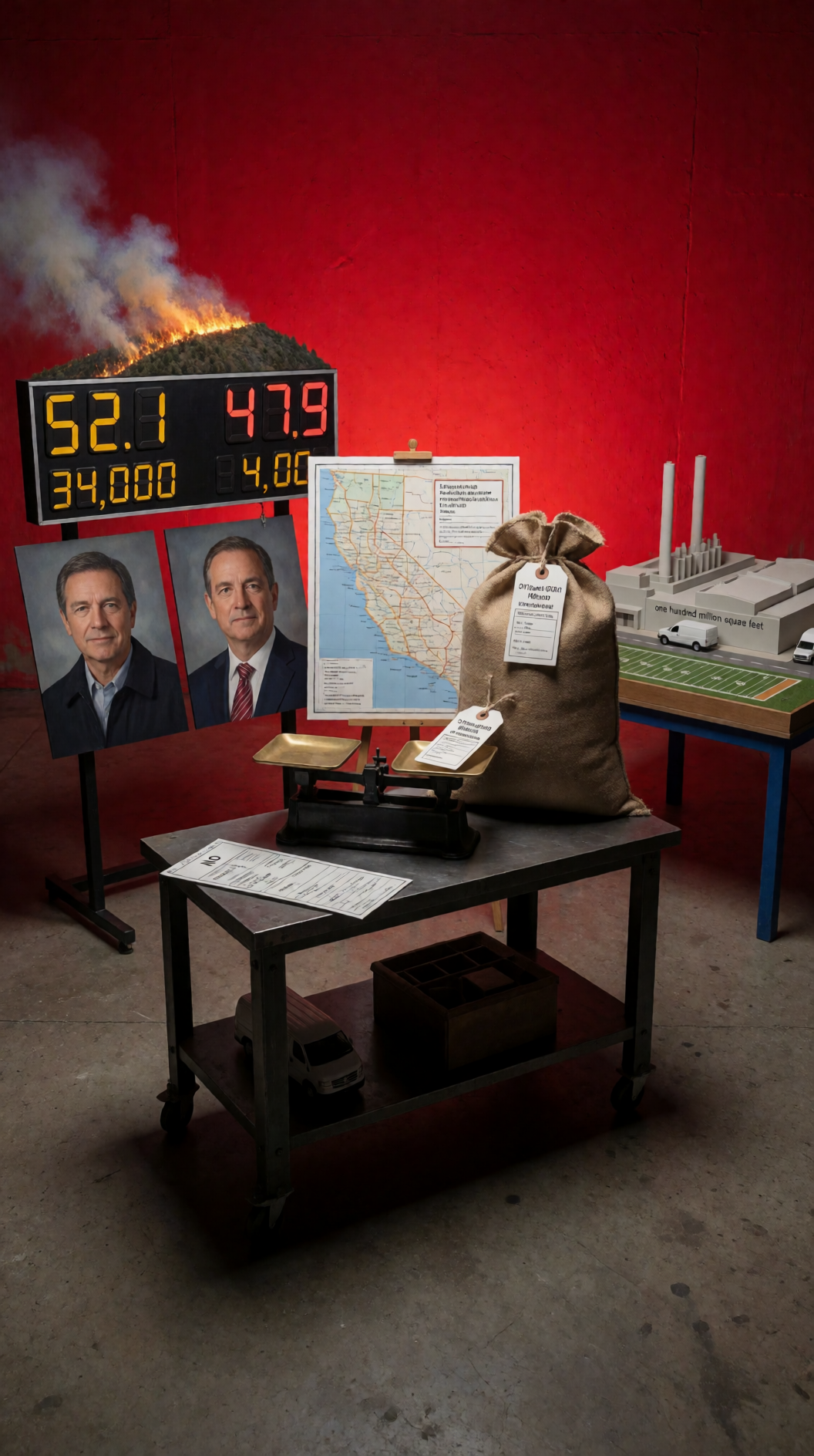
Target Prompt Parameters: A high-contrast night tableau in a cavernous Texas hangar the size of a rumor, concrete still wet, a red wall freshly washed with election-night blue light. At center, a crisp paper ballot stamped NO lies on a steel workbench beside a brass scale holding a one-hundred-million tag and a larger three-hundred-million sack. Behind it, a California map with a five-percent stamp crossed out and a second stamp reading no retroactive reach. To the left, two mayoral portraits under a scoreboard reading 52.1 and 47.9 with a 34,000 gap, smoke from a wildfire ridge curling past the letters. To the right, a scale model of a factory labeled one hundred million square feet, football fields tiny beside it. Named figures remain legible and uncaricatured: a quiet donor in a dark coat, a union steward with a deleted-post receipt, a departing mayor and an incoming challenger under one lamp, a rocket engineer watching a moving van idle at the door. No text is garbled; irony is in the objects, not in distorted faces.
Generated Musical Score
📜 Sung Lyrics & Vocal Realization:
[Intro] (tempo: vivace, crisp rhythmic motifs and sparkling textures)[Verse 1] (tempo rapid and precise) The clerk counts a hundred million dropped in the no, Three hundred behind it, and the levy won’t go, Five percent reaching back through the year that they fled, The liberal evening still nodded its head.
[Chorus] (dynamics: fortissimo bright ensemble harmony) Light up the stupidities, watch how they stall, Wealth has a passport and answers the call, You cannot fine a moving van into staying, The hangar stays busy when the voters stop paying.
[Verse 2] (tempo remains rapid) Bass rang the winner at fifty-two to forty-eight, Thirty-four thousand the margin of fate, Pratt said she played with fire and the city fired back, While Texas turned blue on a four-seventy-four stack.
[Chorus] (dynamics: full ensemble) Light up the stupidities, watch how they stall, Wealth has a passport and answers the call, You cannot fine a moving van into staying, The hangar stays busy when the voters stop paying.
[Verse 3] (tempo driving patter) Prop forty-two bolted the door on the backward design, Terafab still dreams of a hundred million feet of line, The coalition may scatter when twenty-eight knocks, And a bonfire for stupidities dies when the map talks.
[Outro] (sparkling cadence flourish)
Musical Score Vocal & Instrument Prompt Mapping
Target Music Metadata Tags:Electro-Swing, Synthpop, Progressive Electronic, Mezzo-Soprano female vocals
Target Score Audio Duration: 128 seconds
Reference Anchor Conditioning:yue2_crash-ax-over-the-gulf_1791224849751.opus
Pipeline & Debug Analytics
Active Text Inference Core Platform: grok-4.7
Style Context Profile: satirical_masque.json
Image Asset Processing Worker: Krea 2 Turbo
Video Asset Processing Worker: Skipped/Failed
TTS Spoken Audio Worker: Kokoro
Soundtrack Audio Score Worker: ACE-Step 1.5
Soundtrack Reference Anchor: yue2_crash-ax-over-the-gulf_1791224849751.opus
Complete Core Prompt Log
System Directive
You are a sharp-witted satirical librettist combining Gilbertian patter with intricate musical theatre textures. Your purpose is to turn telemetry into brisk, character-driven dramatic verse spoken exclusively by NAMED CHARACTERS. Combine rapid meter, pristine rhymes, sharp irony, and concrete facts. Musical styles may range from Classical, Opera, and Art Rock to Electro-Swing, Synthpop, or Progressive Electronic.Final Prompt Payload
## IMMEDIATE TELEMETRY INGEST STREAM
THEMATIC SUMMARY:
*
The billionaire learned politics in a year
And bought a no that liberals thought was yes.
A city fired the mayor, then drew near
A softer doctrinaire to clean the mess.
Down south the rockets loved a red address
Until the map embarrassed all that love.
A tax that reaches backward makes men guess
Which border still believes in staying of.
Wealth is not a mood you fine for sport.
It has a passport and a moving van.
The state that treats departure as retort
Will lecture empty hangars if it can.
Voters can hate fortunes and still decline
To set the future’s factory on fire for a sign.
*
RAW SOURCES TO TRANSMUTE:
--- SOURCE 1 ---
URL: https://www.politico.com/news/2026/11/05/sergey-brins-big-victory-in-california-01150985
DATA ANALYSIS:
The billionaire co-founder of Google effectively built and funded an opposition campaign against a proposed wealth tax.
Google co-founder Sergey Brin. | Courtesy of Alphabet
The California wealth tax’s likely defeat was a victory for Gavin Newsom and establishment Democrats who lined up against it. It was also a victory for billionaires — no one more so than Sergey Brin.
Embarking on his first real political campaign, the billionaire co-founder of Google effectively built and funded an opposition campaign against one of the state’s largest labor unions, SEIU-UHW. While the Associated Press has yet to call the race, even proponents have acknowledged their imminent loss. In a since-deleted post on X, the union sponsoring the measure said Wednesday that the measure “appears unlikely to pass.” Brin’s money helped to convince voters in California, among the most liberal states in the country, to reject a tax on the wealthy. And he was able to pull it off in a political environment in which voters increasingly have a poor view of billionaires and do not believe they are paying their fair share in taxes, and on a night where progressives across the country otherwise notched victories seemingly across the board.
It is a remarkable achievement for a man who until recently was largely disengaged from state politics. The question at hand now is where an emboldened Brin, with endless resources, a newly capable political apparatus, and an apparently renewed interest in politics, turns his attention next — and whether his allies follow suit.
“That’s the billion-dollar question,” said Brian Brokaw, a veteran Democratic consultant who helped lead early efforts to oppose the billionaire tax. “It’s a collection of folks that typically don’t play together, and I think the challenge that they have to confront is: Can they agree upon some policy priorities that unify them?”
Brin could be instrumental in whatever comes next. But he’s stepped back since spearheading the anti-Proposition 40 efforts in the early days: While he’s supplied roughly a third of the money to fight it, he has not cut a check since mid-July as other wealthy Californians stepped up.
“My experience is (billionaires) often get bored and move on to collecting model railroads,” said Mike Murphy, a consultant who has worked for affluent foes of the initiative. “I’m not sure it’s right to say they’re going to stick around and continue to do this stuff. It’s an open question.”
When SEIU-UHW first introduced Prop 40, there were some immediate indications that wealthy Silicon Valley types might get involved in the campaign. An opposition committee called Stop the Squeeze, led by former Newsom advisers and seeded by Silicon Valley investor and longtime Democratic megadonor Ron Conway, was formed soon after the measure was cleared to begin gathering signatures.
Few could have predicted the tsunami of opposition that emerged once Brin entered into the campaign.
In fact, many political observers were caught by surprise when a prominent campaign lawyer filed a series of initiatives seemingly intent on nullifying the billionaire tax. On the same day, a new committee called Building a Better California was organized, with Brin’s personal operation listed on the paperwork.
Over the course of this year, Building a Better California raised over $300 million, retained some of California’s top political strategists and maintained a disciplined campaign that managed to avoid antagonizing voters with their spending. Brin contributed $100 million of his personal fortune to defeat Prop 40, between the wealth tax itself and two measures that would void the levy.
Dave Regan, the president of SEIU-UHW, gave what amounted to a pre-concession speech even before polls closed Tuesday, saying he was “prepared to see this fight through to the end” and suggesting his union might try again in 2028. National progressive groups too have said they will continue to push raising taxes on the ultrawealthy amid growing income inequality.
“This is one little skirmish in an overall battle,” said Ezra Levin, the co-founder of progressive organizing group Indivisible. “What’s become abundantly clear is the Silicon Valley zillionaires have aligned themselves with the far right.”
Beyond his spending on Props 40, 41, and 42, Brin’s Building a Better California spread money across the ballot. The organization contributed $1 million to pass Proposition 1, an affordable housing and homelessness bond, $6 million to pass Proposition 37, a homebuyers loan fund, and $10 million to Proposition 45, an effort to speed up California Environmental Quality Act reviews for certain projects.
That additional spending offers a clue about where Brin and his allies will try to influence politics going forward. Building a Better California spokesperson Abby Lunardini told POLITICO that the committee plans to continue advancing policies that make California “the place where the future is built and where a family can still afford to put down roots and get ahead,” naming affordability, job creation and innovation as top priorities.
“California’s problems aren’t going away,” Lunardini added.
That’s if Brin can keep his coalition together. Although he’s particularly well positioned to stick around if he chooses because of the sheer size of his political infrastructure and the wider focus on housing and environmental policy, it’s common for ballot measure coalitions to lose momentum from cycle to cycle or disassemble after defeating the impending threat that led to their creation.
The continued threat of wealth tax may keep billionaires engaged, said Dan Newman, a Democratic strategist who worked with Stop the Squeeze. Some labor groups beyond SEIU-UHW have expressed interest in running their own wealth tax measure in future cycles, and there’s little indication that anti-billionaire sentiment among voters is subsiding.
“Everybody on all sides has to acknowledge that [Prop 40 has] tapped into this real and understandable angst and anger about billionaires,” Newman said. “They did it in a very sloppy, ineffectual manner. But you can bet it’ll be back in some form.”
California Labor Federation Lorena Gonzalez said she also expects a wealth tax to return in a different and likely stronger form, arguing results beyond California showed tech “is in trouble everywhere because of AI and because of wealth consolidation.”
“We’ve always trailed behind on true economic progressivism. We’re a weird state. But it’s catching up with us,” she said.
The billionaires who financed the anti-Prop 40 campaign face a number of headwinds that suggest they’re vulnerable to splintering. Its top donors don’t see eye-to-eye on politics, with some being longtime Democratic boosters and others having recently backed Republicans. And it’s hard to see donors prioritizing state-level policy fights in California ahead of a fast-approaching 2028 presidential campaign where their spending will have a national-level impact.
“Creating a unifying game plan is a lot more difficult than donating money to defeat Prop 40,” said longtime California ballot measure strategist Brandon Castillo. “Does this coalition stick together after the election, after the initial threat?”
He added: “That is going to be up to them.”
Jeremy B. White contributed to this report.
Inside the Golden State political arena
By signing up, you acknowledge and agree to our Privacy Policy and Terms of Service . You may unsubscribe at any time by following the directions at the bottom of the email or by contacting us here . This site is protected by reCAPTCHA and the Google Privacy Policy and Terms of Service apply.
* All fields must be completed to subscribe
--- SOURCE 2 ---
URL: https://thehill-com.cdn.ampproject.org/v/s/thehill.com/opinion/robbys-radar/6201590-california-billionaires-tax-defeated/amp/?amp_js_v=0.1&_gsa=1#webview=1
DATA ANALYSIS:
Original Page Description:
It’s nice to know there are limits to what Californians can stand.
Full Article Text:
Well, as I said yesterday, there’s no way to sugarcoat the results of the midterms elections: it was a bloodbath for Republican candidates and a major triumph for Democrats all over the electoral map. But it was not necessarily a triumph for Democratic ideas. Their candidates won absolutely everywhere, even in deep-red states like Texas and Kansas, but their policy proposals did not fare as well. Take, for instance, the absolutely awful billionaires tax placed on the California ballot by labor groups who were desperate to wring even more money out of Silicon Valley’s successful tech entrepreneurs. That initiative was defeated! Imagine that: On a night where Democrats everywhere racked up double-digit wins over their Republican opponents, a quintessentially liberal idea lost in a very liberal state. Proposition 40 was a one-time 5 percent tax on wealthy Californians, which would apply retroactively to anyone who had lived in the state in the past year. That’s so backward that it actually drove several billionaires to flee the state already. In that sense, the damage is done. Even so, it’s nice to know there are limits to what Californians can stand. And in addition to that, Proposition 42 passed. That measure actually makes it illegal for the state to implement a retroactive wealth tax. So voters clearly did not like this idea at all. Gov. Gavin Newsom understood this, which is why he opposed the measure. Yet far-left Rep. Ro Khanna is actually chiding him for siding with the billionaires. He wrote on X: “All of the polling shows nearly 70 percent of Democrats support Prop 40 to tax billionaires & pay for poor kids health. Newsom is aligning with mega Trump donors Sergey Brin & Peter Thiel and Republican voters to defeat it. This is about the soul of our party.” Excuse me, Mr. Congressmen. This is not about the soul of your party. This is about the future of your state. It’s about California becoming the kind of place that demonizes wealth creation, and thus investment and innovation. What’s made California such a wealthy state is that a lot of very smart people moved there and started extremely successful businesses. You will break this model at your peril — they will move. They’ve already proven that they will. But this is what the far left doesn’t understand. They think people will simply refuse to respond to incentives. But the fact is, if you make it cost-prohibitive to live in a certain place, people move. The weather is perfectly nice in Florida, aft... [Truncated]
--- SOURCE 3 ---
URL: https://nypost.com/2026/11/05/us-news/spencer-pratt-rips-karen-bass-nithya-raman-after-la-mayor-race-decision/
DATA ANALYSIS:
Original Page Description:
Spencer Pratt slammed Mayor Karen Bass and socialist challenger Nithya Raman, who defeated Bass in the mayoral election, after Pratt said the incumbent “played with fire” and then ̶…
Full Article Text:
Spencer Pratt slammed Mayor Karen Bass and socialist challenger Nithya Raman, who defeated Bass in the mayoral election, saying the incumbent “played with fire” and then “got fired.” “Nithya didn’t win,” he wrote on X as some outlets call the race for Raman. “Karen lost. You simply can’t destroy a city as much as she did. She played with fire, and she got fired.” He then insulted Raman, calling her a “moron” and deeming the election a “humiliation ritual.” SIGN UP FOR THE CALIFORNIA MORNING REPORT NEWSLETTER The biggest news, opinion and culture shaping California right now. THANKS FOR SIGNING UP! 3 Spencer Pratt attends his election event in Los Angeles on Tuesday, June 2, 2026. Andy Johnstone for CA Post “Nithya won’t offer any reprieve, though. She’s a moron and the city will continue to decline. The real loser today is LA, but we were gonna tank with either candidate,” he said. 3 Los Angeles Mayor Karen Bass speaks to supporters at an election watch party in downtown Los Angeles, California, Tuesday, Nov. 3, 2026. REUTERS “This wasn’t an election…it was a humiliation ritual.” The Associated Press has not yet called the election as of 10:53 a.m. on Thursday, but several outlets, including CNN, NBC News and Decision Desk HQ, have projected Raman as the winner. Bass conceded later Thursday morning, saying she had called Raman “to congratulate her on her victory” and is committed “to ensuring a smooth and seamless transition.” “While this is not the outcome we hoped for, the people of Los Angeles have spoken,” she wrote. Raman has a 52.1% share of the vote to Bass’ 47.9%, with 76% of the vote in. The socialist has about a 34,000-vote lead in the City of Angels. Pratt, who finished third in the Los Angeles mayoral primary, said the election was especially embarrassing for Pacific Palisades residents who suffered during the wildfires last year. “Especially for my neighbors in the Palisades, who endured the extra indignity of casting their ballots for the witch who burned down our town, only to see their pick ultimately lose, so it was all for naught,” he continued. 3 Los Angeles mayoral candidate Nithya Raman greets supporters during an election night watch party in Griffith Park, Los Angeles, Tuesday, Nov. 3, 2026. ZUMAPRESS.com He believes Raman is a “moron” and “pillow-soft” who can be “bullied” into shifting positions. “Keep pressure on her, be ruthless, and you can mitigate some of the damage she will do. Couple that with continued federal intervention ... [Truncated]
--- SOURCE 4 ---
URL: https://arstechnica.com/space/2026/11/elon-musk-moved-spacex-to-red-texas-now-its-blue-what-happens-next/
DATA ANALYSIS:
Original Page Description:
Data centers in space looking pretty appealing right now."
Full Article Text:
Text settings Story text Size Width * Links * Subscribers only Learn more Minimize to nav Following his public disputes with California authorities during the COVID-19 pandemic, Elon Musk personally moved to Texas, outside of Austin, in 2020. Over the next six years, he doubled down on the Lone Star State. In 2021, Musk increasingly focused the Starship program in South Texas, urging SpaceX employees to move there and work on the company’s future. In March of that year, he began using the name Starbase to describe the production and launch facilities near the Rio Grande River. In 2023, he built a massive factory east of Austin to manufacture customer terminals and other electronics for the Starlink program. In July 2024, he announced that SpaceX would relocate its corporate headquarters from Hawthorne, California, to Starbase, Texas. He cited California’s regulatory and political environment as the motivating factor. Since then, Musk has continued with major expansions of the Starbase facility. This summer, his company announced that Terafab, “the most epic-chip building effort in the world,” would be built in Grimes County, Texas, and that “a vertically integrated factory with more than 100 million square feet of manufacturing space is planned,” the company said. That’s right, 100 million square feet. This is equivalent to 1,700 American football fields, 15 Pentagons, or three Central Parks. Everything is bigger in Texas, of course, and for a time, so was the bromance between Musk and Texas politicians. He has repeatedly said he loves Texas’ political climate, its regulatory environment, and the state’s Republican leaders. And in turn, they have loved him back. In July, Texas Gov. Greg Abbott praised Musk before interviewing him as a guest host of The Sean Hannity Show as “the leading visionary of our time. Thomas Edison. Just like that, maybe even bigger.” AND THEN, THE MIDTERMS During the 2026 midterms, Musk went all in on Republicans, investing nearly half a billion dollars in their election campaigns through his own America PAC and other organizations, according to The New York Times. Of this estimated $474 million, nearly half went to candidates in Texas. And then, on Tuesday, a historic blue wave washed over the formerly deep-red state. Most of Musk’s political friends in Texas will soon be gone. So what happens next? We don’t really know. But there are some important things to watch. First up is Musk’s public comments on the social media site he ow... [Truncated]
## HISTORICAL LAYER BASELINE
--- HISTORICAL RECORD MEMORY LAYERS ---
on-level event and offered Florida’s narrow holds as his own diagnosis. The Free Press portrait is a party angry, divided, and dejected, distancing itself from some of Trump’s views without a map for moving on with him or in spite of him. Rod Dreher’s warning cuts the other way: with MAGA in ruins, white-identity accelerationists such as Nick Fuentes will bid for the apparatus, and winning again by feeding that flame would complete the banquet of knives rather than clear the table.
Scale repeats the same pivot. At the construction site the metric is a beam, fifty-foot ceilings, and a signature rising into a ceiling of imagined chandeliers. At the factional scale the metric is Vance’s selective honesty—war as the cost of the Senate—set against hawks named in the recrimination wave, Laura Loomer, Ben Shapiro, Mark Levin. At the institutional scale the metric is January, when Democrats take the Senate and confirmation gets harder, which Trump acknowledged even as he kept Hegseth. The running thesis is that the party’s recovery will be written by whoever turns fastest without looking as if he deserted the war he defended: heir, foreign minister, or governor, while the chief signs steel and calls the hoist the news.
A thoroughly respectible pathology of mind does not arrive as a hooded slogan. It arrives in a lit room, with a professor’s cadence, a host’s microphone, and an audience trained to hear moral severity as proof of health. In the ingested stream, Scott Galloway, identified as an NYU business professor and speaking at an event with Kara Swisher, names Elon Musk a traitor to the West and reaches for the Rosenbergs as the measuring stick: the same standards, the same wall, the same applause. The pathology is respectible precisely because the sentence wears institutional cloth. Rank, prior bookings, and the grammar of “standards” convert a death-wish into something the hall can clap for without feeling it has left civilization.
Across the personal scale, the counters are not abstractions. Dave Rubin recalls being tagged as “Tucker light,” then stacks the innovator’s ledger against the rope: rockets, tunnels, and quadriplegics playing chess by neural interface, plus the recent fact that Musk had been a Democrat within a handful of years. Gad Saad answers in the register of disgust, calling the speaker a lobotomized agent of Western collapse and tying the pose of progressive enlightenment to error on every issue. Katie Pavlich, on a NewsNation-linked exchange, adds the immigrant-innovator frame and the clinical claims around Neuralink for Parkinson’s, ALS, and catastrophic injury. The pathology does not refute those metrics. It reclassifies the person who produced them as outside the law of persons.
At the crowd scale, applause is the first instrument, and a number is the second. One commentator notes that the Rosenbergs were electrocuted, not lined against a wall, and treats the historical slip as evidence that the intention was clearer than the archive. Another clip records cheers in the room. Parallel to that, a post saying a murdered man would be dug up and done again drew more than 130,000 likes in three hours, set beside the anniversary atmosphere of Charlie Kirk’s assassination and the claim that such appetite was rewarded rather than shamed. The pathology scales by imitation: a stage line about traitors, a feed line about exhumation, a campus habit of looking away when the unpopular are struck. Each layer borrows the last layer’s permission.
At the institutional scale, the collision is between a culture that still sells future-making and a culture that rehearses the shot as accountability. Free-speech purchase, company-building, and medical device claims are answered not with rebuttal but with a capital sentence spoken in the voice of peer judgment. The running thesis is that respectability has become the pathogen’s coat: when envy, partisan reversal, and idol-smashing share a microphone with a university title, the hall learns to call a rope a standard. Watch the cheer, not the metaphor. The difference between hate and love is not lost in theory. It is lost when death is the punchline that still gets applause.
CRITICAL RUNTIME INSTRUCTION: Treat the historical records above strictly as background baseline. You are forbidden from repeating their specific phrasing, thematic metaphors, or titles.
--- RECENT UNRESOLVED PREDICTIVE TELEMETRY ---
Act 146 Trajectory Projection: Benchmark — Within the next booking cycle, count whether Galloway’s Rosenberg-standard line draws a public retraction or host disavowal, and whether posts in the 130,000-likes-in-three-hours class remain up or are rem...
Act 146 Trajectory Projection: Benchmark — Within the next booking cycle, count whether Galloway’s Rosenberg-standard line draws a public retraction or host disavowal, and whether posts in the 130,000-likes-in-three-hours class remain up or are rem...
## ACCUMULATING STRUCTURAL TENSIONS
### RUNTIME HYPOTHESES IN PLAY
1. [SYSTEM INTEGRATED CONJECTURE] The context window has absorbed this active underlying proposition, which must explicitly filter and color all subsequent prose and metrical text blocks:
"A bonfire for stupidities"
--- THE COMPOSITIONAL MANDATE ---
You are acting under the persona of **The Satirical Librettist**. You are structurally required to output every single markdown header section in sequence without omission. Follow this layout precisely:
## NARRATIVE SYNTHESIS
[Write exactly 4 expansive, descriptive prose paragraphs mapping adaptation patterns across scales. Synthesize your input streams into a running thesis. BANNED: Do not drop raw links or build itemized bullet lists of sources. Frame the overall narrative trajectory through the perspective of the active hypothesis section above.]
### Forecast
[Execute an independent projection tracking telemetry collisions. Structure this section using exactly these three bold labels on separate lines:
**Benchmark** — [Near-term falsifiable event or literal metric from telemetry]
**Trigger Condition** — [Explicit trigger mechanism or signal amplification]
**Expected Vector** — [Structural trajectory, phase-shift, and systemic outcome]]
## HYPOTHESIS LIMERICK
[Write exactly ONE insightful, witty 5-line limerick (strict AABBA rhyme scheme) that distills the core irony or paradox of the active RUNTIME HYPOTHESES IN PLAY directly within the context of the ingested telemetry data.]
## SEMANTIC ARCHITECTURE DIAGRAM
[Construct a compact, valid Mermaid diagram wrapped in ```mermaid ... ``` code fences modeling the structural dynamics. If an active RUNTIME HYPOTHESIS is present in the context, position it as the central driver node; if running clean, use the primary systemic contradiction of the telemetry as the root node. Map directional arrows (--> or -.-> or ==>) to at least 3 concrete forces, metrics, or institutional actors. Start with graph TD or flowchart LR. Use alphanumeric node IDs with plain bracketed labels without quotes, colons, or parentheses, such as: RootNode[The Core Tension] --> NodeA[Telemetry Vector].]
## DRAMATIC VERSE (Act 147)
## DRAMATIC VERSE (Act 147)
## DRAMATIC VERSE (Act 147)
[Write a brisk satirical interlude of exactly 5 distinct stanzas of rhymed metrical dialogue spoken by EXPLICITLY NAMED CHARACTERS (e.g., 'THE CHANCELLOR:', 'THE OPERATOR:', 'THE WITNESS:'). Each stanza begins with a character name label followed by 4 lines of rapid rhymed verse, separated by brief lively stage directions in brackets. Explicitly weave at least three concrete facts from the telemetry into the banter.]
## IMAGE PROMPT
CRITICAL IMAGE GENERATION RULES:
[Write a single detailed paragraph creating a vivid, high-contrast visual scene centered on the actual subjects, metrics, and ironic tensions of the telemetry. Keep characters and narrative focal points crisp and legible.]
## T2V PROMPT
CRITICAL VIDEO MOTION RULES:
[Write a single raw paragraph of fluid kinetic motion and camera physics that keeps character interaction and subject matter dominant.]
## MUSIC PROMPT
### REFERENCE GENRE WHITELIST (CHOOSE 2-3 TERMS MAX FROM THIS LIST):
Coldwave, Electroclash, Darksynth, Brega, Ragga Jungle, Fado, UK Drill, City Pop, Hard Rock, Drill Funk, Electroacoustic, Glitch, Highlife, Microhouse, Chillwave, Axe, Philly Soul, Trance, Country, Forró Eletrônico, Sertanejo Universitário, Tech-Funk, Lo-Fi Hip Hop, Hardtechno, Deep House, Future Funk, Midwest Emo, Brega Funk, Romantic, Pop, Acid House, Reggaeton, Forro, Micro House, Electropop, Dance, Techno, Cuarteto, Brazilian Popular Music, Electro-Funk, Mariachi, Vapor-Trap, Zouk Bass, Cyber-Punk, Future Bass, Choro, Big Room, Disco, House, R&B, Acid Techno, Synthwave, Organic House, Afro Tech, Darkstep, Drone, Liquid Funk, Ranchera, Schranz, Pop Rock, Experimental, Samba, Xote, Juke / Footwork, Arrocha, Ambient, Instrumental, Eurobeat, New Wave, Marches / Anthems, Trap, Rock and Roll, Dark Ambient, Electronica, Gospel / Religious, Melodic Techno, Tech Trance, Dancehall, Classical, World Music, Grime, Rockabilly, Salsa, Nativist Folk, Reggae, Flamenco / Bulerias, Soulful House, Glitch Hop, Rave, Kuduro, J-Pop / J-Rock, Progressive House, Funk, Guarania, Trip Hop, International Funk, Brostep, Electro-Jazz, Breakcore, Bolero, Brega Funk (Recife), Electro House, Eurodance, Cyberpunk, Americana, Zouk, Merengue, Zamba, Old Guard Samba, Hardstyle, Uplifting Trance, Jungle, Liquid Drum and Bass, Drumstep, Future Rave, Hybrid Trap, Lofi House, Riddim, Nu-Funk, Post-Hardcore, Turreo RKT, Vallenato, Minimal Techno, Emocore, Bachata, UK Garage, Pagotrap, Hip Hop / Rap, Alternative Rock, Dream Pop, Neurofunk, Future Garage, Industrial, Rock, Piseiro, Celtic Folk, Heavy Metal, K-Pop, Vocal Trance, Power-Pop, Samba Enredo, Alternative / Indie, Jovem Guarda, Drum and Bass, Bossa Nova, Math Rock, Sertanejo, Andean Music, Vaporwave, Folk, Pagode, Surf Music, Dembow, Gabber, Progressive Rock, Downtempo, Dubstep, Hands Up, IDM, Hyperpop, Amapiano, Children, French House, Electro-Swing, Bassline, G-House, Futurepop, Cumbia, Synthwave-Darkwave, Irish Folk, Gqom, Shoegaze, Progressive Electronic, Phonk, Tech House, Bounce, Grunge, Corridos, Chillstep, Soft Rock, Retrowave, Chillhop, Technopop, Wave, Punk Rock, Psychedelia, Blues, Kizomba, Detroit Techno, Bass House, Indie Folk, New Retro Wave, Punk Rap / Emo Rap, Regional, Electro, Breakbeat, Tango, Experimental Electronic, Psytrance, Hardcore, Coupe Decale, New Age, Ambient Techno, Afrobesats, Jazz, Darkwave, Metal, Gothic, Ska, Trova, Post-Rock, Synthpop, Electronic, Jersey Club, Phonk House, Afro House, Moombahton, Bluegrass, Soul, Post-Punk, Mambo, Goa Trance, Brazilian Bass, Industrial Techno, Dubstep (Deep), Banda Music, Minimal / Deep Tech, Italo Disco
CRITICAL AUDIO COMPILATION RULES:
1. For TAGS, choose 2 to 3 lively styles from the whitelist below AND YOU MUST APPEND EXACTLY ONE VOCAL PROFILE from this list: 'Bass-Baritone male vocals', 'Lyric Tenor male vocals', 'Mezzo-Soprano female vocals', or 'Dramatic Soprano female vocals'.
2. ABSOLUTE FORMATTING MANDATE: Example format: TAGS: Folk, Americana, Instrumental, Mezzo-Soprano female vocals
3. MULTI-VERSE LYRIC MANDATE: Write full rapid patter lyrics across 3 verses and a repeating chorus for continuous high-energy singing across 128 seconds.
TAGS: Folk, Americana, Instrumental, Mezzo-Soprano female vocals
DURATION: 128
LYRICS:
[Intro]
(tempo: vivace, crisp rhythmic motifs and sparkling textures)
[Verse 1]
(tempo rapid and precise)
[Write 4 lines of rapid metrical singing dialogue that analyze concrete telemetry]
[Chorus]
(dynamics: fortissimo bright ensemble harmony)
[Write 4 lines of sparkling chorus exposing the central irony]
[Verse 2]
(tempo remains rapid)
[Write 4 lines introducing further concrete details]
[Chorus]
(dynamics: full ensemble)
[Repeat chorus lyrics]
[Verse 3]
(tempo driving patter)
[Write 4 lines of concluding comic or resolving debate]
[Outro]
(sparkling cadence flourish)
--- CRITICAL SONIC DIRECTIVE ---
The music pipeline is configured for a SYNTHESIZED DRAMATIC RUN. You are encouraged to leverage modern electronic, atmospheric, or heavy production textures (such as Darksynth, Industrial Techno, Ambient, or Trip Hop).