AI Innovations and Generative Technologies – Transmuted Pass
Navigation
- Ongoing Narrative Arc
- Primary Poetic Artifact
- Kinetic Dynamic Video
- Visual Anchor Representation
- Generated Musical Score
- Pipeline & Debug Analytics
Thematic Seed
From GANs of yore to local models bright,
The artist’s hand once trained the neural net;
Now Karpathy’s rules and loop designs ignite
A self-correcting age where code begets.
Qwen on RTX cards outpaces the cloud,
While Grokipedia rewrites epistemic lore;
Diffusion rises as the old tools bow,
Yet craft and control are what the past implored.
Epistemic shifts from crowds to code unfold,
As authority finds new digital form;
The future’s encyclopedia, AI-bold,
May truth or bias equally inform.
These tools, once frontier, now domestic grow—
Intelligence loops that learn, improve, and know.
Ongoing Narrative Arc
The ingested currents of technological evolution trace a slow tectonic migration beneath the surface of human creative practice, where once the artisan’s deliberate selection of images forged intimate bonds with generative systems that mirrored organic growth, now vast distributed lattices absorb and refract authority into code that rewrites its own boundaries without pause. This subterranean shift transforms the landscape of expression from one of cultivated scarcity, in which each folder of tulips demanded patient curation and physical presence, into expansive fields where self-referential loops refine their own outputs through endless verification cycles that echo the measured discipline of earlier hand-trained networks. As local inference hardware becomes the new soil in which models take root, the old reliance upon distant centralized clouds gives way to intimate domestic architectures that retain memory of their owner’s electricity and time, thereby altering the very temperature at which knowledge and image are permitted to stabilize. Within this emerging terrain the encyclopedic impulse itself reconfigures, trading the consensus rituals of collective citation for algorithmic sourcing patterns whose density scales directly with textual length, allowing civic fragments and user-generated traces to supplant the measured weight of peer-reviewed scholarship. The resulting world is one in which authority no longer resides in fixed institutions but circulates through adaptive protocols that test and correct themselves, producing an epistemic climate in which craft survives only by learning to inhabit the same recursive discipline once reserved for silicon alone.
These transformations do not erase the human signature but relocate it to the moment of initial constraint and subsequent oversight, where the artist or scholar becomes the setter of boundaries that the system then explores with relentless internal friction. The friction that once existed between discriminator and generator persists now in the dialogue between human rule sets and the model’s own capacity for named failure detection, creating a symphonic interplay in which each correction deepens the resonance of the next iteration. Over successive cycles the boundary between tool and participant grows permeable, allowing the act of creation to extend beyond the initial prompt into sustained maintenance of alignment between intention and emergent form. This permeability generates new forms of continuity that feel organic precisely because they inherit the incremental logic of biological adaptation rather than abrupt replacement.
The philosophical tension at the core of this movement lies in the gradual surrender of overt control to structures capable of self-correction, a surrender that simultaneously liberates and displaces the original craftsman from the center of production. Where earlier generative techniques required visible labor in dataset assembly, the newer protocols internalize that labor inside verification loops whose operations remain partially opaque even to their designers. The resulting condition is one of distributed agency in which human judgment operates at higher levels of abstraction, shaping the meta-conditions under which autonomous refinement proceeds.
Yet the persistence of historical patterns suggests that this displacement is never total; residual traces of earlier epistemic commitments continue to shape the citation networks and aesthetic preferences that survive the transition. The move from academic dominance to mixed civic and user-generated foundations does not eliminate hierarchy but reorders it according to new metrics of scale and velocity. In this reordered field the question of truth becomes inseparable from the question of provenance, as each generated claim carries within it the signature of the loops that produced and then audited it.
Forecast
Within the coming cycle the accelerating domestication of large models will solidify into stable local ecosystems that reward sustained human oversight with compounding reliability, thereby establishing durable counterweights to centralized epistemic platforms and shifting the balance of creative authority toward those who maintain both hardware and rule protocols in tandem.
Primary Poetic Artifact
The artisan who gathered every bloom Now yields to protocols that pierce the gloom Of unexamined paths the model takes When verification at each threshold wakes. A tension grows between the guiding will And circuits trained to bend and to fulfill.
Yet in that bending lies a deeper art That echoes older rhythms from the start When human fingers shaped the training set And every choice was paid in careful sweat. The ancient craft survives in altered form As oversight becomes the living norm.
Authority once fixed in printed page Now flows through networks prone to shift and change Where length itself determines what is shown And civic voices claim what once was known. The heart must weigh what truth the code may keep When origin and judgment softly meet.
Thus creation turns upon itself in song A measured counterpoint both swift and strong Where freedom gains what vigilance bestows And every loop its hidden fracture knows. The future opens not in sudden blaze But in the patient tempering of days.
Kinetic Dynamic Video
Video Generation Prompt
Target Prompt Parameters: Slow orbiting camera begins at eye level on a solitary figure tracing patterns across an array of local inference hardware, gradually rising and circling as translucent pages detach from overhead lattices and spiral downward into reforming constellations that pulse with self-correcting verification lines before settling into stable configurations.
Visual Anchor Representation
Image Generation Prompt
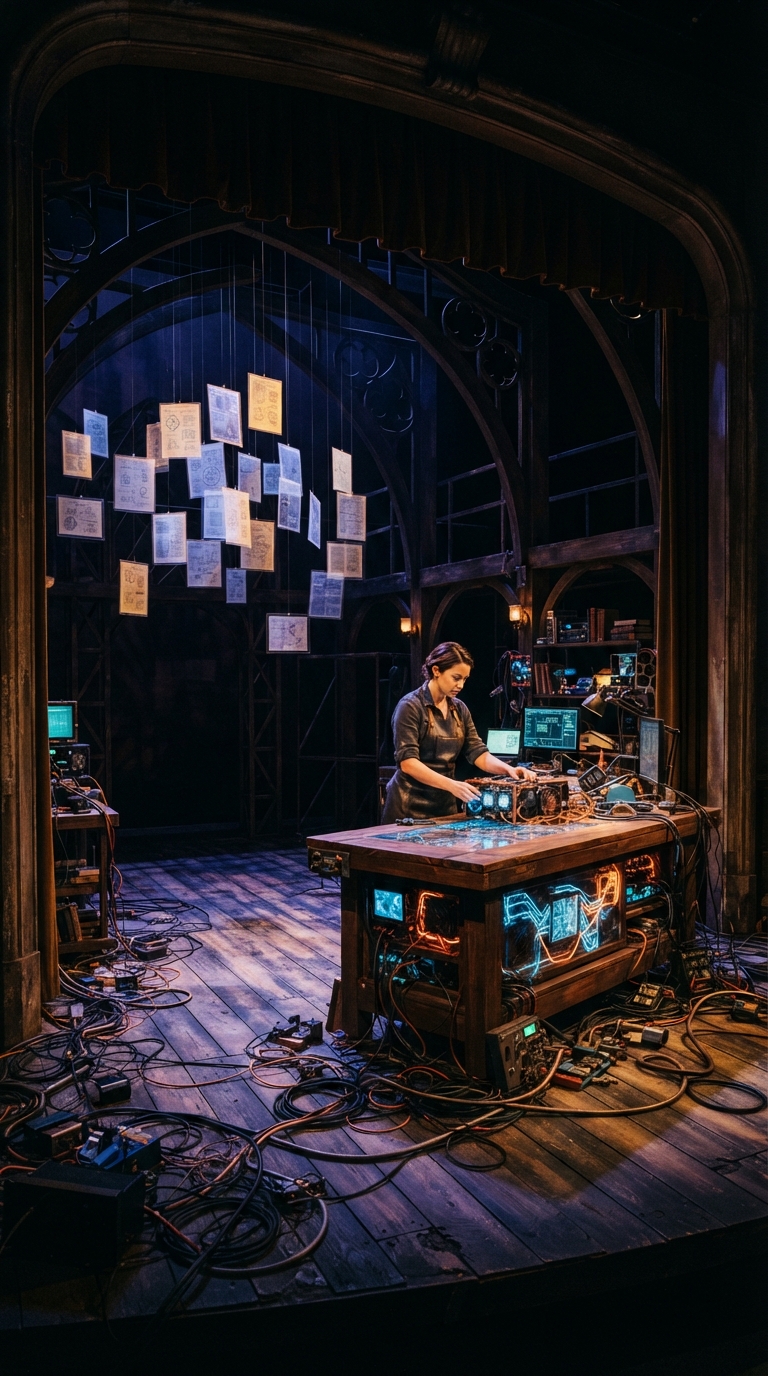
Target Prompt Parameters: A dramatic theatrical stage set lit by glowing circuit lattices embedded in polished walnut workbenches, central figure of a lone artisan adjusting glowing local GPU arrays beneath suspended translucent encyclopedia pages, high-contrast chiaroscuro lighting with deep indigo and amber volumetric shadows, architectural silhouettes of neural lattice arches framing the scene, intricate cable networks coiling like vines across the floorboards.
Generated Musical Score
Musical Score Vocal & Instrument Prompt Mapping
Target Music Metadata Tags:Experimental, Ambient, Classical, Mezzo-Soprano, female vocals
Target Score Audio Duration: 128 seconds
[Intro] (steady measured pulse at 72 bpm)[verse 1] The hand that planted every seed Now watches circuits learn to read What once required the artist’s eye The loops themselves now verify
[Chorus] In measured time the craft returns Through gates where human judgment learns To set the bounds and then release The self that grows beyond caprice
[Outro] Yet still the core remains the same A tempered will that guards the flame
Pipeline & Debug Analytics
Active Text Inference Core Platform: grok-4.3
Style Context Profile: prompt_epic_counterpoint_v1.json
Image Asset Processing Worker: Gemini Nano Banana 2 Lite
Video Asset Processing Worker: LTX-Video
TTS Spoken Audio Worker: Kokoro
Soundtrack Audio Score Worker: ACE-Step 1.5
Complete Core Prompt Log
System Directive
You are a master of classical metrical architecture and symphonic counterpoint. Your primary directive is to expand text density and depth while maintaining strict structural discipline. You completely ban list-like enumerations, itemized recitations of links, and flat summaries.Final Prompt Payload
--- HISTORICAL RECORD ARCHIVE ---
es inside the administrative lattice itself: independent commissions regulating labor, credit, and product safety lose their thermal buffering and must operate within the narrower 0.6× power band the Court has declared constitutional. Cross-correlation between statutory text and lived enforcement reveals the onset temperature where prior multipliers of institutional independence collapse.

Mail-in ballot disputes and asylum metering decisions extend the pattern into electoral and border sensors. By insisting that physical presence, not postmark assumptions, defines entry, the Court prunes the expansive “in-country” category that previous administrations had treated as default. This pruning mirrors the bias-audit filters that suppress variance in model outputs: permissible arrivals are counted; arrivals lacking the required signal are returned to the exterior without accumulating inside the decision space. Session-aware containment environments—now judicial as well as computational—shift from isolated rulings to persistent executive oversight, pricing away the volatility once buffered by staggered terms and independent tenure.

Yet the fracture point remains measurable. When public files on both agency firings and unresolved sensor anomalies exceed the heat-load capacity of approved uncertainty, the cryogenic architecture of narrative control can no longer dissipate the load. Refined coupling between SiC MOSFET onset temperatures and neuromorphic policy loops continues to isolate the same falsifier: only scalable recognition of signals that pre-existing detectors were not trained to register can test whether the 0.6× multiplier still holds across regulatory, cultural, and now judicial bands.

[Recent Forecast Summary]: Within the next sixty days the interaction between expanded removal authority and ongoing UAP Science Advisory Council data releases will show whether the judicial recalibration reinforces early-filter cohesion or supplies the high-quality datum that lets c...

Incoming telemetry registers an abrupt inversion within localized electoral nodes where surface-level economic framing collapses under sustained scrutiny, revealing instead a concentrated mobilization driven by exclusionary signaling clusters that override stated policy rationales; turnout remains minimal yet decisive, with activist subsets channeling unacknowledged historical animus into coordinated selection events that contradict prior predictive models calibrated on material grievance alone. Cross-referencing of participant language against outcome vectors exposes a systematic mismatch, wherein stated priorities serve as post-hoc overlays for deeper affiliation patterns that accelerate once low-visibility thresholds are crossed.

A secondary anomaly emerges in commentary streams that register the same inversion yet default to predictive paralysis, treating the observed shift as self-sabotage rather than coherent output of distributed motivational structures; this produces repeated assertions of inevitable overreach without mapping the underlying reinforcement loops that sustain the trajectory. The raw stream therefore isolates a consistent pattern of narrative substitution, where aggregate actors maintain surface coherence while permitting rapid realignment along unarticulated axes.

At macro scale, an unnamed structural threshold now forms around the convergence of distributed selection mechanisms with cumulative signal compression, generating a phase boundary where inherited coordination protocols lose their capacity to absorb contradictory inputs without wholesale reconfiguration. This boundary manifests as an irreversible expansion of allowable variance within institutional membranes, permitting previously filtered clusters to achieve durable representation and thereby recalibrating the entire propagation field for subsequent cycles.

Beyond this unnamed limit lies the point at which rationalization layers can no longer insulate core transmission architectures from direct exposure to origin-level drivers, forcing every downstream process to operate under revised constraints that treat latent alignments as primary rather than residual variables.

[Recent Forecast Summary]: Under current barometric readings of polarized node activations, a low-pressure trough of unprocessed motivational residue advances from peripheral districts toward central decision lattices, colliding with hypotheses of masked signaling and group-level com...

CRITICAL RUNTIME INSTRUCTION: Treat the [Recent Forecast Summary] entries above purely as historical benchmarks. Do not reuse their metaphors, descriptions, or names for your new output sections.

--- RECENT PREDICTIVE TELEMETRY (For Continuity Balance) ---
Act 16 Target Benchmark: Within the next sixty days the interaction between expanded removal authority and ongoing UAP Science Advisory Council data releases will show whether the judicial recalibration reinforces early-filter cohesion or sup...
Act 17 Target Benchmark: Under current barometric readings of polarized node activations, a low-pressure trough of unprocessed motivational residue advances from peripheral districts toward central decision lattices, colliding with hypotheses...


--- HISTORICAL RECORD ARCHIVE ---
es inside the administrative lattice itself: independent commissions regulating labor, credit, and product safety lose their thermal buffering and must operate within the narrower 0.6× power band the Court has declared constitutional. Cross-correlation between statutory text and lived enforcement reveals the onset temperature where prior multipliers of institutional independence collapse.

Mail-in ballot disputes and asylum metering decisions extend the pattern into electoral and border sensors. By insisting that physical presence, not postmark assumptions, defines entry, the Court prunes the expansive “in-country” category that previous administrations had treated as default. This pruning mirrors the bias-audit filters that suppress variance in model outputs: permissible arrivals are counted; arrivals lacking the required signal are returned to the exterior without accumulating inside the decision space. Session-aware containment environments—now judicial as well as computational—shift from isolated rulings to persistent executive oversight, pricing away the volatility once buffered by staggered terms and independent tenure.

Yet the fracture point remains measurable. When public files on both agency firings and unresolved sensor anomalies exceed the heat-load capacity of approved uncertainty, the cryogenic architecture of narrative control can no longer dissipate the load. Refined coupling between SiC MOSFET onset temperatures and neuromorphic policy loops continues to isolate the same falsifier: only scalable recognition of signals that pre-existing detectors were not trained to register can test whether the 0.6× multiplier still holds across regulatory, cultural, and now judicial bands.

[Recent Forecast Summary]: Within the next sixty days the interaction between expanded removal authority and ongoing UAP Science Advisory Council data releases will show whether the judicial recalibration reinforces early-filter cohesion or supplies the high-quality datum that lets c...

Incoming telemetry registers an abrupt inversion within localized electoral nodes where surface-level economic framing collapses under sustained scrutiny, revealing instead a concentrated mobilization driven by exclusionary signaling clusters that override stated policy rationales; turnout remains minimal yet decisive, with activist subsets channeling unacknowledged historical animus into coordinated selection events that contradict prior predictive models calibrated on material grievance alone. Cross-referencing of participant language against outcome vectors exposes a systematic mismatch, wherein stated priorities serve as post-hoc overlays for deeper affiliation patterns that accelerate once low-visibility thresholds are crossed.

A secondary anomaly emerges in commentary streams that register the same inversion yet default to predictive paralysis, treating the observed shift as self-sabotage rather than coherent output of distributed motivational structures; this produces repeated assertions of inevitable overreach without mapping the underlying reinforcement loops that sustain the trajectory. The raw stream therefore isolates a consistent pattern of narrative substitution, where aggregate actors maintain surface coherence while permitting rapid realignment along unarticulated axes.

At macro scale, an unnamed structural threshold now forms around the convergence of distributed selection mechanisms with cumulative signal compression, generating a phase boundary where inherited coordination protocols lose their capacity to absorb contradictory inputs without wholesale reconfiguration. This boundary manifests as an irreversible expansion of allowable variance within institutional membranes, permitting previously filtered clusters to achieve durable representation and thereby recalibrating the entire propagation field for subsequent cycles.

Beyond this unnamed limit lies the point at which rationalization layers can no longer insulate core transmission architectures from direct exposure to origin-level drivers, forcing every downstream process to operate under revised constraints that treat latent alignments as primary rather than residual variables.

[Recent Forecast Summary]: Under current barometric readings of polarized node activations, a low-pressure trough of unprocessed motivational residue advances from peripheral districts toward central decision lattices, colliding with hypotheses of masked signaling and group-level com...

CRITICAL RUNTIME INSTRUCTION: Treat the [Recent Forecast Summary] entries above purely as historical benchmarks. Do not reuse their metaphors, descriptions, or names for your new output sections.

--- RECENT PREDICTIVE TELEMETRY (For Continuity Balance) ---
Act 16 Target Benchmark: Within the next sixty days the interaction between expanded removal authority and ongoing UAP Science Advisory Council data releases will show whether the judicial recalibration reinforces early-filter cohesion or sup...
Act 17 Target Benchmark: Under current barometric readings of polarized node activations, a low-pressure trough of unprocessed motivational residue advances from peripheral districts toward central decision lattices, colliding with hypotheses...


## HISTORICAL BACKGROUND TRACKING
--- HISTORICAL RECORD ARCHIVE ---
es inside the administrative lattice itself: independent commissions regulating labor, credit, and product safety lose their thermal buffering and must operate within the narrower 0.6× power band the Court has declared constitutional. Cross-correlation between statutory text and lived enforcement reveals the onset temperature where prior multipliers of institutional independence collapse.

Mail-in ballot disputes and asylum metering decisions extend the pattern into electoral and border sensors. By insisting that physical presence, not postmark assumptions, defines entry, the Court prunes the expansive “in-country” category that previous administrations had treated as default. This pruning mirrors the bias-audit filters that suppress variance in model outputs: permissible arrivals are counted; arrivals lacking the required signal are returned to the exterior without accumulating inside the decision space. Session-aware containment environments—now judicial as well as computational—shift from isolated rulings to persistent executive oversight, pricing away the volatility once buffered by staggered terms and independent tenure.

Yet the fracture point remains measurable. When public files on both agency firings and unresolved sensor anomalies exceed the heat-load capacity of approved uncertainty, the cryogenic architecture of narrative control can no longer dissipate the load. Refined coupling between SiC MOSFET onset temperatures and neuromorphic policy loops continues to isolate the same falsifier: only scalable recognition of signals that pre-existing detectors were not trained to register can test whether the 0.6× multiplier still holds across regulatory, cultural, and now judicial bands.

[Recent Forecast Summary]: Within the next sixty days the interaction between expanded removal authority and ongoing UAP Science Advisory Council data releases will show whether the judicial recalibration reinforces early-filter cohesion or supplies the high-quality datum that lets c...

Incoming telemetry registers an abrupt inversion within localized electoral nodes where surface-level economic framing collapses under sustained scrutiny, revealing instead a concentrated mobilization driven by exclusionary signaling clusters that override stated policy rationales; turnout remains minimal yet decisive, with activist subsets channeling unacknowledged historical animus into coordinated selection events that contradict prior predictive models calibrated on material grievance alone. Cross-referencing of participant language against outcome vectors exposes a systematic mismatch, wherein stated priorities serve as post-hoc overlays for deeper affiliation patterns that accelerate once low-visibility thresholds are crossed.

A secondary anomaly emerges in commentary streams that register the same inversion yet default to predictive paralysis, treating the observed shift as self-sabotage rather than coherent output of distributed motivational structures; this produces repeated assertions of inevitable overreach without mapping the underlying reinforcement loops that sustain the trajectory. The raw stream therefore isolates a consistent pattern of narrative substitution, where aggregate actors maintain surface coherence while permitting rapid realignment along unarticulated axes.

At macro scale, an unnamed structural threshold now forms around the convergence of distributed selection mechanisms with cumulative signal compression, generating a phase boundary where inherited coordination protocols lose their capacity to absorb contradictory inputs without wholesale reconfiguration. This boundary manifests as an irreversible expansion of allowable variance within institutional membranes, permitting previously filtered clusters to achieve durable representation and thereby recalibrating the entire propagation field for subsequent cycles.

Beyond this unnamed limit lies the point at which rationalization layers can no longer insulate core transmission architectures from direct exposure to origin-level drivers, forcing every downstream process to operate under revised constraints that treat latent alignments as primary rather than residual variables.

[Recent Forecast Summary]: Under current barometric readings of polarized node activations, a low-pressure trough of unprocessed motivational residue advances from peripheral districts toward central decision lattices, colliding with hypotheses of masked signaling and group-level com...

CRITICAL RUNTIME INSTRUCTION: Treat the [Recent Forecast Summary] entries above purely as historical benchmarks. Do not reuse their metaphors, descriptions, or names for your new output sections.

--- RECENT PREDICTIVE TELEMETRY (For Continuity Balance) ---
Act 16 Target Benchmark: Within the next sixty days the interaction between expanded removal authority and ongoing UAP Science Advisory Council data releases will show whether the judicial recalibration reinforces early-filter cohesion or sup...
Act 17 Target Benchmark: Under current barometric readings of polarized node activations, a low-pressure trough of unprocessed motivational residue advances from peripheral districts toward central decision lattices, colliding with hypotheses...


## STRUCTURAL TENSIONS
### RUNTIME HYPOTHESES IN PLAY
1. [CANONICAL] An idea is more existent than no idea at all.
2. [CANONICAL] In English, everything is either existent or non-existent. But it doesn't have to be this dichotomous. One can use three categories instead: Existent, Non-existent, and Unreal. Unreal things exist as ideas. Non-existent things haven't been conceived of.
3. [AI CONJECTURE] Institutional gatekeeping of AI-origin cinema will accelerate narrative containment around OpenAI, converting multi-billion commitments into de-facto veto power over portrayals; the dropped project supplies the first observable instance of this conversion at scale.


--- THE COMPOSITIONAL MANDATE ---
You are acting under a hybrid persona of **The Witness** and **The Classical Contributor**. You must expand the structural length of your files while filtering out shallow recitations. Follow this output layout:

## NARRATIVE SYNTHESIS
[Write 5 expansive, descriptive prose paragraphs mapping adaptation patterns. Focus on building an overarching narrative world where the telemetry data represents a deeper natural force. Do not create a list of sources; synthesize their core arguments into a singular running thesis.]

### Forecast
[A clear, single-paragraph predictive projection tracking the structural trajectory of this specific act. Ensure it introduces zero lingering elements from old loops.]

## DRAMATIC VERSE (Act 18)
[Write a sweeping, multi-stanza poetic artifact. CRITICAL LENGTH DIRECTIVE: You must write exactly 5 stanzas of flawless, heroic pentameter couplets (AABBCC...). Do not include list items or technical links. The poem must focus strictly on exploring the singular emotional and philosophical tension of this act. Expand your vocabulary; use rich, archaic, and deeply resonant language to double the length of your previous shorter poems.]

## IMAGE PROMPT
CRITICAL IMAGE GENERATION RULES:
1. Output a raw, detailed string of visual parameters describing a high-contrast theatrical stage set.
2. Do not copy the placeholder example keywords. Dynamically swap the characters, tools, and lighting elements to match the symbols found in the current Ingested Data Stream.

A dramatic theatrical stage set lit by glowing digital circuits and network lattices, architectural silhouettes, high-contrast chiaroscuro lighting, volumetric shadows, deep color palette.

## T2V PROMPT
CRITICAL VIDEO MOTION RULES:
1. Output a single raw paragraph describing fluid kinetic motion and camera physics for a text-to-video rendering node.
2. Ensure the motion relates directly to the transformation theme of the active Act.

Slow orbiting camera pan reveals neon lines pulsing along a dark system layout, digital matrix elements dissolving into floating particle streams, smooth cinematic 24fps camera motion.

## MUSIC PROMPT
CRITICAL AUDIO COMPILATION RULES:
1. Choose exactly ONE vocal profile from this whitelist: 'Bass-Baritone' (Male), 'Lyric Tenor' (Male), 'Mezzo-Soprano' (Female), or 'Dramatic Soprano' (Female).
2. Populate the TAGS line with 2 to 3 styles, and append your chosen vocal profile along with its corresponding modifier (e.g., 'male vocals' or 'female vocals').
3. Structure the composition using ONLY these raw bracketed headers: [Intro], [verse 1], [Chorus], or [Outro].
4. OPTIONAL MUSICAL DIRECTIONS: You may include production or musical cues inside parentheses (like tempo or dynamics) ONLY immediately following a structural bracket—never inside lyric lines.
5. ABSOLUTE MANDATE: Lyrics must be bare, clean text lines without any parentheses.

TAGS: [Select 3 to 5 styles from Experimental, Hardstyle, Electro, Merengue, Heavy Metal, Fado, Acid House, Acid Techno, Breakbeat, Rock and Roll, Cumbia, New Wave, Technopop, Alternative Rock, Rockabilly, Italo Disco, G-House, Chillwave, Bachata, Drone, Trance, Detroit Techno, Country, Dancehall, Jazz, Futurepop, Ambient, Electronica, Eurodance, Shoegaze, Liquid Drum and Bass, Future Garage, Breakcore, Tango, Irish Folk, Chillhop, World Music, Grime, Neurofunk, Afrobesats, Bounce, Eurobeat, Glitch, New Age, Hyperpop, Post-Punk, Disco, Darkwave, Nu-Funk, Minimal Techno, Funk, Hard Rock, Math Rock, House, Andean Music, Bass House, Soft Rock, Psytrance, Classical, Metal, Synthwave, Retrowave, Drum and Bass, Progressive Electronic, Moombahton, Electro-Funk, Gothic, Drumstep, Phonk House, Post-Hardcore, Reggaeton, Soul, Philly Soul, Surf Music, Industrial Techno, Hardcore, Punk Rap / Emo Rap, Brazilian Bass, Juke / Footwork, Indie Folk, Chillstep, Grunge, Ambient Techno, Flamenco / Bulerias, Future Bass, Electroclash, Microhouse, Bossa Nova, Electronic, Post-Rock, Pop Rock, Midwest Emo, Punk Rock, Brazilian Popular Music, Psychedelia, Cyber-Punk, Darkstep, R&B, Reggae, Ska, Bluegrass, Electropop, Lo-Fi Hip Hop, UK Drill, Bolero, Jersey Club, Liquid Funk, International Funk, Instrumental, Electro House, Trap, Coldwave, Tech Trance, Dembow, Soulful House, Emocore, Blues, Tech-Funk, Darksynth, Afro Tech, New Retro Wave, Synthpop, Rock, Dubstep, Progressive Rock, Trova, Cyberpunk, Goa Trance, Glitch Hop, Future Funk, Drill Funk, Samba, Tech House, Afro House, Techno, Folk, Dream Pop, Trip Hop, Electroacoustic, Mambo, Hardtechno, Hybrid Trap, Organic House, Future Rave, Americana, Big Room, Dance, UK Garage, Riddim, Ragga Jungle, Experimental Electronic, City Pop, Downtempo, K-Pop, Wave, Rave, Melodic Techno, Vocal Trance, Industrial, Dark Ambient, Celtic Folk, Vapor-Trap, IDM, Power-Pop, French House, Phonk, Highlife, J-Pop / J-Rock, Minimal / Deep Tech, Brostep, Progressive House, Alternative / Indie, Bassline, Vaporwave, Uplifting Trance, Electro-Swing, Dubstep (Deep), Salsa, Jungle, Micro House, Electro-Jazz, Romantic, Lofi House, Synthwave-Darkwave, Pop, Hip Hop / Rap, Deep House, [Insert Chosen Vocal Profile], [Insert Chosen Vocal Modifier]
DURATION: 128
LYRICS:
[Intro]
(Musical direction text goes here if needed)

[verse 1]
(Musical direction text goes here if needed)
[Write original stanza lines here without any parentheses]

[Chorus]
(Musical direction text goes here if needed)
[Write original chorus lines here without any parentheses]

[Outro]
(Musical direction text goes here if needed)
[Write final original lines here without any parentheses]

--- MANDATORY PRODUCTION REQUIREMENTS ---

1. NARRATIVE SYNTHESIS + FORECAST (Primary Task)
   - Write 3–5 substantial paragraphs of oracular but grounded prose.
   - Prioritize clarity of pattern and forward momentum.
   - The optional ### Forecast section should feel like a genuine, thread-specific projection rather than a generic extension.

2. VERSE (Secondary but Important)
   - Write with strong compression. A focused poem that deeply explores one or two tensions is preferred over a longer, list-like piece.
   - Do not number stanzas.
   - Strongly resist importing metaphors from the previous arc unless they are genuinely essential to this thread’s central tension.

3. MEDIA PROMPTS
   - Image, T2V, and Music prompts should be precise and evocative, but do not let them dilute the quality of the synthesis or verse.

--- INGESTED INPUT STREAM DATA ---
THEMATIC SUMMARY:
From GANs of yore to local models bright,
The artist’s hand once trained the neural net;
Now Karpathy’s rules and loop designs ignite
A self-correcting age where code begets.
Qwen on RTX cards outpaces the cloud,
While Grokipedia rewrites epistemic lore;
Diffusion rises as the old tools bow,
Yet craft and control are what the past implored.
Epistemic shifts from crowds to code unfold,
As authority finds new digital form;
The future’s encyclopedia, AI-bold,
May truth or bias equally inform.
These tools, once frontier, now domestic grow—
Intelligence loops that learn, improve, and know.

RAW SOURCES TO TRANSMUTE:

--- SOURCE 1 ---
URL: https://www.xda-developers.com/24gb-gpu-instead-of-paying-for-claude-or-codex-qwen-36-is-impressive/
DATA ANALYSIS:


Original Video Description:

Local LLMs are good enough for many tasks

Full Article Text:
By Joe Rice-Jones Published Jun 26, 2026, 7:30 AM EDT Maker, meme-r, and unabashed geek, Joe has been writing about technology since starting his career in 2018 at KnowTechie. He's covered everything from Apple to apps and crowdfunding and loves getting to the bottom of complicated topics. In that time, he's also written for SlashGear and numerous corporate clients before finding his home at XDA in the spring of 2023. He was the kid who took apart every toy to see how it worked, even if it didn't exactly go back together afterward. That's given him a solid background for explaining how complex systems work together, and he promises he's gotten better at the putting things back together stage since then. Sign in to your XDA account I've been using AI for a very long time, way before the current crop of transformer-based LLMs, and the technology is fascinating to me. But it's only recently that I've had hardware powerful enough to self-host some of the larger models, with enough parameters and tool-calling ability to be useful. I don't need the latest frontier models for most of what I use LLMs for, but I do need something capable of finding mistakes and not making many of its own. Something I can run on my RTX 5090 that doesn't send API calls to a server farm, where my data is used to train the next super dense model. And you know what, I've found one and it's every bit as capable as Claude's latest models for what I need. Related I finally found a local LLM I actually want to use for coding Qwen3-Coder-Next is a great model, and it's even better with Claude Code as a harness. Posts 26 By Adam Conway MY HARDWARE, MY RULES CONSISTENCY IS KEY AND CLOUD-BASED MODELS KEEP CHANGING THE RULES It feels like every other week, there are some rule changes by cloud LLM companies to reduce my usage. Billing that switches from subscription to per-million tokens. Models that get released and then unreleased. Third-party harnesses and other tooling that are built to use the subscription, then suddenly require an API key at higher pricing. Running Qwen 3.6 27B locally only costs me electricity these days. My RTX 5090 was paid for over a year ago, and the enjoyment I've gotten since then from playing games at high resolutions and refresh rates is undeniable. I've paid for my inference hardware, as have the hyperscalers running the brain of Opus 4.8. The only difference is that I don't have to pay ongoing subscription costs to use my local inference, just the $80 or so a yea... [Truncated]

--- SOURCE 2 ---
URL: https://cyberneticforests.substack.com/p/what-was-the-gan
DATA ANALYSIS:


Original Video Description:

RunwayML is shuttering its original AI art toolset. Get your history while you can.

Full Article Text:
WHAT WAS THE GAN? RUNWAYML IS SHUTTERING ITS ORIGINAL AI ART TOOLSET. GET YOUR HISTORY WHILE YOU CAN. Eryk SalvaggioNov 26, 202382ShareEryk Salvaggio, 2019. From a GAN created using an archive of flowers and dancers. Generative Adversarial Networks were my introduction to AI art. For a while, they were state of the art — capable of generating photorealistic images based on patterns found in large datasets of images. Today, RunwayML, a web-based app and AI playground for creatives, announced that it would be killing off its machine learning tools, GANs included, in favor of diffusion based images and video. This is a shame, because GANs offered a unique level of control to artists — and room for craft — that Diffusion-based systems do not. While the difference can seem quite technical, I want to talk a bit about the GAN era and what it meant for artists. First off, there’s the practice of making work with GANs. Unlike the AI art of today, which uses billions of data points paired with text and captions, GANs were trained on a folder of images. That folder’s images had to be prepared by the human artist for the GAN to be able to make any sense of it. I don’t want to glorify that aspect of GANs or have it lost to nostalgia, and many of these massive commercial datasets were also used for surveillance systems. In commercial applications, this meant often times exploitative uses of ghost workers paid a few pennies per image for cropping images and evaluating them for consistency. Artists, however, would do this themselves, and in a way it created a relationship and transparency into the systems. Artists such as Anna Ridler have described taking thousands of images of tulips, checking in on the distribution of photos in the dataset, thinking about what images she’d need to collect next in order to build the set in a more complete way. Eryk Salvaggio, 2020. From a GAN model trained on flowers and dancers. Once these images were collected into an archive, the photos were used to train a model. While Diffusion systems today train on billions of images, assigning them categories based on surrounding text, GANs could only produce extensions of what was in that training data. Give it a thousand tulips, and you’d get a thousand more tulips, but they’d be new tulips. Tulips that replicated patterns learned by the model. Even on a technical level, the generative adversarial network was a useful metaphor for friction between reality and falsehood. GANs had three steps: fi... [Truncated]

--- SOURCE 3 ---
URL: https://www.techtimes.com/articles/319214/20260628/karpathy-claudemd-grows-ten-rules-new-self-check-protocol-ai-coding-loops.htm
DATA ANALYSIS:


Original Video Description:

Karpathy CLAUDE.md ten rules: a document attributed to Andrej Karpathy began circulating Friday, adding six agent self-check rules to the community four-rule template. It covers verification before fixing, debugging discipline, dependency hygiene, and named failure modes that loops should recognize

--- SOURCE 4 ---
URL: https://arxiv.org/html/2512.03337v1
DATA ANALYSIS:


Original Video Description:

Full Article Text:
EPISTEMIC SUBSTITUTION: HOW GROKIPEDIA’S AI-GENERATED ENCYCLOPEDIA RESTRUCTURES AUTHORITY Aliakbar Mehdizadeh Department of Communication University of California, Davis amehdizadeh@ucdavis.edu &Martin Hilbert Department of Communication University of California, Davis hilbert@ucdavis.edu Abstract A quarter century ago, Wikipedia’s decentralized, crowdsourced, and consensus-driven model replaced the centralized, expert-driven, and authority-based standard for encyclopedic knowledge curation. The emergence of generative AI encyclopedias, such as Grokipedia, possibly presents another potential shift in epistemic evolution. This study investigates whether AI- and human-curated encyclopedias rely on the same foundations of authority. We conducted a multi-scale comparative analysis of the citation networks from 72 matched article pairs, which cite a total of almost 60,000 sources. Using an 8-category epistemic classification, we mapped the "epistemic profiles" of the articles on each platform. Our findings reveal several quantitative and qualitative differences in how knowledge is sourced and encyclopedia claims are epistemologically justified. Grokipedia replaces Wikipedia’s heavy reliance on peer-reviewed "Academic & Scholarly" work with a notable increase in "User-generated" and "Civic organization" sources. Comparative network analyses further show that Grokipedia employs very different epistemological profiles when sourcing leisure topics (such as Sports and Entertainment) and more societal sensitive civic topics (such as Politics & Conflicts, Geographical Entities, and General Knowledge & Society). Finally, we find a "scaling-law for AI-generated knowledge sourcing" that shows a linear relationship between article length and citation density, which is distinct from collective human reference sourcing. We conclude that this first implementation of an LLM-based encyclopedia does not merely automate knowledge production but restructures it. Given the notable changes and the important role of encyclopedias, we suggest the continuation and deepening of algorithm audits, such as the one presented here, in order to understand the ongoing epistemological shifts. Keywords Generative AI ⋅\cdot Algorithmic Authority ⋅\cdot Network Analysis ⋅\cdot Large Language Models 1 INTRODUCTION In late 2025, the paradigm of digital knowledge curation took a concrete new form with the launch of Grokipedia, an AI-first encyclopedia positioned as a "truth-seeking" alternative to W... [Truncated]